
 BTC
BTC
 ETH
ETH
 USDT
USDT
 BNB
BNB
 XRP
XRP
 USDC
USDC
 SOL
SOL
 TRX
TRX
 ZEC
ZEC
 FIGR_HELOC
 HYPE
HYPE
 DOGE
DOGE
 LINK
LINK
 XMR
XMR
 WBT
WBT
 USDS
USDS
 ADA
ADA
 RAIN
RAIN
 LEO
LEO
 XLM
XLM
 NEAR
NEAR
 BCH
BCH
 UNI
UNI
 LTC
LTC
 CC
CC
 SUI
SUI
 USDE
USDE
 AVAX
AVAX
 DAI
DAI
 GRAM
GRAM
 USD1
USD1
 HBAR
HBAR
 TAO
TAO
 SHIB
SHIB
 CRO
CRO
 BTW
BTW
 USDG
USDG
 ENA
ENA
 QNT
QNT
 PYUSD
PYUSD
 M
M
 ONDO
ONDO
 XAUT
XAUT
 OKB
OKB
 RLUSD
RLUSD
 USYC
USYC
 AAVE
AAVE
 PUMP
PUMP
 BUIDL
BUIDL
 USDY
USDY
 MNT
MNT
 DOT
DOT
 WLD
WLD
 ASTER
ASTER
 MORPHO
 SKY
SKY
 PAXG
PAXG
 WLFI
WLFI
 PEPE
PEPE
 ICP
ICP
 USDD
USDD
 ARB
ARB
 HTX
HTX
 ETC
ETC
 EURSAFO
 U
U
 VVV
VVV
 BGB
BGB
 USDGO
USDGO
 USDF
USDF
 KAS
KAS
 BFUSD
BFUSD
 POL
POL
 GT
GT
 LIT
LIT
 JUP
JUP
 ALGO
ALGO
 RENDER
 JST
JST
 PI
PI
 KCS
KCS
 ATOM
ATOM
 BCAP
BCAP
 FIL
FIL
 CAKE
CAKE
 NEXO
NEXO
 DASH
DASH
 AERO
AERO
 VET
VET
 INJ
INJ
 USTB
USTB
 EUTBL
EUTBL
 APT
APT
 STABLE
 AKE
AKE
 GHO
GHO
 ETHFI
ETHFI
 PYTH
PYTH
 XDC
XDC
 STX
STX
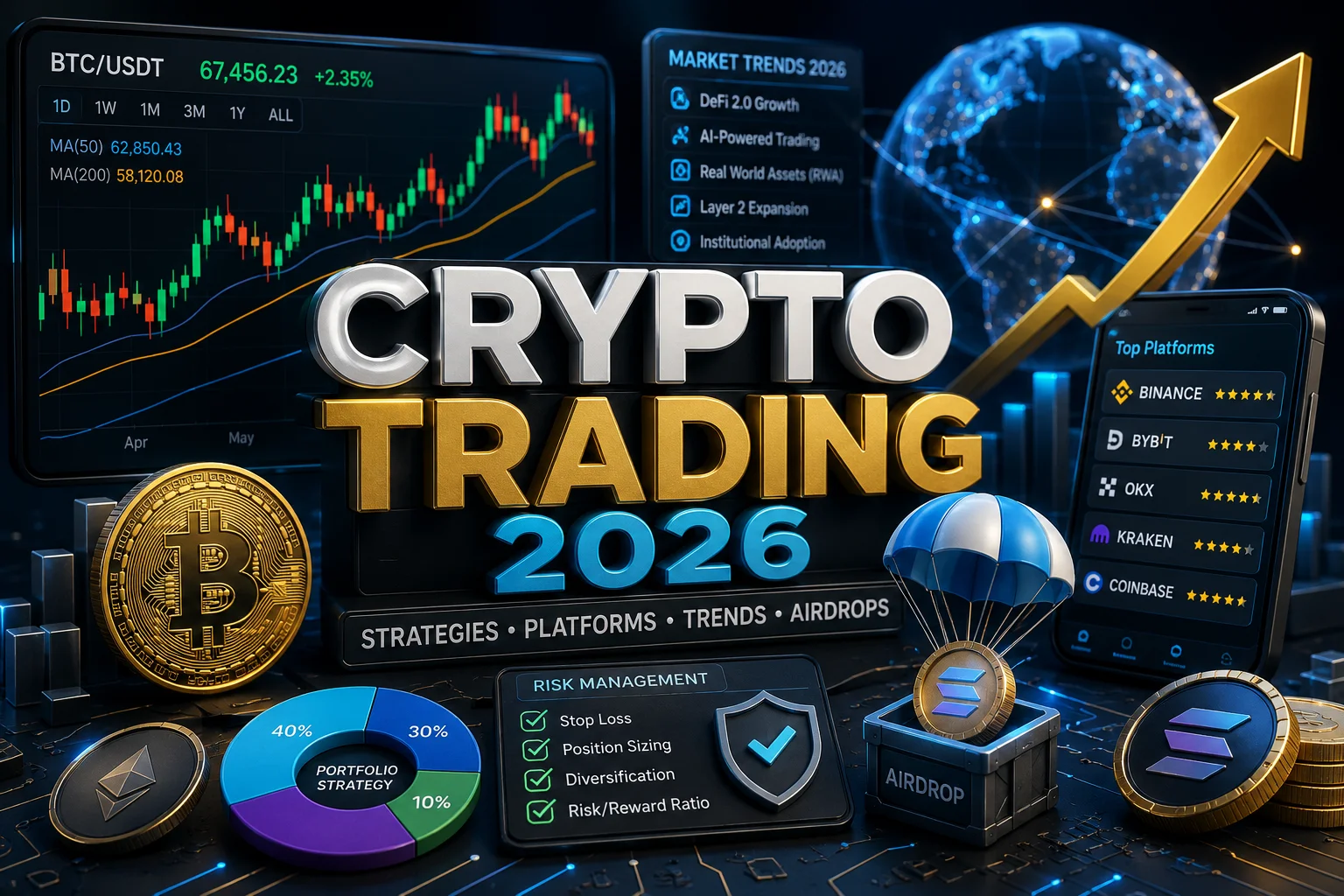

In 2026, crypto trading is defined by sophisticated strategies, a rapidly evolving platform landscape, and fast-moving market trends. Whether you’re a beginner, an institutional investor, or a developer, success hinges on education, risk management, and staying ahead of regulatory and technological changes. This comprehensive guide explores the latest strategies, platform reviews, market trends, and the role of airdrops, offering actionable insights for every participant in the digital asset ecosystem.
Crypto Trading in 2026: What’s Changed and Why It Matters
The crypto trading landscape in 2026 is more dynamic and complex than ever. With institutional adoption accelerating, DeFi and RWA (real-world asset) integration expanding, and regulatory frameworks maturing, the market presents both new opportunities and risks. Traders and investors must navigate a crowded field of platforms, tools, and protocols, while keeping a close eye on security, compliance, and evolving market structures.
Key drivers shaping the market include the proliferation of on-chain derivatives, the rise of decentralized trading infrastructure, and the increasing sophistication of trading bots and algorithmic strategies. Meanwhile, regulatory clarity in major jurisdictions has brought both stability and new compliance challenges. Understanding these shifts is essential for anyone seeking to trade or invest in digital assets in 2026.
Top Crypto Trading Strategies for 2026: What’s Working Now
Trading strategies in 2026 reflect the maturation of both the crypto market and its participants. While classic approaches like swing trading and scalping remain popular, new strategies have emerged, leveraging on-chain data, cross-chain arbitrage, and advanced automation. Here are some of the most effective strategies this year:
- Algorithmic and Bot Trading: Automated strategies powered by custom bots are now mainstream, with many traders using open-source and proprietary tools to execute trades based on technical indicators, order book depth, and even social sentiment.
- On-Chain Arbitrage: With liquidity fragmented across multiple chains and protocols, cross-chain arbitrage has become a lucrative—though technically demanding—strategy. Traders exploit price discrepancies between DEXs, CEXs, and bridges.
- DeFi Yield Trading: Advanced users combine trading with yield farming, staking, and liquidity provision to maximize returns, often using derivatives to hedge or amplify exposure.
- Event-Driven Trading: Market participants increasingly trade around protocol upgrades, governance votes, and major airdrop events, seeking to capitalize on volatility and liquidity spikes.
- Risk-Managed Position Sizing: With increased market volatility, sophisticated risk management—such as dynamic position sizing and automated stop-losses—has become non-negotiable for both retail and institutional traders.
For a deeper dive into strategy selection and risk management, see our crypto guides and market analysis.
Best Crypto Trading Platforms in 2026: Security, Features, and User Experience
The choice of trading platform can make or break a trader’s experience. In 2026, the market is split between centralized exchanges (CEXs), decentralized exchanges (DEXs), and hybrid platforms that blend the best of both worlds. Here’s what sets the top platforms apart this year:
- Security First: Leading platforms prioritize robust security measures, including multi-factor authentication, cold storage, and real-time monitoring. Users are advised to enable all available security features and use hardware wallets for large balances. For more on staying safe, visit our crypto safety guide.
- Advanced Trading Tools: The best platforms offer a full suite of tools—advanced charting, real-time analytics, API access, and support for algorithmic trading—catering to both retail and institutional users.
- Deep Liquidity: Platforms with high trading volumes and deep order books provide tighter spreads and lower slippage, especially important for large trades and institutional flows.
- Regulatory Compliance: Regulatory-compliant platforms offer peace of mind and easier fiat on/off ramps, though they may require more extensive KYC/AML procedures.
- Cross-Chain and Multi-Asset Support: In 2026, top platforms support a wide range of assets, including tokenized RWAs, stablecoins, and emerging Layer 2 tokens, with seamless cross-chain swaps.
For a curated list of the best platforms, see our crypto guides and market analysis.
How to Choose a Crypto Trading Platform in 2026
When selecting a trading platform, consider the following:
- Security track record and insurance policies
- Fee structure (maker/taker, withdrawal, deposit)
- Asset selection and supported trading pairs
- User interface and mobile app quality
- Customer support responsiveness
- Integration with wallets and DeFi protocols
Crypto Airdrops in 2026: Opportunities, Risks, and Trading Implications
Airdrops remain a significant event in the crypto trading calendar, often creating short-term volatility and new trading opportunities. In 2026, projects use airdrops to bootstrap liquidity, reward early users, and decentralize governance. However, the landscape has matured, with stricter eligibility criteria and more sophisticated anti-sybil measures.
For traders, airdrops can present both opportunities and risks:
- Volatility: Newly airdropped tokens often experience sharp price swings as recipients rush to sell or accumulate, creating opportunities for short-term traders but also increasing risk.
- Liquidity Challenges: Some airdropped tokens may initially have low liquidity, leading to slippage and price manipulation risks.
- Regulatory Uncertainty: Depending on jurisdiction, airdropped tokens may trigger tax obligations or compliance requirements.
For the latest on airdrop events and eligibility, visit our latest crypto airdrops page.
Evaluating Airdrop Opportunities for Traders
Traders should assess airdrop events based on:
- Project fundamentals and long-term viability
- Tokenomics and vesting schedules
- Liquidity and exchange listings
- Regulatory status in your jurisdiction
If you want to understand how eligibility, snapshots, claiming, and reward distribution usually work, start with our crypto airdrop guide before joining new campaigns.
Crypto Trading for Beginners: Step-by-Step Guide to Entering the Market in 2026
For newcomers, entering the crypto trading world in 2026 can be daunting. Here’s a practical guide to getting started:
- Educate Yourself: Start with foundational knowledge of blockchain, digital assets, and basic trading concepts. Reliable resources include official protocol documentation and reputable crypto publications.
- Choose a Secure Platform: Select a platform with a strong security record, user-friendly interface, and robust customer support. Always enable two-factor authentication and use secure passwords.
- Start Small: Begin with small trades to learn the mechanics of order placement, stop-losses, and portfolio management.
- Understand Risks: Crypto markets are volatile. Never invest more than you can afford to lose and always set stop-losses to manage downside risk.
- Track Your Trades: Keep detailed records for performance analysis and tax reporting.
For more, see our crypto guides and market analysis.
Common Mistakes Beginners Make in 2026
- Chasing hype or FOMO-driven trades without research
- Over-leveraging positions in volatile markets
- Neglecting security best practices
- Failing to account for fees and slippage
- Ignoring tax and regulatory obligations
Institutional and Advanced Crypto Trading: Trends and Case Studies in 2026
Institutional participation in crypto trading has surged in 2026, driven by clearer regulations, improved custody solutions, and the growth of tokenized assets. Asset managers, hedge funds, and proprietary trading firms are deploying increasingly sophisticated strategies, including:
- High-Frequency Trading (HFT): Leveraging co-location and low-latency APIs on both CEXs and DEXs
- Quantitative Arbitrage: Exploiting inefficiencies across fragmented liquidity pools and cross-chain venues
- Options and Structured Products: Using on-chain derivatives for hedging and yield enhancement
- RWA Tokenization: Trading tokenized bonds, equities, and real estate on regulated platforms
Institutions are also influencing market structure, driving demand for compliant trading venues, audited smart contracts, and transparent reporting tools.
How Institutions Approach Crypto Trading in 2026
Key institutional priorities include:
- Counterparty risk management and due diligence
- Integration with traditional finance (TradFi) systems
- Automated compliance and reporting solutions
- Participation in governance and protocol development
Crypto Trading for Developers: APIs, Automation, and Custom Tools in 2026
Developers play a crucial role in shaping the crypto trading ecosystem. In 2026, the demand for custom trading bots, analytics dashboards, and DeFi integrations has never been higher. Leading platforms offer robust APIs, SDKs, and sandbox environments for rapid prototyping and deployment.
- API Access: Most major exchanges and DEX aggregators provide REST and WebSocket APIs for order execution, market data, and account management.
- Bot Frameworks: Open-source frameworks enable developers to build, test, and deploy algorithmic strategies with minimal friction.
- On-Chain Data Analytics: Tools for parsing blockchain data, monitoring wallet activity, and tracking DeFi protocol metrics are essential for building edge in trading strategies.
Developers should prioritize security, rate limiting, and compliance when integrating with trading APIs.
APIs and Automation Tools for Developers
Popular tools and frameworks in 2026 include:
- Modular trading bot SDKs with plug-and-play strategy modules
- On-chain analytics platforms for real-time data feeds
- Smart contract auditing tools for DeFi trading integrations
Crypto Market Trends and Predictions for 2026: What’s Shaping the Year Ahead
Several macro and micro trends are defining the crypto trading environment in 2026:
- Layer 2 and Modular Chains: The rise of scalable Layer 2s and modular blockchain architectures has reduced fees and enabled new trading venues.
- Tokenization of Real-World Assets: RWAs are now a major asset class, with tokenized bonds, equities, and commodities traded alongside native crypto assets.
- Decentralized Derivatives: On-chain options, futures, and structured products are gaining traction, attracting both retail and institutional flows.
- Regulatory Clarity: Major jurisdictions have introduced clearer rules for trading, custody, and reporting, though global harmonization remains a work in progress.
- Security and Compliance: Security incidents and regulatory enforcement actions have made robust compliance and risk management a top priority for all market participants.
For ongoing coverage, see our crypto guides and market analysis and crypto safety guide.
If this opportunity involves trading, deposits, or exchange activity, review our crypto trading guide for beginners to understand fees, risk control, and safer decision-making.
Risks and Regulatory Considerations for Crypto Traders in 2026
Crypto trading remains high-risk, with unique challenges in 2026:
- Market Volatility: Price swings can be extreme, especially for low-liquidity tokens and during major news events.
- Counterparty and Protocol Risk: Not all platforms or protocols are equally secure. Smart contract bugs, rug pulls, and governance attacks remain concerns.
- Regulatory Uncertainty: While some regions have clarified rules, others remain ambiguous, especially regarding DeFi, stablecoins, and cross-border trading.
- Tax Implications: Tax treatment of crypto trades, airdrops, and staking rewards varies by jurisdiction. Traders should maintain detailed records and consult qualified professionals.
- Security Threats: Phishing, SIM swaps, and wallet exploits continue to target traders. Always use hardware wallets, strong passwords, and never share private keys.
For more on risk management, visit our crypto safety guide.
Tax Implications for Crypto Traders in 2026
Tax authorities in many countries now require detailed reporting of crypto trades, airdrop receipts, and DeFi income. Key considerations include:
- Capital gains and losses on each trade
- Taxable events from airdrops and staking rewards
- Reporting requirements for cross-border transactions
Failure to comply can result in penalties. Use reputable tax software or consult a crypto-savvy accountant.
Security Best Practices for Crypto Trading
- Enable two-factor authentication on all accounts
- Use hardware wallets for large balances
- Regularly update software and firmware
- Beware of phishing and social engineering attacks
- Never share private keys or seed phrases
Key Takeaways: Navigating Crypto Trading in 2026
Crypto trading in 2026 is defined by rapid innovation, institutional adoption, and evolving regulatory frameworks. Success requires a blend of education, risk management, and adaptability. Whether you’re a beginner, an institutional investor, or a developer, focus on security, compliance, and continuous learning. Stay informed with trusted resources, and always prioritize safety over short-term gains.
For more in-depth analysis and up-to-date guides, explore our crypto guides and market analysis and crypto safety guide.
Best Crypto Trading Platforms in 2026: A Comparative Overview
The landscape of crypto trading platforms in 2026 is more competitive than ever, with both centralized and decentralized exchanges offering advanced features, enhanced security, and regulatory compliance. Choosing the right platform is crucial for both individual traders and institutions. Below is a comparative table highlighting some of the most prominent platforms this year:
| Platform | Type | Key Features | Regulatory Compliance | Security Measures |
|---|---|---|---|---|
| Binance Global | Centralized | Spot & derivatives, advanced trading bots, fiat on-ramps | Licensed in multiple jurisdictions | Multi-factor authentication, insurance fund |
| Uniswap X | Decentralized | Permissionless trading, cross-chain swaps, MEV protection | Smart contract audits, open-source | Non-custodial, audited contracts |
| Kraken Pro | Centralized | Institutional tools, futures, staking | SEC and EU compliant | Cold storage, 24/7 monitoring |
| dYdX v4 | Decentralized | On-chain order book, perpetuals, zero gas fees | DAO governance, open-source | Non-custodial, insurance module |
For a deeper dive into platform features and user reviews, visit our crypto trading platforms guide.
Crypto Airdrops: Opportunities and Risks in 2026
Crypto airdrops have become a significant driver of trading activity in 2026, offering both seasoned traders and newcomers the chance to earn new tokens. However, the landscape has evolved, with increased competition, stricter eligibility criteria, and more sophisticated scams. Understanding how to evaluate and capitalize on airdrops is essential for maximizing returns and minimizing risks.
How to Find Profitable Airdrops for Trading in 2026
- Follow reputable project announcements and community channels.
- Use dedicated airdrop aggregators and verification tools.
- Check eligibility requirements, such as minimum wallet holdings or protocol usage.
- Be wary of phishing attempts and fake airdrop websites.
For a curated list of current opportunities, check our latest crypto airdrops page.
Before connecting a wallet or approving any transaction, slow down and verify the source. Our crypto safety guide explains how to avoid fake claim pages, phishing links, risky approvals, and common wallet mistakes.
Impact of Airdrops on Trading Strategies
Airdrops can create volatility and liquidity surges in newly listed tokens. Traders often employ strategies such as:
- Quick flipping of airdropped tokens to capture early price spikes.
- Accumulating tokens in anticipation of future utility or governance value.
- Hedging against potential price dumps post-airdrop.
However, airdrop farming can also expose users to crypto trading risks such as Sybil attacks, regulatory scrutiny, and wallet blacklisting.
Crypto Trading for Developers: Tools and APIs in 2026
Developers play a pivotal role in the crypto trading ecosystem, leveraging APIs and automation tools to build bots, integrate trading strategies, and analyze market data. In 2026, the following resources are widely used:
- Exchange APIs: Most major platforms offer REST and WebSocket APIs for order execution, account management, and real-time data streaming.
- Open-source Trading Bots: Frameworks like Hummingbot and Freqtrade support custom strategy development and backtesting.
- DeFi Protocol SDKs: Toolkits for interacting with decentralized exchanges, liquidity pools, and on-chain analytics.
- Security Libraries: Libraries for wallet management, transaction signing, and smart contract auditing.
Developers should prioritize security, rate limits, and compliance when building automated trading solutions. For more technical guides, visit our crypto guides and market analysis section.
Risks and Regulatory Considerations in 2026
With increasing institutional participation and global regulatory harmonization, understanding the risks and regulations of crypto trading in 2026 is more important than ever. Key areas to monitor include:
- Market Volatility: Rapid price swings can lead to significant gains or losses. Use stop-loss orders and position sizing to manage risk.
- Platform Security: Exchange hacks and smart contract exploits remain a threat. Always enable two-factor authentication and use hardware wallets for storage.
- Regulatory Compliance: New KYC/AML rules and tax reporting requirements are in force in many jurisdictions. Non-compliance can result in account freezes or legal penalties.
- Tax Implications: Trading profits are taxable events in most countries. Keep detailed records and consult a tax professional for guidance.
For a comprehensive overview of risks, see our crypto trading risks resource. For safety tips, visit our crypto safety guide.
Key Takeaways for Crypto Traders in 2026
- Stay updated on platform features, security, and regulatory changes.
- Evaluate airdrop opportunities carefully and beware of scams.
- Leverage automation and APIs responsibly, with a focus on security.
- Understand and manage your tax obligations.
- Continuously educate yourself using reputable resources and guides.
Frequently Asked Questions (FAQ)
What is the safest way to trade crypto in 2026?
The safest approach includes using reputable platforms, enabling all available security features, storing assets in hardware wallets, and staying informed about the latest security threats. For more, see our crypto safety guide.
 Kryvora Network
 Note Systems
 Nado
Nado
How do airdrops affect trading strategies?
Airdrops can introduce new tokens and liquidity to the market, often resulting in short-term volatility. Traders may adjust their strategies to capitalize on price swings or accumulate tokens for long-term value. Learn more about crypto airdrops 2026.
What are the most common mistakes new traders make in 2026?
Common mistakes include over-leveraging, neglecting risk management, falling for scams, and failing to keep up with regulatory changes. Beginners should start with small positions and consult our beginner crypto trading guide.
How can institutions participate in crypto trading?
Institutions typically use regulated platforms offering advanced trading tools, custody solutions, and compliance support. They may also deploy algorithmic strategies and participate in governance of DeFi protocols.
Are there automated tools for crypto trading in 2026?
Yes, a wide range of trading bots, portfolio management tools, and APIs are available for both retail and institutional users. Developers can build custom solutions using open-source frameworks and exchange APIs.
What regulations should traders be aware of in 2026?
Traders should monitor KYC/AML requirements, tax reporting obligations, and platform-specific compliance rules. Regulatory landscapes vary by country, so always consult local guidelines.
How do I report crypto trading profits for taxes in 2026?
Most jurisdictions require detailed reporting of crypto gains and losses. Use portfolio tracking tools to maintain records and consult a tax professional for accurate filing based on your location.






 Gaming Platforms
 Crypto Casinos
 Blockchain Bridges
 Staking & Restaking
 DEX Token Swapping
 Crypto Wallets