
 BTC
BTC
 ETH
ETH
 USDT
USDT
 BNB
BNB
 XRP
XRP
 USDC
USDC
 SOL
SOL
 TRX
TRX
 ZEC
ZEC
 FIGR_HELOC
 HYPE
HYPE
 DOGE
DOGE
 LINK
LINK
 XMR
XMR
 WBT
WBT
 USDS
USDS
 ADA
ADA
 RAIN
RAIN
 LEO
LEO
 XLM
XLM
 NEAR
NEAR
 BCH
BCH
 UNI
UNI
 LTC
LTC
 CC
CC
 SUI
SUI
 USDE
USDE
 AVAX
AVAX
 DAI
DAI
 GRAM
GRAM
 USD1
USD1
 HBAR
HBAR
 TAO
TAO
 SHIB
SHIB
 CRO
CRO
 BTW
BTW
 USDG
USDG
 ENA
ENA
 QNT
QNT
 PYUSD
PYUSD
 M
M
 ONDO
ONDO
 XAUT
XAUT
 OKB
OKB
 RLUSD
RLUSD
 USYC
USYC
 AAVE
AAVE
 PUMP
PUMP
 BUIDL
BUIDL
 USDY
USDY
 MNT
MNT
 DOT
DOT
 WLD
WLD
 ASTER
ASTER
 SKY
SKY
 MORPHO
 WLFI
WLFI
 PAXG
PAXG
 PEPE
PEPE
 ICP
ICP
 ARB
ARB
 USDD
USDD
 HTX
HTX
 ETC
ETC
 EURSAFO
 U
U
 VVV
VVV
 BGB
BGB
 USDGO
USDGO
 USDF
USDF
 KAS
KAS
 BFUSD
BFUSD
 POL
POL
 GT
GT
 LIT
LIT
 JUP
JUP
 ALGO
ALGO
 RENDER
 JST
JST
 PI
PI
 KCS
KCS
 ATOM
ATOM
 BCAP
BCAP
 FIL
FIL
 CAKE
CAKE
 NEXO
NEXO
 DASH
DASH
 AERO
AERO
 VET
VET
 INJ
INJ
 USTB
USTB
 EUTBL
EUTBL
 APT
APT
 STABLE
 AKE
AKE
 GHO
GHO
 ETHFI
ETHFI
 PYTH
PYTH
 STX
STX
 XDC
XDC
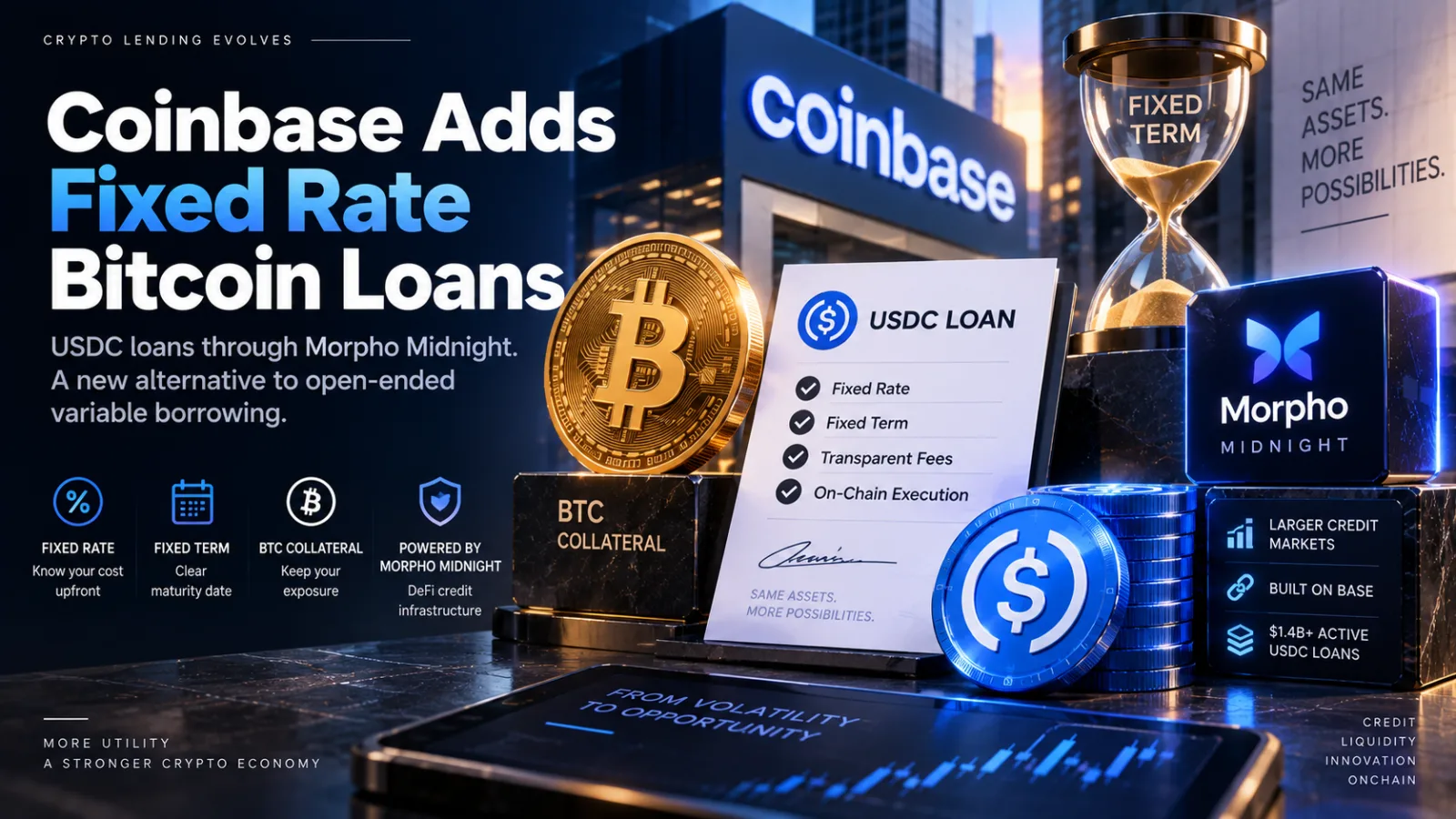

Coinbase has added fixed rate, fixed term USDC loans against Bitcoin through Morpho Midnight, giving users an alternative to open ended variable borrowing. The headline sounds like simpler credit. The deeper change is a risk swap: borrowers shed rate uncertainty but accept a hard maturity, upfront fees and a second liquidation trigger if repayment misses the deadline. With Morpho now powering more than $1.4 billion in active USDC loans on Base, the question is whether Coinbase can turn fixed term DeFi into repeatable consumer credit.
For additional context, explore AirdropHotList's crypto market analysis.
Coinbase fixed the rate by making time nonnegotiable
Coinbase's existing Morpho loans use variable rates and open ended terms. Borrowers can keep a position running as long as they maintain sufficient collateral and continue paying the changing cost of capital. Midnight reverses that structure: the interest rate and repayment date are established when the loan is opened.
According to Coinbase representatives cited by The Block, the initial fixed loans mature either at the end of the current month or the end of the following month, with "end of month" defined as the final Friday. That is a major qualification. Coinbase is not yet giving Bitcoin holders multi-year fixed financing. It is offering short dated certainty with a firm exit date.
The transaction remains crypto native beneath Coinbase's interface. For a Bitcoin backed loan, BTC is converted into Coinbase Wrapped BTC, or cbBTC, and transferred to a Morpho smart contract on Base. USDC is delivered to the borrower, while the wrapped Bitcoin secures the debt.
If this opportunity involves trading, deposits, or exchange activity, review our crypto trading guide for beginners to understand fees, risk control, and safer decision-making.
The real product change is a retail maturity wall
Morpho Midnight does not calculate rates through the utilization formula used by conventional DeFi pools. Its fixed rate markets match offers through units that mature into one loan token on a specified date. The price of those units establishes the implied rate. In practical terms, borrowers and lenders agree on the cost of money through an order book rather than accepting a continuously changing pool rate.
Coinbase has not publicly disclosed the rates displayed to fixed loan customers. Those quotes depend on available lender offers, loan size and maturity. That missing number matters because "fixed" does not automatically mean "cheap." It only means the cost will not change after execution.
The distinction becomes especially important with short maturities. A borrower may know the cost for several weeks, but must then repay, refinance into a new maturity or risk losing collateral. The product removes floating rate risk for the current term while creating rollover risk at the next one.
DeFi campaigns can involve protocol usage, liquidity, staking, or wallet activity. Before spending gas or locking funds, compare more DeFi airdrops and review the effort-to-reward balance.
Bitcoin holders traded one uncertainty for three concrete risks
Collateral risk has not disappeared. Coinbase's loan documentation says collateral is automatically liquidated if loan to value reaches 86%, with a 4.38% liquidation penalty. Fixed loans add another trigger: they can become eligible for liquidation after maturity even when their LTV would otherwise be healthy. Coinbase says the post-maturity liquidation incentive increases over roughly 15 minutes, meaning a missed deadline can turn into an onchain collateral sale quickly.
Coinbase plans to send reminders seven days, three days and 24 hours before maturity, according to its official loan health guide. Notifications reduce accidental defaults, but they do not remove funding risk. A borrower still needs accessible USDC or sufficient market liquidity to close or replace the debt.
Fees are the third variable. Coinbase's published fee schedule lists a processing charge of 2% on the first $250,000 and 1% on amounts above that threshold, while warning that the fee shown for a fixed loan may differ. Coinbase also collects its fixed loan platform fee upfront rather than monthly. For short terms, borrowers should therefore compare the total dollar repayment with the variable alternative instead of looking only at a quoted annual rate.
The investor paradox is straightforward: the rate becomes safer while the calendar becomes more dangerous.
The growth lever runs through USDC, Base and Morpho
This launch is not automatically a directional Bitcoin price catalyst. Existing BTC is being wrapped and pledged rather than newly purchased. At the margin, loans can reduce the need for holders to sell Bitcoin when they need liquidity. The opposite mechanism appears during a sharp drawdown, when leveraged collateral can be liquidated into falling markets. Which effect dominates depends on loan growth, borrower LTVs and Bitcoin volatility.
The clearer beneficiaries are the credit rails. Each loan adds potential demand for USDC, settles on Base and pushes more consumer activity through Morpho's contracts. For Morpho, Coinbase is a distribution channel capable of exposing an unfamiliar fixed term primitive to users who may never interact directly with a DeFi protocol.
That distribution matters because Midnight is still young. Morpho launched the protocol publicly on July 21, 2026, initially limiting its app to Base, cbBTC and USDC with a small selection of maturities. Fixed rate markets require active quotes from lenders as well as demand from borrowers. Coinbase can deliver demand, but competitive pricing will depend on whether capital consistently appears on the other side.
Still unsure about wallets, eligibility, or reward rules? Visit our FAQ page for quick answers before joining any new crypto campaign.
The counter case begins with flexibility
Variable loans remain attractive because they have no scheduled maturity. If Midnight quotes are uncompetitive after Coinbase's upfront charges, borrowers may decide that fluctuating interest is preferable to frequent refinancing. A fixed term of only a few weeks also offers less protection than the phrase "fixed rate" may initially suggest.
Liquidity presents a second constraint. Large borrowers need enough order book depth to execute without receiving a materially worse rate. They also need liquidity when closing early or rolling into a new maturity. If quotes thin out during market stress, the moment when borrowers most need refinancing could be the moment it becomes most expensive.
The bullish interpretation is that Coinbase has supplied Midnight with a ready-made borrower funnel, allowing lenders to build a genuine onchain term market. The bearish interpretation is that short maturities, upfront fees and rollover friction leave the product as a specialized alternative beside the much larger variable loan book.
 Kryvora Network
 Note Systems
 Nado
Nado
The investor watchlist
- All in borrowing cost: Compare fixed loan repayment amounts, processing charges and platform fees with Coinbase's variable rate option.
- Maturity expansion: Longer terms or automatic rolling would make rate certainty more useful and reduce repeated refinancing pressure.
- Midnight liquidity: Watch fixed loan volume, order book depth and the spread between borrower and lender quotes.
- Maturity behavior: Smooth repayments would validate the design, while frequent post-maturity liquidations would expose a consumer risk problem.
Conclusion
Coinbase has done more than add another borrowing rate. It has placed a maturity date inside one of crypto's largest consumer lending channels, shifting risk from an unpredictable interest bill toward deadlines, refinancing and liquidity. If Morpho Midnight develops deep quotes and longer maturities, this could become the missing bridge between DeFi's open pools and conventional term credit. Until then, fixed rate Bitcoin loans should be judged by what happens at the deadline, not by the comfort of the rate displayed on day one.






 Gaming Platforms
 Crypto Casinos
 Blockchain Bridges
 Staking & Restaking
 DEX Token Swapping
 Crypto Wallets