
 BTC
BTC
 ETH
ETH
 USDT
USDT
 BNB
BNB
 XRP
XRP
 USDC
USDC
 SOL
SOL
 TRX
TRX
 ZEC
ZEC
 FIGR_HELOC
 HYPE
HYPE
 DOGE
DOGE
 LINK
LINK
 XMR
XMR
 WBT
WBT
 USDS
USDS
 ADA
ADA
 RAIN
RAIN
 LEO
LEO
 XLM
XLM
 NEAR
NEAR
 BCH
BCH
 UNI
UNI
 LTC
LTC
 CC
CC
 SUI
SUI
 USDE
USDE
 AVAX
AVAX
 DAI
DAI
 GRAM
GRAM
 USD1
USD1
 HBAR
HBAR
 TAO
TAO
 SHIB
SHIB
 CRO
CRO
 BTW
BTW
 USDG
USDG
 ENA
ENA
 QNT
QNT
 PYUSD
PYUSD
 M
M
 ONDO
ONDO
 XAUT
XAUT
 OKB
OKB
 RLUSD
RLUSD
 USYC
USYC
 AAVE
AAVE
 PUMP
PUMP
 BUIDL
BUIDL
 USDY
USDY
 MNT
MNT
 DOT
DOT
 WLD
WLD
 ASTER
ASTER
 SKY
SKY
 MORPHO
 WLFI
WLFI
 PAXG
PAXG
 PEPE
PEPE
 ICP
ICP
 ARB
ARB
 USDD
USDD
 HTX
HTX
 ETC
ETC
 EURSAFO
 U
U
 VVV
VVV
 BGB
BGB
 USDGO
USDGO
 USDF
USDF
 KAS
KAS
 BFUSD
BFUSD
 POL
POL
 GT
GT
 LIT
LIT
 JUP
JUP
 ALGO
ALGO
 RENDER
 JST
JST
 PI
PI
 KCS
KCS
 ATOM
ATOM
 BCAP
BCAP
 FIL
FIL
 CAKE
CAKE
 NEXO
NEXO
 DASH
DASH
 AERO
AERO
 VET
VET
 INJ
INJ
 USTB
USTB
 EUTBL
EUTBL
 APT
APT
 STABLE
 AKE
AKE
 GHO
GHO
 ETHFI
ETHFI
 PYTH
PYTH
 STX
STX
 XDC
XDC
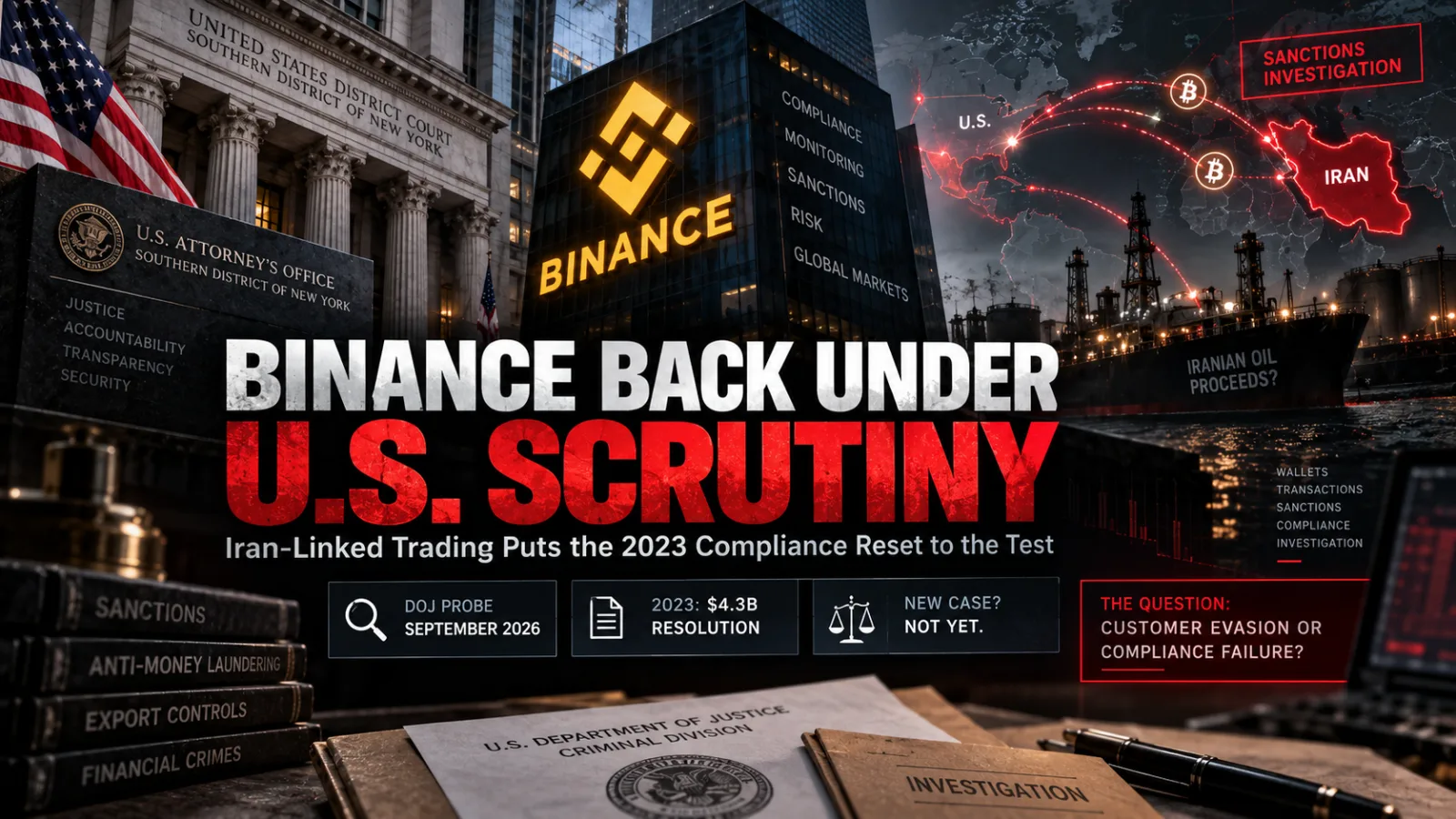

Binance is reportedly back under U.S. criminal scrutiny over Iran linked trading, but the market relevant issue is not simply whether prosecutors can build another sanctions case. The investigation, reported on September 22 by Bloomberg and Reuters, lands against the compliance framework imposed after Binance's 2023 guilty plea. Eight days earlier, Manhattan prosecutors alleged that two companies used Binance accounts within a $1.5 billion Iranian oil network. The key question is whether authorities see customer evasion or a failure of Binance's promised second chance. (news.bloomberglaw.com)
For additional context, explore AirdropHotList's crypto market analysis.
The new probe lands on top of an older promise
Federal prosecutors in the Manhattan U.S. Attorney's Office and the Justice Department's Criminal Division are examining whether Binance knowingly permitted trading that violated Iran sanctions, according to Bloomberg Law's September 22 report. Reuters separately corroborated the investigation, while both Justice Department offices declined to comment. No charge has been announced, and an investigation does not establish wrongdoing. (news.bloomberglaw.com)
That distinction matters, but so does Binance's history. In November 2023, the exchange pleaded guilty to Bank Secrecy Act, money transmitting and sanctions offenses in a resolution exceeding $4 billion. The Justice Department said Binance had caused more than $898 million in trades between U.S. users and users ordinarily resident in Iran from January 2018 through May 2022. Treasury's parallel resolution imposed a five-year FinCEN monitorship covering compliance improvements and Binance's exit from the U.S. market. (justice.gov)
The timing therefore changes the stakes. This is not a first examination of immature controls at a fast-growing exchange. It is a reported investigation into conduct connected to Iran after Binance admitted earlier sanctions failures and committed to monitoring, customer screening and stronger transaction controls.
The government has already mapped part of the crypto trail
On September 14, the Southern District of New York filed a civil forfeiture complaint targeting approximately $61 million in USDT. Prosecutors alleged that Hong Kong companies Blessed Trust and Hexa Whale used Binance trading accounts while helping move proceeds from black-market Iranian oil sales. A connected group of addresses allegedly received and distributed more than $1.5 billion, with funds routed toward Iran's government, the Islamic Revolutionary Guard Corps and related entities. The claims remain allegations unless established in court. (justice.gov)
The complaint does not say Binance itself controlled the network or knowingly joined the alleged scheme. It does, however, create an official transaction map around the same two customers already at the center of questions about Binance's post-settlement compliance. That makes the reported criminal probe more consequential than a vague inquiry built only on anonymous accusations.
DeFi campaigns can involve protocol usage, liquidity, staking, or wallet activity. Before spending gas or locking funds, compare more DeFi airdrops and review the effort-to-reward balance.
The legal hinge is knowledge rather than mere exposure
Large exchanges inevitably encounter wallets later associated with crime, sanctions evasion or compromised counterparties. The harder question is what the platform knew, when it knew it and how quickly it restricted the activity. Bloomberg reported that prosecutors are scrutinizing whether Binance knowingly allowed the trading, placing the focus on internal alerts, escalation decisions, account access and offboarding timelines. (news.bloomberglaw.com)
Binance disputes the suggestion that its controls failed. In a March 6 response to a U.S. Senate inquiry, the company said there were no direct transactions involving Iran-based entities on Binance. It said Hexa Whale was removed on August 13, 2025, and Blessed Trust was offboarded in January 2026 after investigations prompted by law-enforcement requests. Binance later said the funds under discussion neither originated nor terminated on its platform and that it reported suspicious activity after completing its reviews. (binance.com)
That frames the central factual dispute. Binance's position is that its systems detected a complex, indirect network and ultimately worked as intended. The enforcement theory prosecutors are reportedly testing is whether the response came late, whether warning signs were disregarded or whether trading was knowingly allowed to continue.
The 2023 settlement raises the potential consequences. OFAC's enforcement notice says a material breach or misrepresentation involving Binance's compliance commitments can trigger additional penalties. The monitor's mandate includes assessing ongoing sanctions controls. A new violation would therefore matter not only as a standalone case, but as evidence about whether the promised remediation was effective. (ofac.treasury.gov)
USDT reveals crypto's sanctions paradox
The forfeiture case also exposes a defining crypto contradiction. Stablecoins can move across borders and intermediaries rapidly, making them attractive for networks trying to bypass conventional banking controls. Yet public ledgers preserve transaction trails, while centralized issuers retain the power to freeze assets. The September complaint says Tether froze roughly 61.19 million USDT across the targeted addresses, and a seizure warrant authorized their transfer to an FBI-controlled wallet. (justice.gov)
For regulators, this combination turns exchanges and stablecoin issuers into enforcement chokepoints. For crypto users, it means "on-chain" does not automatically mean outside state control. The more illicit networks depend on dollar stablecoins and major trading venues for liquidity, the more they expose themselves to screening, blacklisting and asset seizure.
Still unsure about wallets, eligibility, or reward rules? Visit our FAQ page for quick answers before joining any new crypto campaign.
BNB carries the exchange specific risk
BNB has a genuine network role as the gas and staking asset of BNB Chain, according to the project's official token overview. Traders nevertheless tend to treat it as a confidence gauge for the broader Binance ecosystem. That creates the investor paradox: BNB's utility extends beyond the exchange, but major Binance legal shocks can still dominate its risk premium. (bnbchain.org)
The reported investigation does not itself allege insolvency, missing customer assets or an inability to process withdrawals. It should not automatically be treated as an FTX-style balance-sheet event. The transmission channels are different: potential penalties, compliance restrictions, banking and counterparty friction, management distraction and a possible loss of user confidence.
That also argues against assuming immediate market-wide contagion. Bitcoin and the broader crypto market would face a larger threat only if the case disrupted Binance operations, triggered persistent exchange outflows or impaired a major source of global liquidity. Until then, the cleaner expression of risk is likely to remain Binance and BNB specific.
Three paths now define the risk
Contained case
The investigation ends without charges or focuses narrowly on customers that concealed their counterparties. Binance's cooperation, offboarding records and monitoring evidence support its claim that controls operated reasonably.
Not every reward campaign deserves your time. Before you commit, compare this opportunity with our active airdrops list and focus on campaigns with clearer upside, better trust signals, and realistic participation steps.
Long compliance case
The base case is a prolonged investigation with document demands, monitor scrutiny and further remediation but no immediate operational disruption. Legal uncertainty could keep an exchange-specific discount attached to BNB even without a dramatic enforcement announcement.
Escalation
The bearish case would require evidence that Binance personnel knowingly tolerated prohibited activity or that post-2023 controls materially failed. Charges, a settlement-breach determination or new operating restrictions would increase the probability of sustained outflows and wider liquidity effects. These scenarios are analysis, not confirmed outcomes.
 Kryvora Network
 Note Systems
 Nado
Nado
The signals that would settle the argument
- An official DOJ complaint, settlement or public decision closing the investigation.
- Any OFAC or FinCEN finding concerning Binance's 2023 compliance commitments or monitorship.
- A detailed Binance timeline showing when the accounts were flagged, restricted, reported and removed.
- Sustained BNB weakness relative to the crypto market, accompanied by persistent exchange outflows or withdrawal disruption.
Conclusion
The real story is not that Iran-linked money allegedly touched another crypto platform. It is that the platform is Binance, the activity reportedly under review overlaps with customers named in an official forfeiture case, and the questions arise after one of the largest compliance settlements in crypto history. Unless prosecutors connect Binance's knowledge or controls to a violation, the investigation may remain contained. If they do, the 2023 deal will look less like closure and more like the start of the evidence trail.





 Gaming Platforms
 Crypto Casinos
 Blockchain Bridges
 Staking & Restaking
 DEX Token Swapping
 Crypto Wallets