
 BTC
BTC
 ETH
ETH
 USDT
USDT
 BNB
BNB
 XRP
XRP
 USDC
USDC
 SOL
SOL
 TRX
TRX
 ZEC
ZEC
 FIGR_HELOC
 HYPE
HYPE
 DOGE
DOGE
 LINK
LINK
 XMR
XMR
 WBT
WBT
 USDS
USDS
 ADA
ADA
 RAIN
RAIN
 LEO
LEO
 XLM
XLM
 NEAR
NEAR
 BCH
BCH
 UNI
UNI
 LTC
LTC
 CC
CC
 SUI
SUI
 USDE
USDE
 AVAX
AVAX
 DAI
DAI
 GRAM
GRAM
 USD1
USD1
 HBAR
HBAR
 TAO
TAO
 SHIB
SHIB
 CRO
CRO
 BTW
BTW
 USDG
USDG
 ENA
ENA
 QNT
QNT
 PYUSD
PYUSD
 M
M
 ONDO
ONDO
 XAUT
XAUT
 OKB
OKB
 RLUSD
RLUSD
 USYC
USYC
 AAVE
AAVE
 PUMP
PUMP
 BUIDL
BUIDL
 USDY
USDY
 MNT
MNT
 DOT
DOT
 WLD
WLD
 ASTER
ASTER
 SKY
SKY
 MORPHO
 WLFI
WLFI
 PAXG
PAXG
 PEPE
PEPE
 ICP
ICP
 ARB
ARB
 USDD
USDD
 HTX
HTX
 ETC
ETC
 EURSAFO
 U
U
 VVV
VVV
 BGB
BGB
 USDGO
USDGO
 USDF
USDF
 KAS
KAS
 BFUSD
BFUSD
 POL
POL
 GT
GT
 LIT
LIT
 JUP
JUP
 ALGO
ALGO
 RENDER
 JST
JST
 PI
PI
 KCS
KCS
 ATOM
ATOM
 BCAP
BCAP
 FIL
FIL
 CAKE
CAKE
 NEXO
NEXO
 DASH
DASH
 AERO
AERO
 VET
VET
 INJ
INJ
 USTB
USTB
 EUTBL
EUTBL
 APT
APT
 STABLE
 AKE
AKE
 GHO
GHO
 ETHFI
ETHFI
 PYTH
PYTH
 STX
STX
 XDC
XDC
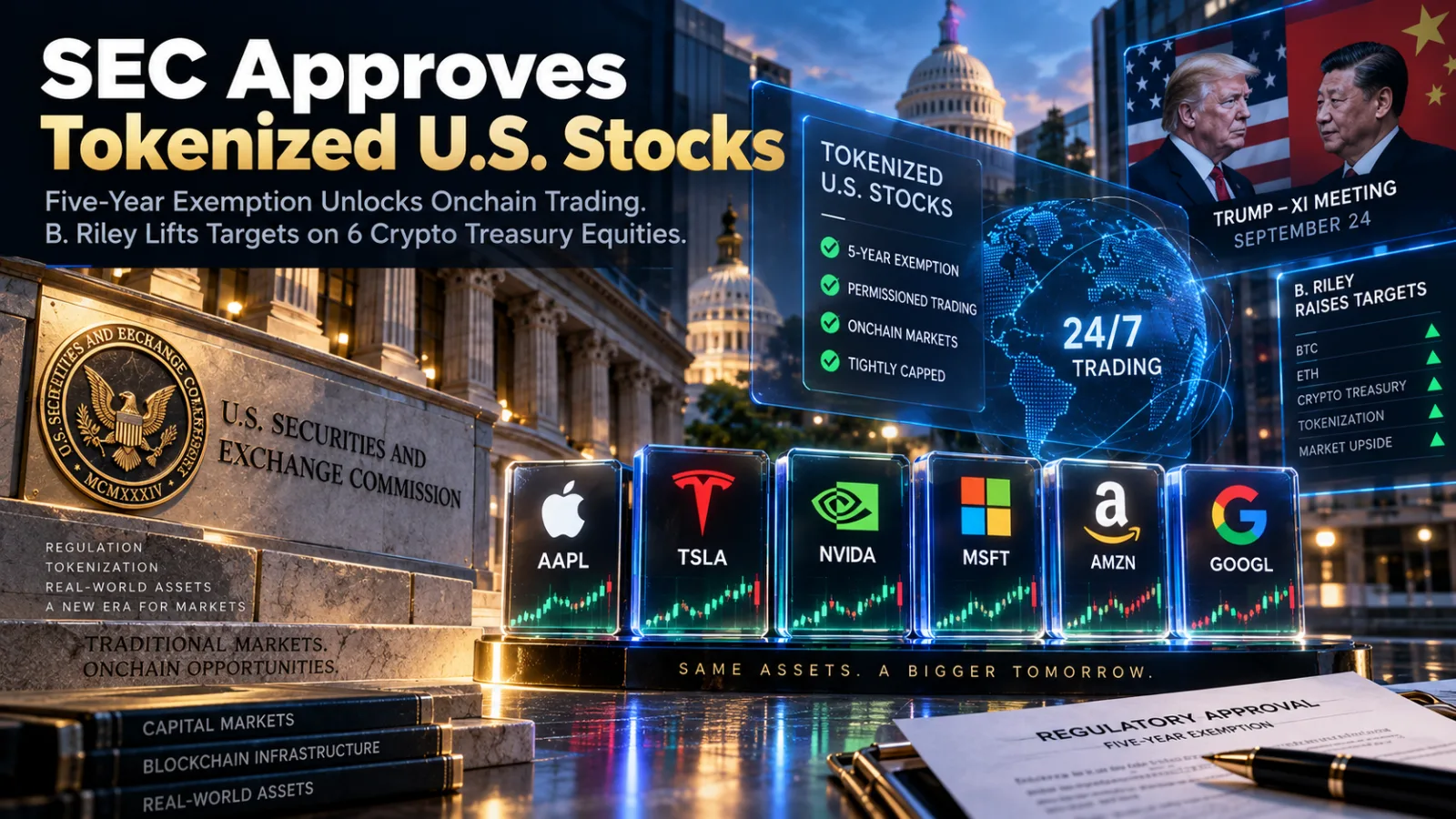

The SEC has delivered the regulatory catalyst B. Riley is citing: on September 17 it granted a five year exemption for permissioned, onchain trading of tokenized U.S. stocks. B. Riley then raised targets on six crypto treasury equities, arguing that round the clock token trading and the September 24 Trump Xi meeting could help lagging shares catch up to crypto. The catch is timing and transmission. No venue can start immediately, trading is tightly capped, and the upgraded companies still live or die mainly by Bitcoin, Ether and their financing engines.
For additional context, explore AirdropHotList's crypto market analysis.
The SEC catalyst is real and more crypto native than it sounds
The regulatory development is not merely a proposed "tokenization rule." The SEC issued a temporary, conditional Innovation Exemption running until September 17, 2031. It allows qualifying Tokenized Securities Venues, or TSVs, to facilitate trading in tokenized National Market System stocks without being treated as exchanges under the relevant section of the Exchange Act.
The market structure is unmistakably borrowed from crypto. TSVs can use automated market makers and liquidity pools deployed through auditable smart contracts on public, permissionless blockchains. Access must remain permissioned, but eligible tokenized shares can be paired with another tokenized stock, a nonsecurity crypto asset such as a qualifying payment stablecoin, or a tokenized money market fund.
This matters because the exemption imports self custody, programmable settlement and potential 24 hour trading into regulated U.S. equities. It also gives liquidity providers limited relief from dealer registration when supplying tokenized shares to eligible pools. The SEC's official fact sheet identifies fractional ownership and near instantaneous settlement among the potential benefits.
Crucially, eligible tokens must carry the same economic and governance rights as the corresponding traditional shares, including dividends, voting rights and liquidation claims. Synthetic tokens that merely track a stock are excluded. This is a framework for putting actual securities onchain, not relabeling price exposure as ownership.
B Riley is betting on a catch up trade
According to a September 22 Stocktwits report, B. Riley analyst Fedor Shabalin raised price targets across a basket of Bitcoin and Ether treasury companies after crypto assets outpaced their listed proxies. The revisions were:
- SharpLink from $12 to $14, Nakamoto from $11 to $13, Strategy from $175 to $195, Forward Industries from $9 to $11, BitMine Immersion Technologies from $30 to $34, and Strive from $26 to $33.
The logic is understandable. Crypto trades continuously, while listed treasury companies remain constrained by equity market hours. Tokenizing those shares could eventually narrow weekend information gaps, broaden access and let traders move between stablecoins, tokenized equities and crypto assets without waiting for the Nasdaq or NYSE opening bell.
Yet the upgraded companies are not primarily tokenization operators. They are leveraged balance sheet vehicles whose valuations depend on the underlying crypto asset, access to new capital, dilution, liabilities, staking income in the Ether cohort and the premium or discount applied to their net asset value. A new trading wrapper does not change those economics by itself.
Before connecting a wallet or approving any transaction, slow down and verify the source. Our crypto safety guide explains how to avoid fake claim pages, phishing links, risky approvals, and common wallet mistakes.
The 30 day clock limits the immediate liquidity story
The SEC's 60 page order contains several brakes that matter to anyone trading the headline. A TSV must publish a detailed public notice at least 30 calendar days before beginning operations. If an unaffiliated third party tokenizes a company's shares, the issuer receives a separate 30 day notice period and can object, blocking the token from trading on that venue.
Scale is also deliberately restricted. Each TSV and its affiliates may support no more than 75 Tier 1 symbols and 250 Tier 2 symbols. Trading in a Tier 1 tokenized stock cannot exceed 0.25% of the underlying stock's prior month average daily share volume. The Tier 2 ceiling is 2.5%. Repeated breaches can trigger a three month trading pause.
Tokenized shares must also stop trading whenever the underlying stock is halted on its primary exchange. Venues must publish transaction data, disclose their smart contracts and explain safeguards covering wallets, oracles, cybersecurity, market manipulation and maximal extractable value.
That creates the central investor paradox: the exemption may be durable precisely because it starts small, but starting small makes it a weaker immediate liquidity catalyst. The SEC has authorized an experiment, not switched the entire U.S. equity market to blockchain settlement overnight.
Trump and Xi are the indirect catalyst in this thesis
The White House has confirmed that President Donald Trump will welcome Chinese President Xi Jinping for an official state visit on Thursday, September 24, 2026, after greeting him at Joint Base Andrews on September 23.
However, the published White House schedule does not identify crypto or tokenization as an agenda item. For digital assets, the summit is therefore a risk appetite catalyst rather than a tokenization catalyst. A constructive outcome could support crypto through lower trade uncertainty, a softer dollar or easing pressure on yields. Renewed tariff or geopolitical friction could produce the opposite transmission.
That distinction matters. The SEC order directly changes what crypto style market infrastructure may do. The Trump Xi meeting can change the environment in which Bitcoin, Ether and crypto equities trade, but it does not currently provide a verified regulatory or commercial bridge to tokenized stocks.
Still unsure about wallets, eligibility, or reward rules? Visit our FAQ page for quick answers before joining any new crypto campaign.
The treasury stocks still need their original engines
Strategy remains fundamentally a Bitcoin capital markets vehicle. Its own August investor briefing describes MSTR as offering amplified, residual Bitcoin exposure rather than spot tracking or redemption. Tokenization might expand when and where MSTR trades, but Bitcoin performance, funding costs and the company's ability to raise capital on favorable terms remain the larger variables.
The Ether treasury names have an additional link to the tokenization narrative because Ethereum is positioned around smart contracts, stablecoins and onchain finance. Even so, no blockchain is guaranteed business by the SEC order. Venues choose their infrastructure, and the framework is technology neutral.
BitMine illustrates the scale of the underlying asset exposure. The company reported in a September 21 SEC filing that it held 5,983,940 ETH as of September 20. For a treasury of that size, changes in Ether, staking economics and the market value assigned to the balance sheet can outweigh the early trading volumes permitted under the SEC pilot.
Three scenarios for the next phase
If you want reward-focused opportunities that involve tasks or activity, compare more earn crypto airdrops before choosing where to spend your time.
Bull case
The Trump Xi meeting reduces risk aversion, Bitcoin and Ether retain momentum, and credible operators publish TSV notices with viable stablecoin settlement and institutional liquidity plans. Crypto treasury equities could then benefit from both stronger underlying assets and a believable path toward continuous onchain trading.
Base case
The summit produces no major market surprise, while the tokenization framework advances through notices, issuer decisions and technical preparation. Treasury stocks continue to trade mainly as leveraged BTC or ETH proxies, with tokenization remaining longer dated optionality rather than an immediate earnings or liquidity event.
 Kryvora Network
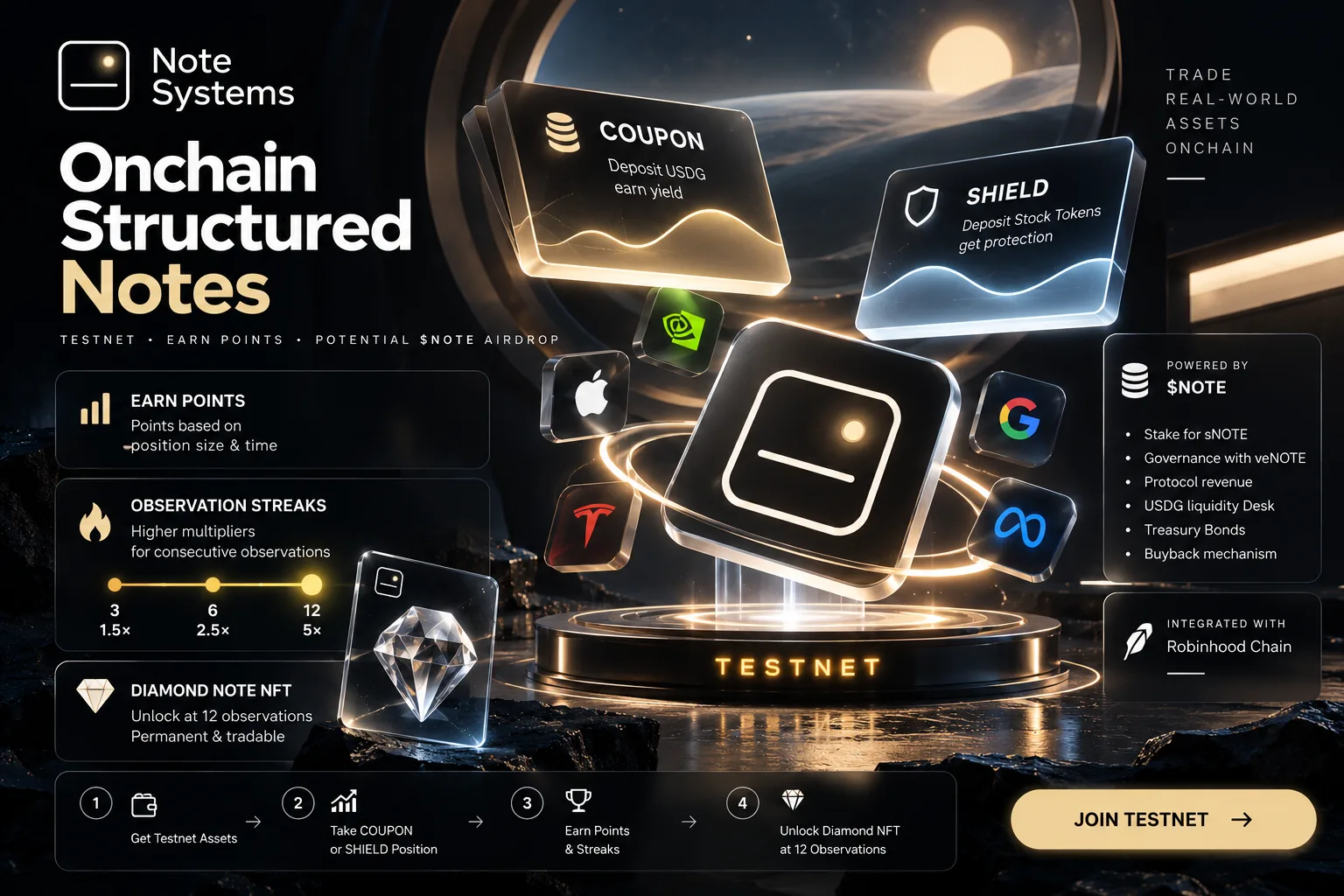
 Note Systems
 Nado
Nado
Bear case
Trade tensions weaken risk appetite while no major venue demonstrates near term demand under the SEC's caps. Crypto treasury premiums could compress as investors conclude that tokenized trading changes the wrapper faster than it changes the value of the assets inside it.
Conclusion
The SEC's action is a genuine milestone for bringing regulated equities into crypto market structure, but B. Riley's catch up thesis still requires execution. Investors should watch four signals: the first formal TSV notices, which issuers permit or reject third party tokenization, whether real liquidity develops within the SEC's volume caps, and whether MSTR, SBET and BMNR outperform Bitcoin or Ether rather than merely following them.
If those signals align, the exemption can become more than a regulatory headline. If they do not, the September catalyst will have validated tokenization's direction without validating every crypto treasury stock attached to the story.





 Gaming Platforms
 Crypto Casinos
 Blockchain Bridges
 Staking & Restaking
 DEX Token Swapping
 Crypto Wallets