
 BTC
 ETH
 USDT
 BNB
 XRP
 USDC
 SOL
 TRX
 FIGR_HELOC
 ZEC
 HYPE
 DOGE
 XMR
 USDS
 WBT
 LINK
 LEO
 ADA
 XLM
 NEAR
 RAIN
 BCH
 USDE
 DAI
 UNI
 LTC
 CC
 AVAX
 USD1
 SUI
 GRAM
 HBAR
 XAUT
 USDG
 QNT
 PYUSD
 SHIB
 TAO
 ENA
 CRO
 RLUSD
 USYC
 USDY
 OKB
 M
 BUIDL
 AAVE
 ONDO
 PUMP
 USDF
 PEPE
 PAXG
 EURSAFO
 ASTER
 USDD
 DOT
 MNT
 WLFI
 WLD
 U
 SKY
 HTX
 ICP
 MORPHO
 BTW
 BFUSD
 BGB
 USDGO
 VVV
 ETC
 ARB
 JST
 KCS
 GT
 KAS
 POL
 ALGO
 JUP
 RENDER
 ATOM
 PI
 OUSD
 NEXO
 INJ
 LIT
 FIL
 USTB
 AKE
 GHO
 CAKE
 DASH
 XDC
 ZRO
 NIGHT
 PEARL
 ETHFI
 APT
 PYTH
 BDX
 JAAA
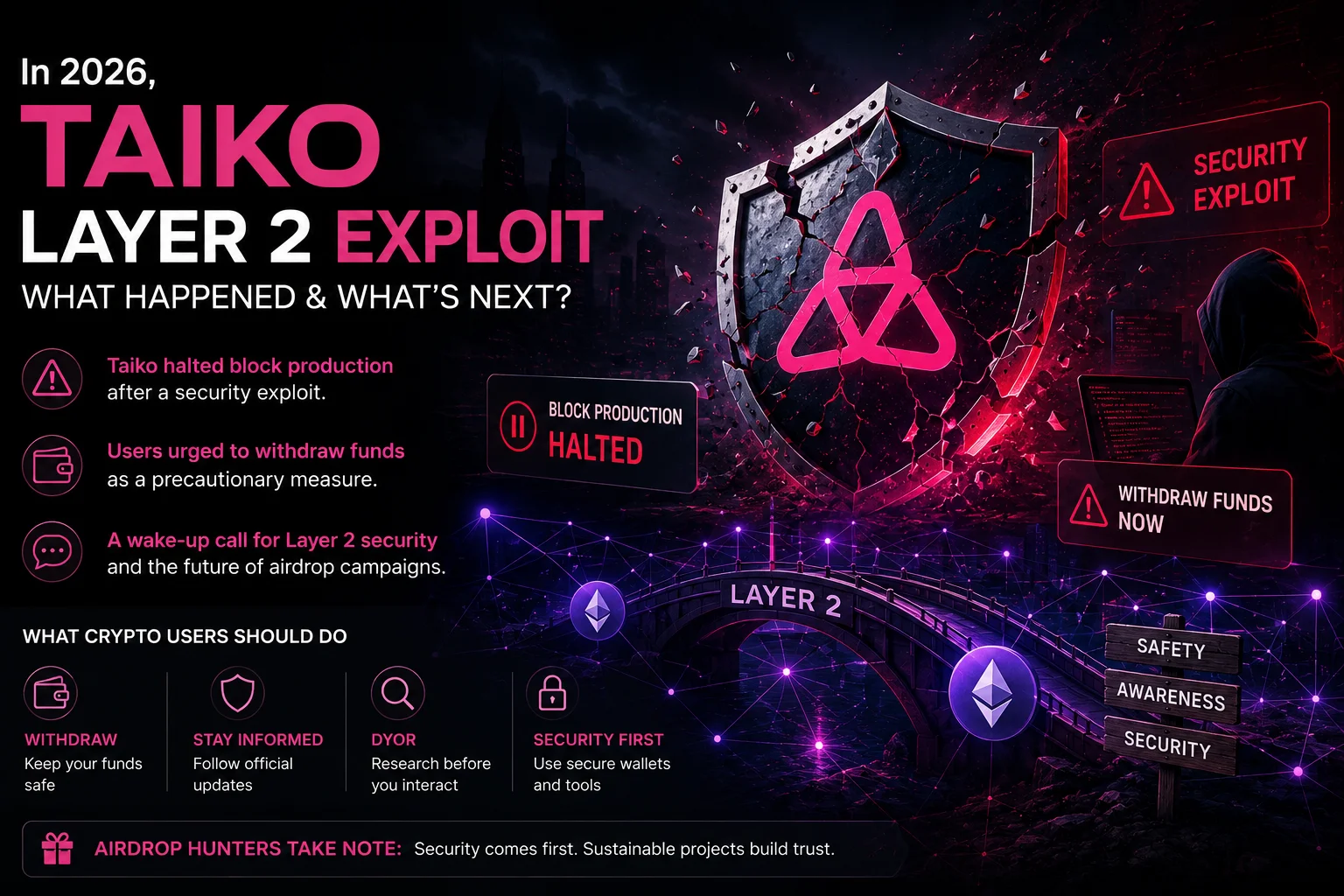

In 2026, Taiko, a leading Ethereum Layer 2 protocol, halted block production following a security exploit. Users were urged to withdraw their funds as a precautionary measure. This incident has sparked widespread discussion about Ethereum Layer 2 security, the safety of user assets, and the future of airdrop campaigns. Understanding the Taiko Layer 2 exploit, its impact, and how to protect your funds is essential for all crypto users, investors, and airdrop hunters navigating the evolving Layer 2 landscape.
Overview of the Taiko Layer 2 Exploit in 2026
Taiko, recognized for its innovative approach to Ethereum scaling, faced a significant challenge in 2026 when it halted block production after discovering a security exploit. While specific technical details remain under review, the event underscores the persistent vulnerabilities present in Layer 2 solutions, even as they become more popular for reducing transaction costs and congestion on Ethereum's mainnet.
Layer 2 protocols like Taiko are designed to process transactions off-chain and then settle them on Ethereum, aiming for faster and cheaper transactions. However, as adoption grows, so do the incentives for malicious actors to probe for weaknesses. The Taiko exploit has reignited debates about the security of Ethereum Layer 2 protocols in 2026 and what users can do to safeguard their assets.
Timeline: How the Taiko Block Production Halt Unfolded
The sequence of events began when Taiko's monitoring systems detected irregular activity suggesting a potential exploit. In response, the Taiko team made the decision to halt block production—a critical move to prevent further risk to user funds and protocol integrity. The Ethereum and Layer 2 communities quickly mobilized, sharing updates and urging users to take proactive steps.
Official statements from Taiko emphasized user safety, transparency, and the importance of withdrawing funds until a full security audit could be completed. The rapid response highlighted both the strengths and challenges of decentralized protocols: while swift action can contain damage, the decentralized nature of Layer 2s means users must stay vigilant and informed.
What Triggered the Taiko Exploit?
While the exact vector of the exploit is still under investigation, preliminary analysis points to a vulnerability in one of Taiko's smart contract modules. This allowed for abnormal transaction patterns, prompting the halt. Community speculation and analyst discussion suggest that the exploit may have involved a novel attack method not previously seen in Layer 2 protocols, highlighting the evolving threat landscape in 2026.
Official Responses from Taiko and Ethereum Community
Taiko's development team released a series of updates, reassuring users that their funds were not lost but urging immediate withdrawals as a precaution. The Ethereum community, including prominent security researchers, offered support and began independent reviews of Taiko's codebase. This collaborative approach is a hallmark of the Ethereum ecosystem, but it also highlights the need for ongoing vigilance and transparent communication during protocol incidents.
Immediate Steps for Taiko Users: Withdrawing Funds Safely
For users with assets on Taiko, the priority is to withdraw funds safely and efficiently. Below is a step-by-step guide to help you navigate the process and minimize risk:
- Check Official Channels: Visit Taiko's official website and verified social media for the latest withdrawal instructions and updates.
- Connect Your Wallet: Use a reputable wallet (such as MetaMask or Ledger) to connect to the Taiko interface.
- Initiate Withdrawal: Follow the on-screen prompts to bridge your assets back to Ethereum mainnet or another supported chain.
- Confirm Transactions: Double-check transaction details, including recipient addresses and amounts, before confirming.
- Monitor Network Status: Be aware of potential network congestion or delays during high-traffic periods.
- Stay Alert for Phishing: Only use official links and beware of phishing attempts or scam withdrawal sites.
For a more detailed walkthrough, see our crypto safety guide and always prioritize security when moving funds during protocol incidents.
If this opportunity involves trading, deposits, or exchange activity, review our crypto trading guide for beginners to understand fees, risk control, and safer decision-making.
How to Check If Your Funds Are at Risk
Users can verify the status of their assets by:
- Checking wallet balances on Taiko's official block explorer.
- Reviewing recent transaction history for any unauthorized activity.
- Consulting Taiko's support channels for updates on affected smart contracts or tokens.
If you notice any discrepancies, act quickly and seek support from official Taiko representatives.
Impact on Ethereum Layer 2 Ecosystem and Airdrops
The Taiko exploit has sent ripples through the Ethereum Layer 2 ecosystem in 2026. As more users and projects migrate to Layer 2s for scalability, security incidents like this one raise important questions about protocol robustness and user safety. For airdrop hunters, the event also brings uncertainty regarding eligibility and the continuity of ongoing campaigns.
Many Layer 2 protocols, including Arbitrum, Optimism, and zkSync, have responded by reviewing their own security postures and communicating with users about best practices. The exploit has also prompted renewed interest in decentralized insurance products and risk mitigation strategies for Layer 2 users.
Airdrop Eligibility After the Exploit
One pressing concern for airdrop hunters is whether participation on Taiko during the exploit period affects eligibility for current or future airdrops. While each campaign has its own rules, most protocols prioritize user safety and may adjust eligibility criteria in response to security incidents. Users are advised to monitor official announcements and check our latest crypto airdrops page for updates on campaign status and requirements.
Security Best Practices for Layer 2 Users in 2026
Security is a shared responsibility between protocol developers and users. In 2026, with Layer 2 adoption at an all-time high, following best practices is critical:
- Use Reputable Wallets: Stick to well-audited wallets with strong security records.
- Stay Informed: Subscribe to official protocol channels for real-time updates.
- Enable Two-Factor Authentication: Where possible, add extra layers of security to your accounts.
- Regularly Audit Your Portfolio: Remove funds from protocols showing signs of instability or risk.
- Beware of Social Engineering: Never share private keys or seed phrases, and be cautious of unsolicited messages.
For more tips, visit our crypto safety guide.
Comparing Taiko Security to Other Layer 2s in 2026
While Taiko's exploit has drawn attention, it's important to recognize that no Layer 2 solution is immune to vulnerabilities. Protocols like Arbitrum, Optimism, and StarkNet have all faced their own security challenges. The key differentiator is how quickly and transparently teams respond, the robustness of their security audits, and the engagement of their user communities. Taiko's rapid block production halt and user communication set a positive example, but ongoing vigilance remains essential across the Layer 2 landscape.
Expert Analysis: What This Means for Investors and Traders
For investors and traders, the Taiko incident is a stark reminder that technological innovation comes with risk. While Layer 2s offer compelling benefits—lower fees, faster transactions, and access to new dApps—they also introduce new attack surfaces. Experts recommend diversifying across multiple protocols, maintaining a portion of assets on the Ethereum mainnet, and staying up to date with security advisories.
Market uncertainty following the Taiko exploit has led to increased volatility in Layer 2 tokens and related DeFi projects. Analysts suggest that while short-term sentiment may be cautious, the long-term outlook for Ethereum scaling solutions remains strong, provided that security practices continue to evolve.
Before connecting a wallet or approving any transaction, slow down and verify the source. Our crypto safety guide explains how to avoid fake claim pages, phishing links, risky approvals, and common wallet mistakes.
Lessons Learned for Crypto Security
- Always prioritize user safety over yield or rewards.
- Monitor protocol health and community sentiment.
- Participate in governance and audits where possible.
- Be prepared to act quickly in response to incidents.
Future Outlook: Can Taiko and Layer 2 Solutions Regain Trust?
The path forward for Taiko and other Layer 2 protocols will depend on transparent communication, robust security upgrades, and community engagement. Historically, protocols that respond swiftly and openly to incidents are able to regain user trust over time. In 2026, the Layer 2 ecosystem is more competitive than ever, and protocols must prioritize security to remain relevant.
For users, the Taiko exploit is a valuable lesson in risk management and the importance of staying informed. As the Ethereum scaling landscape evolves, expect to see more emphasis on security audits, bug bounty programs, and user education.
Predictions for Layer 2 Security Trends in 2026
- Increased adoption of formal verification and automated security tools.
- Greater collaboration between Layer 2 teams and independent security researchers.
- Growth in decentralized insurance and risk-sharing products.
- More frequent security drills and incident response simulations.
Practical Checklist: How to Protect Your Assets on Layer 2 Protocols
- Only use official protocol interfaces and links.
- Regularly withdraw idle funds to mainnet or cold storage.
- Enable all available wallet security features.
- Participate in community channels for real-time alerts.
- Bookmark and use official protocol explorers to monitor your assets.
- Double-check all transaction details before confirming.
- Stay updated on the crypto guides and market analysis section for the latest security trends.
Common Mistakes to Avoid When Using Layer 2 in 2026
- Ignoring official warnings or updates during incidents.
- Using unverified third-party interfaces or links.
- Leaving large amounts of assets on experimental protocols.
- Failing to keep backup copies of wallet seed phrases in secure locations.
- Assuming all Layer 2s have the same security standards.
Pros and Cons of Using Layer 2 Protocols for Ethereum in 2026
| Pros | Cons |
|---|---|
| Lower transaction fees | Potential for new vulnerabilities |
| Faster transaction speeds | Complexity in bridging and withdrawals |
| Access to innovative dApps and airdrops | Reliance on protocol security and audits |
| Scalability for Ethereum ecosystem | Risk of protocol-specific incidents |
If you want to understand how eligibility, snapshots, claiming, and reward distribution usually work, start with our crypto airdrop guide before joining new campaigns.
Advanced User Section: Navigating Layer 2 Risks and Opportunities in 2026
Advanced users and institutional participants are increasingly leveraging Layer 2s for complex strategies, including liquidity provision, cross-chain arbitrage, and governance participation. However, these activities amplify exposure to protocol-specific risks. Experts recommend:
- Using multi-signature wallets for team-managed funds.
- Participating in Layer 2 governance to advocate for stronger security measures.
- Engaging with bug bounty programs to support protocol resilience.
- Maintaining diversified positions across multiple Layer 2s and mainnet.
For those seeking the latest opportunities, including airdrops, always verify campaign legitimacy and eligibility through official sources and our latest crypto airdrops page.
Market Outlook: The Future of Ethereum Layer 2 Security After Taiko’s 2026 Incident
The Taiko exploit has highlighted both the promise and the perils of Ethereum Layer 2 scaling in 2026. While the incident has temporarily shaken user confidence, it also serves as a catalyst for improved security standards and community awareness. As Layer 2 adoption continues to grow, expect ongoing innovation in both protocol design and user safety measures.
For airdrop hunters, investors, and everyday users, the key takeaway is to stay informed, practice diligent risk management, and engage with protocols that demonstrate transparency and a commitment to security. The future of Ethereum scaling remains bright, but only for those who navigate it with care and awareness.
Frequently Asked Questions: Taiko Layer 2 Exploit and Ethereum Security in 2026
- What is Taiko and how does it work as an Ethereum Layer 2?
Taiko is a Layer 2 scaling solution for Ethereum, designed to process transactions off-chain and settle them on the mainnet, enabling faster and cheaper transactions. - Why did Taiko halt block production in 2026?
Taiko halted block production after detecting a security exploit, as a precaution to protect user funds and protocol integrity. - How can I safely withdraw my funds from Taiko?
Follow official withdrawal instructions, use reputable wallets, and double-check all transaction details. Refer to our crypto safety guide for more tips. - Are my airdrop rewards affected by the Taiko exploit?
Airdrop eligibility may be adjusted by protocols in response to security incidents. Monitor official announcements and our latest crypto airdrops page for updates. - What are the main risks of using Layer 2 solutions in 2026?
Risks include smart contract vulnerabilities, protocol outages, and potential loss of funds during exploits or technical failures. - How can I protect my crypto assets during protocol outages?
Withdraw funds promptly, use only official interfaces, and stay updated via verified channels. - Will Taiko resume operations after the exploit?
Taiko's future operations depend on the outcome of security audits and community trust. Official updates will provide guidance on resumption. - Where can I find more information about Ethereum Layer 2 security?
Visit our crypto guides and market analysis section for in-depth articles and updates.
Step-by-Step Guide: How to Withdraw Funds from Taiko After the Exploit
Following the Taiko Layer 2 exploit in 2026, users have been strongly advised to withdraw their funds as a precaution. If you are unsure how to proceed, follow this practical checklist to ensure your assets are moved safely:
- 1. Verify Official Communications: Always check Taiko’s official blog or social media channels for the latest withdrawal instructions and phishing warnings.
- 2. Use the Official Taiko Bridge: Access the official Taiko withdrawal portal. Double-check the URL to avoid phishing sites.
- 3. Connect Your Wallet: Use a reputable wallet (such as MetaMask or Ledger) to connect to the Taiko network.
- 4. Initiate Withdrawal: Select the assets you wish to withdraw and follow the on-screen prompts. Confirm all transaction details before proceeding.
- 5. Monitor Transaction Status: Track your withdrawal on both the Taiko and Ethereum mainnet explorers to ensure successful completion.
- 6. Secure Your Assets: Once funds arrive on Ethereum mainnet, consider moving them to cold storage or a more secure wallet.
- 7. Stay Informed: Continue monitoring crypto guides and market analysis for updates on Taiko’s recovery and broader Layer 2 security news.
Understanding the Risks: Layer 2 Vulnerabilities in 2026
The Taiko incident has highlighted several risks associated with Ethereum Layer 2 solutions in 2026. Here’s what users should be aware of:
- Smart Contract Bugs: Layer 2 protocols rely on complex smart contracts, which can harbor undiscovered vulnerabilities.
- Centralization Risks: Some Layer 2s, including Taiko, may have centralized components or upgrade mechanisms that can be targeted by attackers.
- Withdrawal Delays: During outages or exploits, withdrawal processes may be delayed or temporarily disabled, increasing user anxiety.
- Phishing and Social Engineering: Exploit events often lead to increased phishing attempts. Always verify sources before interacting with any links or forms.
- Protocol Upgrades and Forks: Emergency upgrades can introduce further instability or incompatibility issues.
For a comprehensive overview of how to protect your crypto, refer to our crypto safety guide.
 Arcus Exchange
 JoinCare
 Breath of Estova
Beginner’s Corner: What Is a Layer 2 and Why Does Security Matter?
Layer 2 solutions like Taiko are built on top of Ethereum to process transactions more efficiently. They bundle multiple transactions off-chain and periodically settle them on the mainnet, reducing fees and congestion. However, because these protocols handle large volumes of funds and interact with Ethereum through smart contracts, they become attractive targets for exploits. Understanding the basics of Layer 2 can help users make informed decisions about where to store and use their assets.
Expert Insights: What the Taiko Exploit Means for Investors and Traders
Industry experts have weighed in on the broader implications of the Taiko exploit for Ethereum Layer 2 security in 2026. According to blockchain security analysts, the incident underscores the need for:
- Continuous Auditing: Regular and independent code audits remain critical for all Layer 2 protocols.
- Transparent Incident Reporting: Prompt and clear communication from project teams builds user trust during crises.
- Diversification: Investors and traders should avoid concentrating assets on a single Layer 2 solution.
- Community Involvement: Open-source development and community bug bounties can help uncover vulnerabilities before they are exploited.
As one security researcher noted, “The Taiko exploit is a wake-up call for the entire Layer 2 ecosystem. Security must evolve as fast as scalability.”
Market Outlook: Can Taiko and Layer 2 Solutions Regain Trust?
The immediate aftermath of the exploit has seen a dip in user confidence and TVL (Total Value Locked) across several Layer 2 protocols. However, the Ethereum community has historically shown resilience following security incidents. Key factors that will determine the recovery of Taiko and similar projects include:
- Speed and Transparency of Remediation: How quickly and openly Taiko addresses the exploit will influence user sentiment.
- Implementation of Enhanced Security Measures: Adoption of advanced auditing, monitoring, and insurance mechanisms.
- Community Engagement: Ongoing dialogue with users and developers to rebuild trust.
- Regulatory Developments: Potential for increased oversight of Layer 2 protocols in response to high-profile exploits.
For ongoing updates and analysis, visit our crypto guides and market analysis section.
Airdrop Hunter Angle: What Happens to Airdrop Eligibility After the Exploit?
Many users interact with Layer 2 protocols like Taiko in hopes of qualifying for future airdrops. The exploit and subsequent withdrawal rush have raised concerns about airdrop eligibility:
- Snapshot Timing: If the airdrop snapshot was taken before the exploit, your eligibility is likely unaffected. If not, check official Taiko channels for updates.
- Activity Requirements: Some airdrops require ongoing activity or holding funds on the protocol. Withdrawing may impact eligibility if the snapshot is pending.
- Official Announcements: Always rely on official sources for airdrop criteria. Beware of scams promising guaranteed eligibility post-exploit.
Stay updated on latest crypto airdrops and eligibility changes as the situation evolves.
Checklist: Securing Your Crypto Assets on Layer 2 in 2026
- Use hardware wallets for large balances.
- Regularly review protocol security updates and audit reports.
- Withdraw funds promptly if a protocol announces a security incident.
- Bookmark official project URLs to avoid phishing.
- Participate in community forums to stay informed about risks and solutions.
- Enable multi-factor authentication where possible.
- Limit exposure to new or unaudited Layer 2 protocols.
Frequently Asked Questions (FAQ)
| Question | Answer |
|---|---|
| What is Taiko and how does it work as an Ethereum Layer 2? | Taiko is a Layer 2 scaling solution for Ethereum that processes transactions off-chain and settles them on the mainnet, reducing costs and improving speed. |
| Why did Taiko halt block production in 2026? | Block production was halted as a precaution after a security exploit was detected, to prevent further risk to user funds. |
| How can I safely withdraw my funds from Taiko? | Follow official withdrawal instructions, use the verified Taiko bridge, and confirm all transaction details. See the checklist above for detailed steps. |
| Are my airdrop rewards affected by the Taiko exploit? | This depends on the timing of the airdrop snapshot and official criteria. Monitor Taiko’s announcements for updates. |
| What are the main risks of using Layer 2 solutions in 2026? | Risks include smart contract bugs, centralization, withdrawal delays, and increased phishing attempts during incidents. |
| How can I protect my crypto assets during protocol outages? | Stay informed, use hardware wallets, and withdraw funds promptly when advised. Refer to our crypto safety guide for more tips. |
| Will Taiko resume operations after the exploit? | Taiko’s team is working on remediation. Follow official channels for updates on the protocol’s status and future plans. |




 Gaming Platforms
 Crypto Casinos
 Blockchain Bridges
 Staking & Restaking
 DEX Token Swapping
 Crypto Wallets