
 BTC
 ETH
 USDT
 BNB
 XRP
 USDC
 SOL
 TRX
 FIGR_HELOC
 ZEC
 HYPE
 DOGE
 XMR
 USDS
 WBT
 LINK
 LEO
 ADA
 NEAR
 XLM
 RAIN
 BCH
 USDE
 DAI
 UNI
 LTC
 CC
 AVAX
 USD1
 SUI
 GRAM
 HBAR
 XAUT
 USDG
 QNT
 PYUSD
 SHIB
 TAO
 ENA
 CRO
 RLUSD
 USYC
 USDY
 OKB
 M
 BUIDL
 AAVE
 ONDO
 PUMP
 USDF
 PEPE
 BTW
 EURSAFO
 PAXG
 ASTER
 USDD
 DOT
 WLFI
 MNT
 WLD
 U
 SKY
 ICP
 MORPHO
 HTX
 BFUSD
 BGB
 USDGO
 VVV
 ETC
 ARB
 JST
 KCS
 GT
 KAS
 POL
 ALGO
 JUP
 RENDER
 ATOM
 PI
 OUSD
 NEXO
 INJ
 LIT
 FIL
 USTB
 AKE
 GHO
 ZRO
 CAKE
 DASH
 NIGHT
 XDC
 PEARL
 ETHFI
 APT
 PYTH
 BDX
 STX
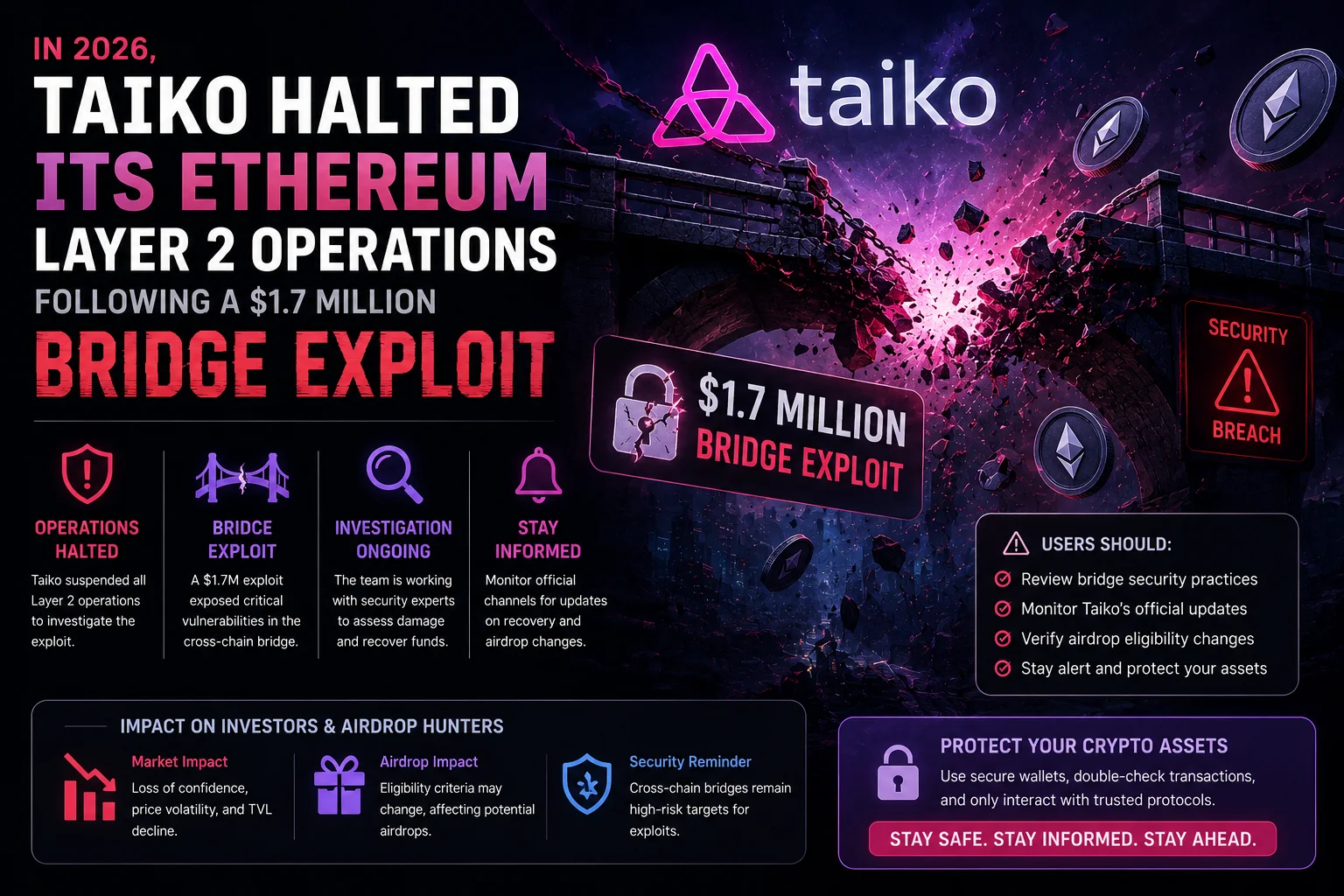

In 2026, Taiko halted its Ethereum Layer 2 operations following a $1.7 million bridge exploit. The incident exposed critical vulnerabilities in cross-chain bridge security, prompting an immediate suspension of activity as Taiko investigates the breach. Users are urged to review bridge security practices, monitor official updates for asset recovery, and stay informed about airdrop eligibility changes. This article provides a comprehensive analysis of the exploit, its impact on investors and airdrop hunters, and actionable steps to protect your crypto assets in the evolving Layer 2 landscape.
What Actually Happened: The Taiko Ethereum Layer 2 Bridge Exploit Explained
On a recent day in 2026, the Taiko protocol—a prominent Ethereum Layer 2 scaling solution—was forced to halt its bridge operations after an exploit resulted in the loss of approximately $1.7 million in user funds. The exploit targeted Taiko’s cross-chain bridge, a critical infrastructure component that enables users to transfer assets between Ethereum mainnet and Taiko’s Layer 2 network. The breach has sent shockwaves through the Layer 2 ecosystem, raising urgent questions about bridge security, user safety, and the future of airdrop eligibility for those affected.
Timeline: How the $1.7M Taiko Bridge Hack Unfolded
Key Events Leading to the Exploit
While the full technical details are still under investigation, preliminary reports indicate that the exploit was executed in a series of rapid transactions. Attackers exploited a vulnerability in the bridge’s smart contract logic, allowing unauthorized withdrawals. The incident was detected by on-chain monitoring tools and quickly escalated within the Taiko community.
- Initial Suspicion: Unusual withdrawal patterns were flagged by automated monitoring systems.
- Exploit Execution: Attackers leveraged a flaw in the bridge contract to siphon funds.
- Community Alert: Users began reporting missing funds and transaction anomalies on social channels.
- Official Confirmation: Taiko’s team confirmed the exploit and immediately halted bridge operations to prevent further losses.
Immediate Response from Taiko Team
Within hours, Taiko’s developers issued a public statement acknowledging the incident, suspending all bridge activity, and initiating a comprehensive security audit. The team is working with security researchers and external auditors to trace the attacker’s movements and assess the full scope of the breach. Users have been advised not to interact with the bridge until further notice.
Security Analysis: What Caused the Taiko Exploit?
Common Bridge Vulnerabilities in 2026
Bridge exploits remain one of the most persistent threats in the crypto ecosystem. In 2026, despite advancements in smart contract security, cross-chain bridges are still vulnerable due to their complexity and the high value of assets they manage. Common attack vectors include:
- Smart Contract Bugs: Flaws in contract logic can be exploited for unauthorized withdrawals.
- Oracle Manipulation: Attackers may exploit weaknesses in how bridges verify cross-chain transactions.
- Insufficient Auditing: Rapid protocol development can outpace thorough security reviews.
- Centralized Validators: Bridges relying on a small set of validators are at higher risk of collusion or compromise.
The Taiko exploit appears to fit the pattern of logic vulnerabilities, though the exact technical root cause is still under review. This incident highlights the ongoing need for rigorous security practices and continuous monitoring in the Layer 2 space.
User Impact: How Investors, Traders, and Airdrop Hunters Are Affected
If you want reward-focused opportunities that involve tasks or activity, compare more earn crypto airdrops before choosing where to spend your time.
Investor Reactions and Market Impact
The exploit has triggered significant concern among Taiko users and the broader Layer 2 community. Investors are worried about the safety of their funds, while traders are facing uncertainty regarding asset withdrawals and trading activity. The incident has also led to increased scrutiny of other Layer 2 bridges, with many users reviewing their exposure to similar protocols.
- Asset Freezes: Users with funds on the Taiko bridge are currently unable to withdraw or transfer assets.
- Market Volatility: The exploit has contributed to short-term volatility in Taiko-related tokens and Layer 2 assets.
- Trust Erosion: Confidence in bridge security has been shaken, prompting calls for more transparency and robust audits.
For airdrop hunters, the halt has introduced new challenges in tracking eligibility and claiming potential rewards.
Airdrop Eligibility and Updates After the Taiko Exploit
AirdropHotList’s Guidance for Airdrop Hunters
One of the major concerns following any protocol incident is how it affects airdrop eligibility. Many users interact with Layer 2 bridges like Taiko specifically to qualify for future airdrops. In the wake of the exploit, Taiko has not yet released a definitive statement regarding the status of ongoing or planned airdrops. However, based on industry precedent, several scenarios are possible:
- Snapshot Adjustments: Taiko may update eligibility snapshots to exclude exploit-related transactions or affected addresses.
- Compensation Plans: Some protocols have issued compensation or retroactive airdrops to users impacted by exploits.
- Eligibility Pauses: Airdrop campaigns may be temporarily paused while the team assesses the situation.
For the latest updates on airdrop eligibility and recovery plans, monitor Taiko’s official channels and check the latest crypto airdrops page on AirdropHotList.com.
Protecting Your Assets on Ethereum Layer 2 Bridges in 2026
Best Practices for Bridge Security
Bridge exploits like the one affecting Taiko underscore the importance of proactive security measures for all crypto users. Here are actionable steps to help safeguard your assets on Layer 2 bridges:
- Research Bridge Security: Only use bridges with a track record of third-party audits and transparent security practices.
- Limit Exposure: Avoid keeping large sums on bridges for extended periods. Transfer assets back to mainnet or cold storage when not actively trading.
- Monitor Official Channels: Stay updated on protocol announcements, especially during periods of market uncertainty or technical incidents.
- Use Reputable Wallets: Ensure your wallet is up-to-date and supports the latest security standards.
- Enable Alerts: Set up on-chain monitoring tools or wallet notifications for unusual activity.
For a comprehensive overview of crypto safety, visit our crypto safety guide.
Comparing the Taiko Exploit with Previous Layer 2 Bridge Hacks
The Taiko incident is the latest in a series of bridge exploits that have plagued the Ethereum ecosystem since 2026. While each case has unique technical details, several common themes have emerged:
- Rapid Exploitation: Attackers often act within minutes of discovering a vulnerability.
- Community-Driven Detection: Many exploits are first reported by vigilant users or independent security researchers.
- Protocol Response: Immediate halts and audits are standard, but recovery and compensation vary widely.
Learning from past incidents, protocols are increasingly investing in real-time monitoring, bug bounty programs, and multi-layered security checks. However, as the Taiko exploit demonstrates, the threat landscape continues to evolve.
What Users Should Do Next: Action Steps and Safety Warnings
If you interacted with the Taiko bridge recently, here’s what you should do:
- Do Not Use the Bridge: Avoid all transactions involving the Taiko bridge until official updates confirm it is safe.
- Check Your Wallet: Verify your balances and review recent transaction history for any unauthorized activity.
- Monitor Announcements: Follow Taiko’s official channels and AirdropHotList.com for recovery and airdrop updates.
- Document Interactions: Keep records of your bridge activity, including transaction hashes and wallet addresses, in case compensation or recovery processes are announced.
- Stay Informed: Read our crypto guides and market analysis for ongoing coverage of security incidents and best practices.
Remember: Never share your private keys or seed phrases with anyone claiming to be from the Taiko team or recovery services.
Predictions for Layer 2 Security and Bridge Technology Post-2026
The Taiko exploit is likely to accelerate the adoption of advanced security measures across Layer 2 protocols. Experts predict several trends for the remainder of 2026 and beyond:
- Zero-Knowledge Proofs: Increased use of zk-proofs to validate cross-chain transactions without exposing vulnerabilities.
- Decentralized Validators: Shifting away from centralized bridge operators to community-driven validator sets.
- Continuous Auditing: Real-time and on-chain audits to detect anomalies before they escalate.
- User Education: More resources and guides to help users understand bridge risks and security protocols.
Protocols that prioritize security, transparency, and user protection will be best positioned to regain community trust and attract new users in the evolving Layer 2 landscape.
If you want to understand how eligibility, snapshots, claiming, and reward distribution usually work, start with our crypto airdrop guide before joining new campaigns.
Key Takeaways: What the Taiko Bridge Exploit Means for Crypto Users in 2026
- The Taiko Ethereum Layer 2 bridge exploit resulted in a $1.7 million loss and a temporary halt of operations.
- Security vulnerabilities in cross-chain bridges remain a top concern for the crypto community.
- Investors, traders, and airdrop hunters are all impacted, with airdrop eligibility and asset recovery still under review.
- Users should avoid interacting with the Taiko bridge, monitor official updates, and follow best security practices.
- The incident is expected to drive further innovation in Layer 2 security and user education throughout 2026.
FAQ: Taiko Bridge Exploit and Layer 2 Security in 2026
What is the Taiko Layer 2 bridge and how does it work?
The Taiko Layer 2 bridge is a protocol that allows users to transfer assets between Ethereum mainnet and the Taiko Layer 2 network, enabling faster and cheaper transactions by leveraging Layer 2 scaling technology.
How did hackers exploit the Taiko bridge in 2026?
Attackers exploited a vulnerability in the bridge’s smart contract logic, allowing unauthorized withdrawals. The exact technical details are still under investigation by the Taiko team and security auditors.
Are my funds safe if I used the Taiko bridge?
If you have assets on the Taiko bridge, they are currently frozen while the team investigates the exploit. Users are advised not to interact with the bridge and to monitor official updates for recovery plans.
Will Taiko users still receive airdrops after the exploit?
Taiko has not yet confirmed the status of airdrop eligibility post-exploit. Users should monitor official announcements and check the latest crypto airdrops page for updates.
What steps should I take if I interacted with the Taiko bridge?
Do not use the bridge until further notice, check your wallet for unauthorized transactions, document your activity, and stay informed via official channels.
How can I avoid similar bridge exploits in the future?
Use only audited and reputable bridges, limit your exposure, enable wallet alerts, and review our crypto safety guide for more tips.
DeFi campaigns can involve protocol usage, liquidity, staking, or wallet activity. Before spending gas or locking funds, compare more DeFi airdrops and review the effort-to-reward balance.
What are the latest security trends for Ethereum Layer 2 in 2026?
Trends include increased use of zero-knowledge proofs, decentralized validators, continuous auditing, and enhanced user education to mitigate bridge vulnerabilities.
Security Analysis: What Caused the Taiko Exploit?
The Taiko Ethereum Layer 2 bridge exploit in 2026 highlights persistent vulnerabilities in cross-chain infrastructure. According to preliminary findings, the attackers exploited a flaw in the bridge’s transaction validation logic. This allowed unauthorized withdrawals by bypassing certain security checks, enabling the siphoning of $1.7 million in assets. Such vulnerabilities are not unique to Taiko; they reflect broader risks associated with the rapid evolution of Layer 2 solutions and the complexity of bridging assets between chains.
Common Bridge Vulnerabilities in 2026
- Smart Contract Bugs: Coding errors or overlooked edge cases in bridge contracts can be exploited to drain funds.
- Insufficient Auditing: Rapid deployment and innovation sometimes outpace thorough security reviews, leaving bridges exposed.
- Centralized Validators: Bridges relying on a small set of validators are susceptible to collusion or compromise.
- Replay Attacks: Attackers may reuse valid signatures or transactions across chains to trigger unintended actions.
Immediate Response from Taiko Team
Upon detecting the exploit, the Taiko team acted swiftly to halt bridge operations, preventing further losses. Official communications assured users that a full investigation was underway, with third-party security firms brought in to audit the affected contracts. The team has also published regular updates on their official channels, outlining steps taken to secure remaining funds and promising a transparent post-mortem once the investigation concludes.
- Bridge operations suspended pending security review
- Collaboration with external auditors and Ethereum security experts
- Commitment to publishing a detailed incident report
- Ongoing communication with affected users via social media and the Taiko website
Impact on Users: Investors, Traders, and Airdrop Hunters
The exploit’s immediate impact was felt by users with funds on the Taiko bridge, as withdrawals and deposits were frozen. Investors and traders faced uncertainty regarding asset recovery and the timeline for resumed operations. For airdrop hunters—users who interact with Layer 2 protocols in hopes of qualifying for future token distributions—the exploit raised concerns about eligibility and the fairness of upcoming airdrops.
Investor Reactions and Market Impact
- Temporary loss of access to bridged assets
- Increased scrutiny of Layer 2 bridge security across the ecosystem
- Short-term dip in confidence for Taiko and similar protocols
- Heightened demand for transparency and rapid remediation
 Arcus Exchange
 JoinCare
 Breath of Estova
Airdrop Eligibility and Updates After the Taiko Exploit
Many Taiko users participated in the protocol with the expectation of a future airdrop. Following the exploit, the team has acknowledged community concerns and stated that airdrop eligibility will not be negatively impacted for users who interacted with the bridge prior to the incident. However, the final eligibility criteria and snapshot dates remain under review as the team assesses the full scope of the breach.
- Users affected by the exploit will remain eligible for any future airdrops
- Snapshot dates may be adjusted to ensure fairness
- Official updates will be posted on the Taiko website and social channels
- For more on airdrop eligibility, see our latest crypto airdrops page
Protecting Your Assets on Ethereum Layer 2 Bridges in 2026
This incident underscores the importance of proactive security measures for all users of Layer 2 bridges. While no system is entirely immune to exploits, there are several best practices that can help mitigate risk:
Best Practices for Bridge Security
- Research Bridge Protocols: Use bridges with a proven security track record and transparent auditing processes.
- Limit Exposure: Avoid keeping large sums on bridges for extended periods; transfer assets back to mainnet when possible.
- Monitor Official Channels: Follow project updates for security alerts and emergency instructions.
- Use Hardware Wallets: Store assets in hardware wallets to reduce the risk of compromise from browser-based exploits.
- Stay Informed: Read our crypto safety guide for more tips on protecting your funds.
Comparison: Taiko Exploit vs. Previous Layer 2 Bridge Hacks
| Bridge | Year | Amount Lost | Exploit Type | Resolution |
|---|---|---|---|---|
| Taiko | 2026 | $1.7M | Validation logic flaw | Operations halted, investigation ongoing |
| Optimism | 2025 | $2.3M | Smart contract bug | Funds partially recovered, contracts upgraded |
| Arbitrum | 2024 | $1.1M | Validator compromise | Validators replaced, new audit procedures |
What Should Users Do Next?
If you interacted with the Taiko bridge, here are recommended steps:
- Monitor Taiko’s official channels for updates on asset recovery and airdrop announcements
- Do not attempt to use the bridge until operations are officially restored
- Review your wallet activity for unauthorized transactions
- Consider moving assets to more secure storage options if possible
- Stay informed with our crypto guides and market analysis
Key Takeaways
- The Taiko Ethereum Layer 2 bridge exploit in 2026 resulted in a $1.7M loss and a temporary halt of operations
- Users’ airdrop eligibility is expected to be preserved, pending final criteria
- Bridge security remains a critical challenge for the Ethereum ecosystem
- Users should adopt best practices to protect their assets and stay updated on official communications
Frequently Asked Questions (FAQ)
- What is the Taiko Layer 2 bridge and how does it work?
The Taiko bridge enables users to transfer assets between Ethereum mainnet and the Taiko Layer 2 network, facilitating faster and cheaper transactions. - How did hackers exploit the Taiko bridge in 2026?
Attackers exploited a flaw in the bridge’s transaction validation logic, allowing unauthorized withdrawals. - Are my funds safe if I used the Taiko bridge?
Currently, all bridge operations are suspended. Users should monitor official updates regarding asset recovery and avoid interacting with the bridge until further notice. - Will Taiko users still receive airdrops after the exploit?
Yes, the Taiko team has stated that airdrop eligibility will not be negatively impacted for users who interacted with the bridge before the exploit. - What steps should I take if I interacted with the Taiko bridge?
Monitor official channels, check your wallet for suspicious activity, and avoid using the bridge until it is declared safe. - How can I avoid similar bridge exploits in the future?
Use bridges with strong security records, limit exposure, and follow best practices outlined in our crypto safety guide. - What are the latest security trends for Ethereum Layer 2 in 2026?
Protocols are increasingly adopting multi-layered audits, decentralized validator sets, and real-time monitoring to enhance bridge security.





 Gaming Platforms
 Crypto Casinos
 Blockchain Bridges
 Staking & Restaking
 DEX Token Swapping
 Crypto Wallets