
 BTC
 ETH
 USDT
 BNB
 XRP
 USDC
 SOL
 TRX
 FIGR_HELOC
 ZEC
 HYPE
 DOGE
 XMR
 USDS
 WBT
 LINK
 LEO
 ADA
 NEAR
 XLM
 RAIN
 BCH
 USDE
 LTC
 DAI
 UNI
 AVAX
 CC
 SUI
 USD1
 GRAM
 HBAR
 XAUT
 USDG
 TAO
 SHIB
 CRO
 PYUSD
 QNT
 BTW
 ENA
 OKB
 RLUSD
 USYC
 USDY
 AAVE
 BUIDL
 ONDO
 WLD
 PUMP
 DOT
 ASTER
 USDF
 PAXG
 USDD
 M
 PEPE
 MNT
 MORPHO
 EURSAFO
 WLFI
 SKY
 ICP
 U
 HTX
 ARB
 BGB
 BFUSD
 USDGO
 ETC
 VVV
 JST
 GT
 ALGO
 KCS
 POL
 KAS
 JUP
 BCAP
 ATOM
 RENDER
 PI
 INJ
 FIL
 OUSD
 AERO
 NEXO
 LIT
 USTB
 ZRO
 AKE
 GHO
 CAKE
 PRL
 APT
 STX
 NIGHT
 ETHFI
 XDC
 DASH
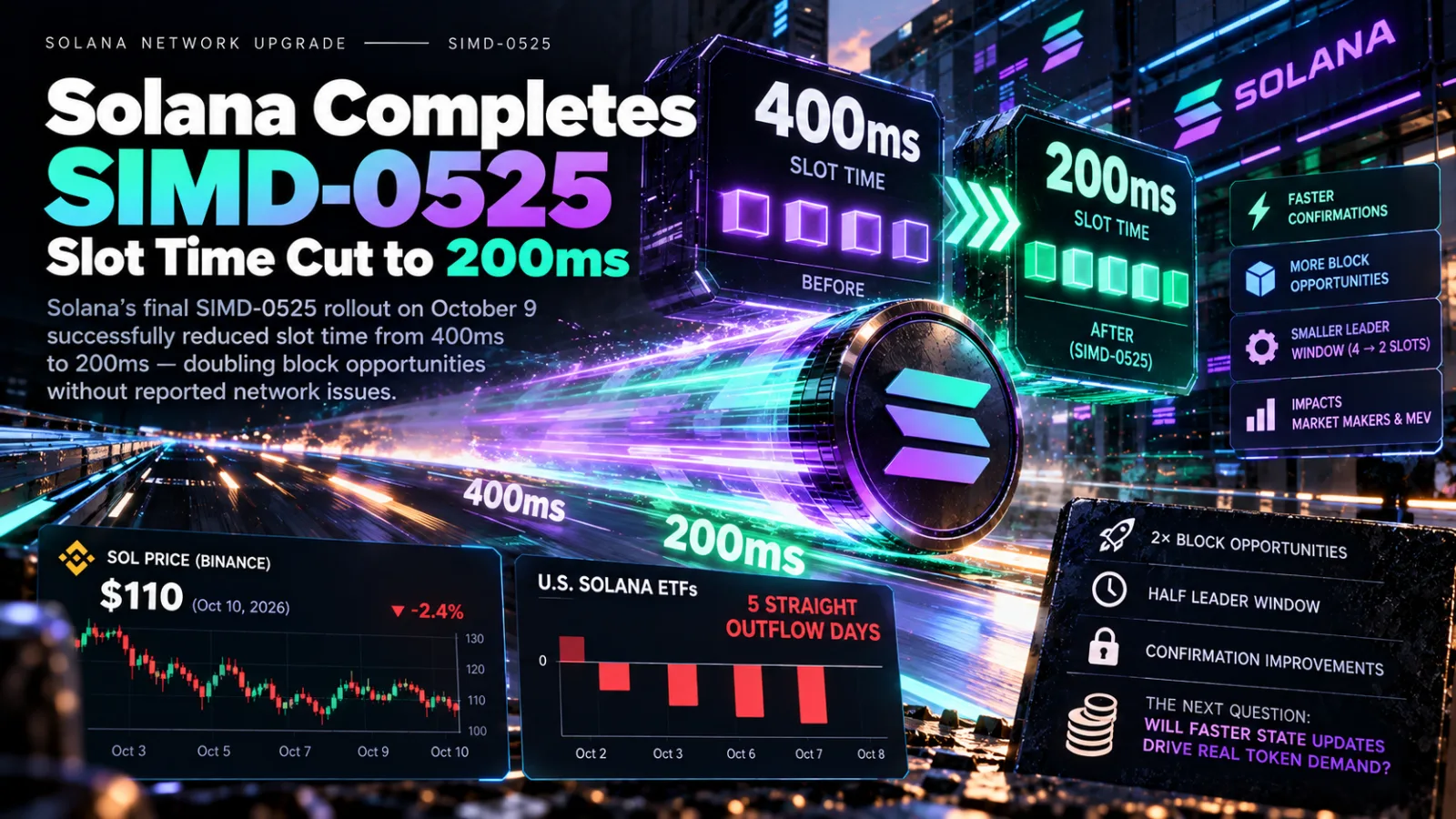

Solana completed the final stage of SIMD-0525 on October 9, cutting its target slot time from 400 milliseconds to 200 milliseconds without a reported network incident. That doubles the cadence of block opportunities and halves a validator leader's four-slot control window, a meaningful change for confirmations, market makers and MEV. Yet SOL was only around $110 on Binance late October 10, while U.S. Solana ETFs logged five straight outflow days. The upgrade worked. The unresolved question is whether faster state updates can create enough economic demand to matter for the token.
For related opportunities and eligibility updates, explore AirdropHotList's latest airdrop listings.
The upgrade is real but narrower than the headline suggests
The final feature gate took effect at the start of epoch 1053 at approximately 14:35 UTC on October 9. It completed a rollout that moved Solana through 350ms, 300ms and 250ms targets before reaching 200ms. Solana's official status page reported no incidents on October 9 or October 10, an important result for a network attempting to operate closer to the physical latency limits faced by a geographically distributed validator set.
However, this is a latency upgrade, not a straightforward doubling of throughput. Under the SIMD-0525 specification, per-slot work limits are reduced proportionally as slots become shorter, keeping wall-clock capacity broadly stable. Solana now offers blockspace in smaller, more frequent increments rather than automatically creating twice as much total capacity.
The distinction matters for SOL valuation. Faster slots do not mechanically double fee revenue, burn twice as many tokens or create an equivalent increase in staking demand. They can improve the environment in which applications compete, but those applications still need to turn better execution into users, volume and sustainable network economics.
Confirmation must also be separated from finality. The 200ms target lets transactions enter Solana's canonical state more frequently, but it does not mean every transaction becomes irreversible in 200ms. That is the job of Alpenglow, Solana's separate consensus overhaul targeting roughly 150ms finality. Alpenglow is active on devnet and testnet but, as of October 11, remains unactivated on mainnet.
If you prefer curated opportunities instead of browsing everything manually, check our featured airdrops and compare higher-signal campaigns first.
Why 200 milliseconds changes Solana market structure
Solana kept each leader's turn fixed at four slots. Cutting each slot from 400ms to 200ms therefore reduces a leader's continuous control window from 1.6 seconds to 800 milliseconds. That limits how long one validator can control transaction ordering before the schedule moves to the next leader.
For traders, the practical opportunity is fresher onchain pricing. Automated market makers can update more frequently, while market makers spend less time exposed to an external price moving before their Solana quote changes. The Foundation's economic analysis argues that this can reduce stale-price arbitrage and support tighter spreads, although it does not guarantee lower sandwich extraction. Faster attackers, user slippage settings and transaction contention still determine who captures value.
That nuance creates the investor paradox: Solana can become a better trading venue without the improvement immediately accruing to SOL. Liquidity providers may keep more value that would otherwise leak to arbitrageurs, but token holders benefit only if the resulting execution quality attracts additional activity, fees and capital.
There is also a practical change for wallets and infrastructure. The blockhash validity window remains 150 blocks, but those blocks now pass in roughly 30 seconds instead of 60. Offline signing flows and transactions waiting for manual approval have less time before their blockhash becomes stale. Indexers face the opposite problem: twice as many blocks arrive during the same wall-clock period, increasing ingestion and storage demands even though the data format has not changed.
The first tests exposed both strength and pressure
Evidence from the earlier rollout stages was encouraging but not uniformly positive. Solana Foundation's post-activation analysis found that skip rates remained stable as the target fell to 250ms. Periods of consecutive dead time also shortened, with the dominant range moving from more than 1,800ms to roughly 1,200ms to 1,400ms.
The same study found that vote latency increased, with validators in Asia and South America affected most. Network-wide average vote latency remained below two slots, and the Foundation reported no evidence of consensus instability, but the regional difference identifies the key engineering risk. A faster global chain is only as resilient as the validators operating across its slowest network paths.
The 200ms stage now needs its own multi-epoch evidence. A clean activation is not the same as proof that skip rates, vote credits and validator economics will remain healthy across congestion, market volatility and uneven internet conditions.
If you want to understand how eligibility, snapshots, claiming, and reward distribution usually work, start with our crypto airdrop guide before joining new campaigns.
SOL price is still following capital rather than the clock
Binance showed SOL at approximately $110.05 late October 10, up 0.83% over 24 hours, with a reported market capitalization near $64.8 billion. The modest bounce confirms that the upgrade did not trigger an immediate selloff, but it also falls short of a clear structural repricing.
The capital-flow signal was weaker. Farside Investors data show U.S. Solana ETFs recording combined net outflows of approximately $25 million from October 5 through October 9, with redemptions on every trading day. That reversal followed stronger September demand and suggests institutions were reducing exposure during the same week Solana delivered its latency milestone.
This does not prove investors rejected the upgrade. ETF flows can reflect portfolio rebalancing, profit-taking or broader risk conditions unrelated to protocol engineering. It does show that technical execution alone was not strong enough to overpower near-term selling. The network moved twice as fast, while the most visible regulated capital channel moved in the opposite direction.
Three paths for SOL after the upgrade
Before connecting a wallet or approving any transaction, slow down and verify the source. Our crypto safety guide explains how to avoid fake claim pages, phishing links, risky approvals, and common wallet mistakes.
Bull case
The network sustains near-target slot times with low skip rates, while decentralized exchanges show tighter spreads, fewer stale quotes and better transaction landing. Improved execution attracts more volume and fee-paying activity, and ETF flows turn positive again. Under this scenario, the upgrade becomes an economic catalyst rather than a technical footnote.
Base case
Wallets and applications feel incrementally faster, but total blockspace and fee generation remain broadly unchanged. SOL continues trading primarily on crypto liquidity, ETF demand and expectations for Alpenglow. SIMD-0525 strengthens the long-term infrastructure thesis without producing an immediate valuation reset.
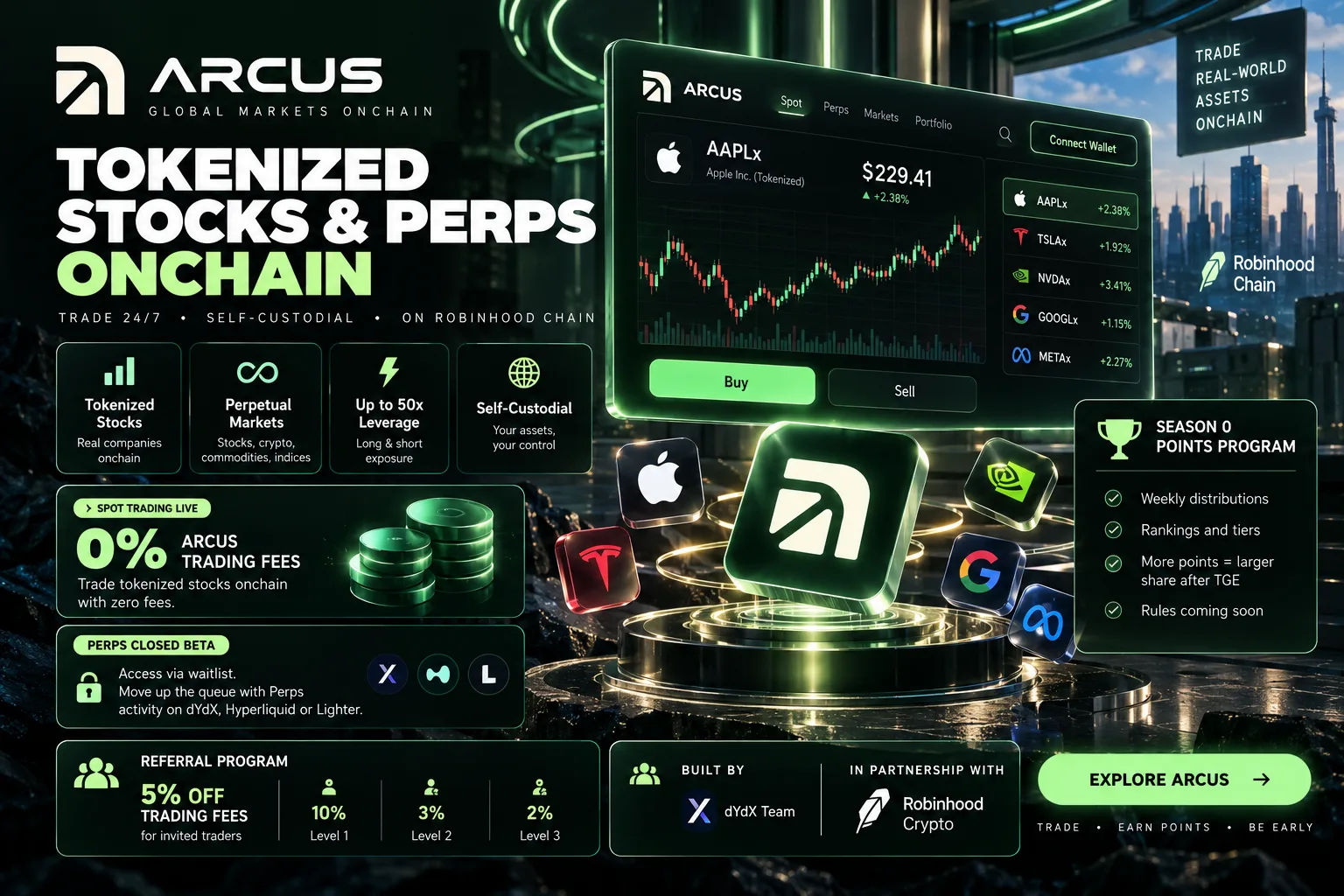
 Arcus Exchange
 JoinCare
 Breath of Estova
Bear case
Shorter signing windows create more expired transactions, regional vote latency pressures smaller validators, or skip rates rise during stress. If ETF outflows continue while measurable application benefits remain limited, the market may treat 200ms slots as an engineering achievement with little near-term token impact.
Conclusion: Four signals decide whether speed becomes demand
Solana has delivered a significant mainnet upgrade without the disruption that once defined its performance debate. But SOL investors now face a harder question than whether the chain can run faster. They need evidence that lower latency creates activity and value that reach the native token. The thesis will be confirmed or invalidated by:
- Mainnet slot-time and skip-rate averages across multiple completed 200ms epochs.
- Transaction expiration, retry and landing rates after the blockhash window fell to roughly 30 seconds.
- DEX spreads, stale-price arbitrage and fee generation compared with the 250ms period.
- A sustained reversal in U.S. Solana ETF flows alongside stronger staking and network demand.



 Gaming Platforms
 Crypto Casinos
 Blockchain Bridges
 Staking & Restaking
 DEX Token Swapping
 Crypto Wallets