
 BTC
 ETH
 USDT
 BNB
 XRP
 USDC
 SOL
 TRX
 FIGR_HELOC
 ZEC
 HYPE
 DOGE
 XMR
 USDS
 WBT
 LINK
 LEO
 ADA
 NEAR
 XLM
 RAIN
 BCH
 USDE
 LTC
 UNI
 DAI
 AVAX
 CC
 SUI
 USD1
 GRAM
 HBAR
 XAUT
 USDG
 TAO
 SHIB
 CRO
 PYUSD
 QNT
 BTW
 ENA
 OKB
 RLUSD
 USYC
 USDY
 AAVE
 BUIDL
 ONDO
 WLD
 PUMP
 DOT
 ASTER
 USDF
 PAXG
 MNT
 M
 USDD
 PEPE
 MORPHO
 EURSAFO
 WLFI
 SKY
 ICP
 U
 HTX
 ARB
 BGB
 BFUSD
 USDGO
 ETC
 VVV
 JST
 GT
 KCS
 ALGO
 POL
 JUP
 KAS
 BCAP
 ATOM
 RENDER
 PI
 INJ
 FIL
 OUSD
 AERO
 NEXO
 LIT
 USTB
 ZRO
 GHO
 AKE
 CAKE
 PRL
 APT
 STX
 NIGHT
 ETHFI
 XDC
 DASH
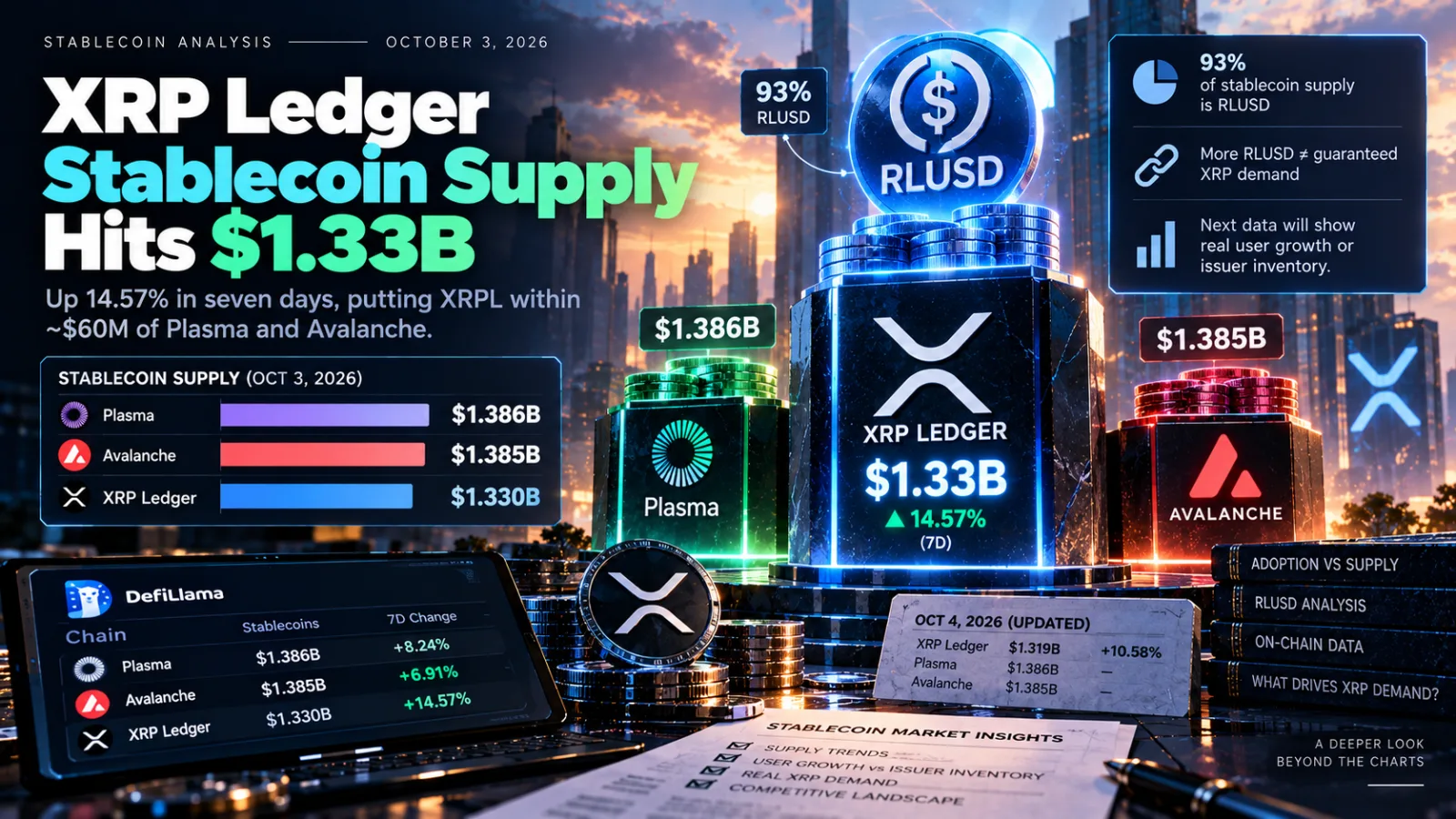

XRP Ledger stablecoin supply touched roughly $1.33 billion on October 3 after a 14.57% seven-day jump, putting the network within about $60 million of Plasma and Avalanche. The headline looks like a clean XRP adoption win. It is not that simple. Roughly 93% of the ledger's stablecoin value is RLUSD, and the mechanism connecting more RLUSD to sustained XRP demand is far weaker than the supply chart suggests. The next data will show whether users arrived with the dollars or an issuer simply positioned more inventory.
The rolling numbers had already shifted by October 4. DefiLlama showed XRPL with approximately $1.319 billion in stablecoins, up 10.58% over seven days, compared with $1.386 billion on Plasma and $1.385 billion on Avalanche. That change does not erase the expansion. It underlines the problem with treating a fast-moving supply snapshot as a finished adoption story.
For additional context, explore AirdropHotList's crypto market analysis.
The $1.33 billion headline is really an RLUSD story
DefiLlama's XRPL dashboard placed RLUSD supply on the ledger at about $1.227 billion on October 4, representing 93.07% of the network's stablecoin capitalization. RLUSD had gained 11.48% over seven days and 19.17% over 30 days. The rest of XRPL's stablecoin market remained below $100 million combined.
That long tail was led by roughly $72.77 million of Valtorum USD and $11.24 million of EUR CoinVertible. USDC, despite Circle launching it natively on XRPL in June 2025 with direct Circle Mint support, accounted for only about $4.61 million. The contrast matters: XRPL is not yet attracting broad dollar liquidity across several major issuers. It is attracting one dominant Ripple-issued asset.
RLUSD's underlying growth is nevertheless substantial. Ripple's official transparency page reported $2.5098 billion in total circulating RLUSD and $2.6338 billion in reserve funds as of October 1. The XRPL allocation therefore represented close to half of the stablecoin's total supply, making the ledger a core RLUSD venue rather than a marginal deployment.
The distribution backdrop has also strengthened. Ripple introduced Ripple Mint in July as an institutional interface for issuing, redeeming and managing RLUSD. Its June launch in Japan through SBI VC Trade followed regulatory approval and brought the token to institutional and retail users there. Ripple valued RLUSD at $1.7 billion when it announced the Japanese launch; by October 1, total supply was roughly 48% higher. That timeline supports a widening distribution thesis, although it does not prove Japan caused the latest weekly minting.
If you want reward-focused opportunities that involve tasks or activity, compare more earn crypto airdrops before choosing where to spend your time.
Stablecoin supply is not the same as usable liquidity
A larger stablecoin base can improve a blockchain's capacity for payments, market making, collateral and tokenized-asset settlement. It gives exchanges and applications more dollar inventory to work with. Yet supply alone does not reveal how much of that inventory is changing hands, entering liquidity pools or reaching independent users.
RLUSD can be minted onto XRPL ahead of anticipated customer demand, held by a treasury or exchange, and later redeemed or reallocated. A supply increase is therefore necessary evidence of expansion, but not sufficient evidence of deeper network effects. Transfer volume, unique holders, payment activity, decentralized exchange depth and active trust lines must move in the same direction.
XRPL's improving chain ranking should be read with the same restraint. Passing Plasma or Avalanche would create a visible milestone, but XRPL still represents only about 0.43% of the roughly $306 billion stablecoin market tracked by DefiLlama. Its latest leap is material for XRPL and RLUSD, not yet for the global stablecoin hierarchy.
The ledger's native architecture remains an advantage. RLUSD uses XRPL's issued-token functionality, with holders establishing trust lines rather than interacting with a separately deployed smart contract. The network also provides a built-in exchange and automated market makers. What remains unproven is whether applications and traders will convert that infrastructure into persistent liquidity rather than episodic issuance.
If this opportunity involves trading, deposits, or exchange activity, review our crypto trading guide for beginners to understand fees, risk control, and safer decision-making.
The XRP link is real but smaller than the headline
Stablecoin activity on XRPL does create some structural XRP use. Every ledger transaction must pay a fee denominated in XRP, while accounts and most owned ledger objects carry XRP reserve requirements. Official documentation currently lists a minimum standard transaction cost of 10 drops, equal to 0.00001 XRP, and a base account reserve of 1 XRP.
But the scale is crucial. At the minimum fee, one million standard transactions destroy just 10 XRP. Adding $126 million of stablecoin supply in a week does not mean investors bought $126 million of XRP, nor does RLUSD need an equivalent quantity of XRP to be minted, held or redeemed.
This creates the investor paradox at the center of the story: RLUSD can become a much bigger business while direct XRP scarcity grows only slowly. The stablecoin strengthens the ledger's utility, but XRP captures that expansion most clearly when it generates more funded accounts, XRP-paired trading, routing demand, collateral use or sustained transaction activity. The supply chart by itself cannot establish any of those outcomes.
Not every reward campaign deserves your time. Before you commit, compare this opportunity with our active airdrops list and focus on campaigns with clearer upside, better trust signals, and realistic participation steps.
Concentration leaves XRPL exposed to one issuer decision
RLUSD's dominance also creates allocation risk. Ripple supports RLUSD across seven networks, including XRPL, Ethereum, Base, Optimism, Ink, Unichain and the XRPL EVM Sidechain. Institutions can choose where they want their dollar liquidity, and Ripple can respond to demand by issuing or redeeming supply on different chains.
Nearly half of RLUSD currently sitting on XRPL is encouraging, but it is not a permanent moat. A shift toward Ethereum's deeper DeFi markets or another supported network could reverse part of XRPL's gain without changing RLUSD's total market capitalization. Conversely, XRPL could continue gaining share even if the broader stablecoin stopped expanding.
The small USDC position sharpens the counter-case. XRPL already has access to another globally recognized stablecoin with native institutional minting, yet liquidity has remained modest. A durable stablecoin ecosystem should eventually become less dependent on RLUSD rather than merely making RLUSD larger.
 Arcus Exchange
 JoinCare
 Breath of Estova
The four signals that decide whether this surge lasts
- Supply persistence: XRPL stablecoins must hold above roughly $1.2 billion after the rolling weekly comparison normalizes, rather than surrendering the increase through large RLUSD redemptions.
- Broader issuer growth: Non-RLUSD stablecoin supply needs to rise from below $100 million, reducing the network's 93% concentration.
- Visible usage: Payment volume, active holders, trust lines and DEX liquidity should increase alongside circulating supply.
- XRP value capture: XRP-paired volume, funded accounts, routing activity and transaction fees must confirm that stablecoin expansion is producing demand beyond issuer inventory.
Conclusion
XRPL's approach toward $1.33 billion in stablecoins is a genuine network milestone, and RLUSD's scale gives the ledger a credible source of institutional dollar liquidity. The move also places XRPL within striking distance of two higher-ranked stablecoin networks.
The catch is that almost the entire story rests on RLUSD, while the automatic link to XRP remains limited to low transaction fees, reserves and whatever secondary activity users create. The bullish thesis is not simply that more digital dollars exist on XRP Ledger. It is that those dollars stay, diversify and begin moving often enough to turn supply into a network effect.




 Gaming Platforms
 Crypto Casinos
 Blockchain Bridges
 Staking & Restaking
 DEX Token Swapping
 Crypto Wallets