
 BTC
BTC
 ETH
ETH
 USDT
USDT
 BNB
BNB
 XRP
XRP
 USDC
USDC
 SOL
SOL
 TRX
TRX
 ZEC
ZEC
 FIGR_HELOC
 HYPE
HYPE
 DOGE
DOGE
 LINK
LINK
 XMR
XMR
 WBT
WBT
 USDS
USDS
 ADA
ADA
 RAIN
RAIN
 LEO
LEO
 XLM
XLM
 NEAR
NEAR
 BCH
BCH
 UNI
UNI
 LTC
LTC
 CC
CC
 SUI
SUI
 USDE
USDE
 AVAX
AVAX
 DAI
DAI
 GRAM
GRAM
 USD1
USD1
 HBAR
HBAR
 TAO
TAO
 SHIB
SHIB
 CRO
CRO
 QNT
QNT
 BTW
BTW
 USDG
USDG
 ENA
ENA
 PYUSD
PYUSD
 M
M
 ONDO
ONDO
 XAUT
XAUT
 OKB
OKB
 RLUSD
RLUSD
 USYC
USYC
 AAVE
AAVE
 PUMP
PUMP
 BUIDL
BUIDL
 USDY
USDY
 MNT
MNT
 DOT
DOT
 WLD
WLD
 ASTER
ASTER
 MORPHO
 SKY
SKY
 PAXG
PAXG
 WLFI
WLFI
 PEPE
PEPE
 ICP
ICP
 USDD
USDD
 ARB
ARB
 HTX
HTX
 ETC
ETC
 EURSAFO
 U
U
 VVV
VVV
 BGB
BGB
 USDGO
USDGO
 USDF
USDF
 KAS
KAS
 BFUSD
BFUSD
 POL
POL
 GT
GT
 JUP
JUP
 LIT
LIT
 ALGO
ALGO
 RENDER
 CAKE
CAKE
 JST
JST
 PI
PI
 KCS
KCS
 ATOM
ATOM
 BCAP
BCAP
 FIL
FIL
 NEXO
NEXO
 DASH
DASH
 AERO
AERO
 VET
VET
 INJ
INJ
 USTB
USTB
 EUTBL
EUTBL
 APT
APT
 STABLE
 AKE
AKE
 GHO
GHO
 ETHFI
ETHFI
 PYTH
PYTH
 XDC
XDC
 PENGU
PENGU
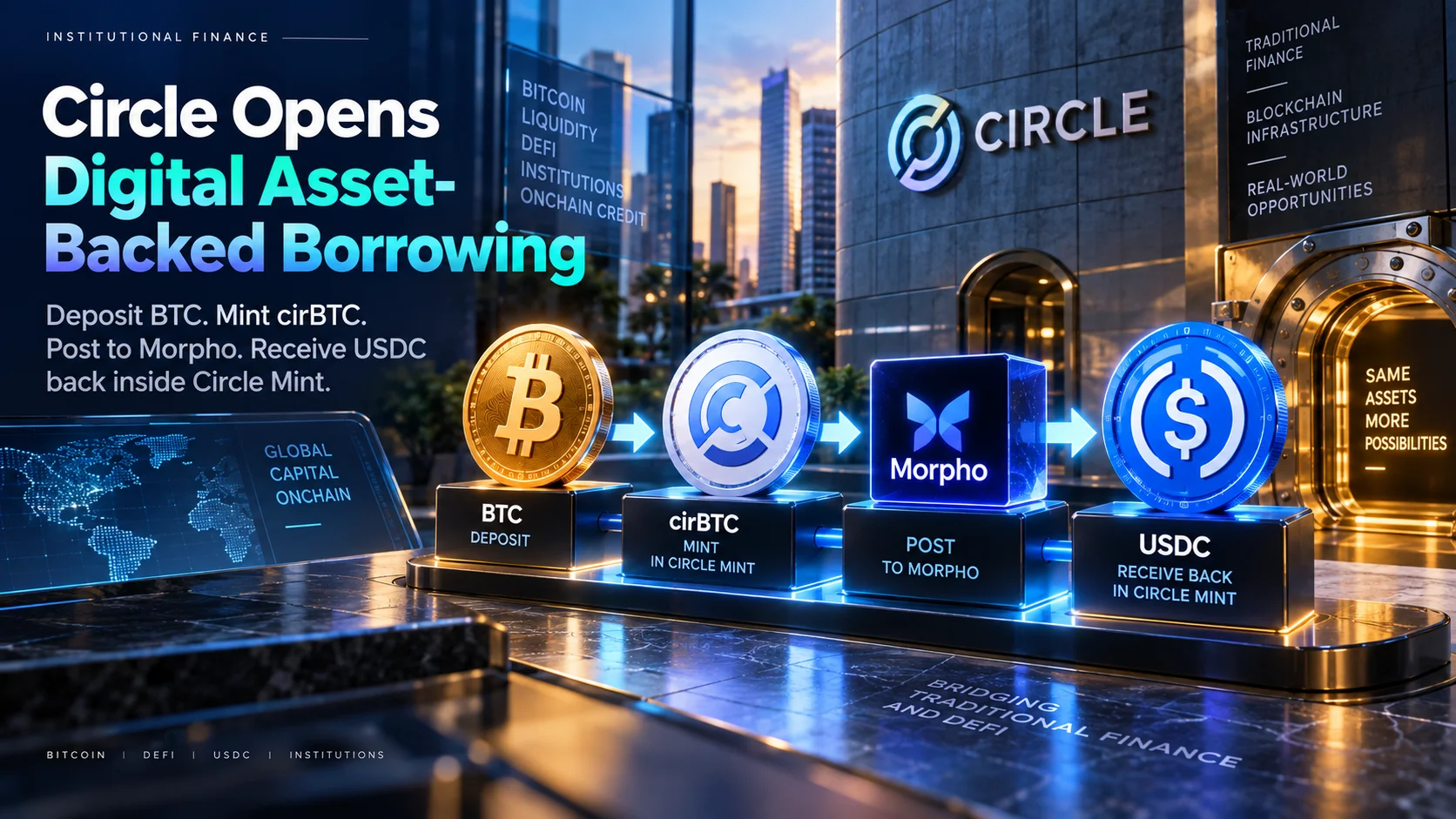

Circle has opened Digital Asset-Backed Borrowing to eligible Circle Mint clients, letting institutions deposit BTC, mint cirBTC, post it to Morpho and receive borrowed USDC back inside Mint on Arc or Ethereum. The important detail is what Circle did not launch: a balance-sheet lending desk. Credit terms, liquidity and liquidations live in third-party DeFi markets, while Circle supplies the wrapper, wallet and interface. That distinction could accelerate institutional borrowing, but it makes cirBTC adoption, Morpho liquidity and protocol risk the real tests.
For practical risk controls, review AirdropHotList's crypto safety guide.
Circle Mint is becoming a DeFi distribution layer
The product compresses a fragmented onchain transaction into one coordinated workflow. A client deposits native Bitcoin, mints Circle Wrapped Bitcoin, transfers the cirBTC into a user-controlled smart wallet, posts it as collateral and borrows USDC from a supported market. The borrowed stablecoins then move automatically into the client's Circle Mint balance.
That is materially different from Circle underwriting a loan, setting its interest rate or funding it with corporate capital. Circle says the positions are open-ended and overcollateralized, with borrowing costs, collateral requirements, liquidity and liquidation thresholds determined by the selected third-party market.
The separation is explicit in Circle's Digital Asset-Backed Borrowing terms. Once assets leave Circle Mint for the smart wallet, they are no longer held within the Mint account. Lending, collateralization and liquidation occur through external protocols and smart contracts that Circle does not own or control. Circle Technology Services provides the software interface rather than the underlying credit.
This structure gives Circle a potentially valuable position without recreating the centralized crypto-lending model. Mint can become the institutional entry and settlement layer, cirBTC provides the collateral, and USDC provides the loan asset. DeFi protocols supply the balance sheet and risk engine.
cirBTC is the strategic hinge in the transaction
Native Bitcoin cannot be deposited directly into an Ethereum or Arc lending contract, so the transaction depends on cirBTC. Circle says each token is redeemable for native BTC and backed 1:1 by Bitcoin held in segregated accounts through a Circle affiliate, with Circle National Trust acting as qualified custodian.
Its reserve design combines disclosed Bitcoin addresses, circulating-token data and Chainlink Proof of Reserve. That gives protocols and risk desks a way to compare the wrapped supply with the underlying BTC rather than relying only on periodic issuer statements.
If the borrowing product gains traction, its most important consequence may be demand for cirBTC rather than immediate demand for spot Bitcoin. Every position requires institutions to convert BTC into the wrapped asset before reaching USDC liquidity. Growing loan volumes could therefore deepen cirBTC's supply, trading liquidity and acceptance as collateral across other venues.
The trade-off is an additional dependency stack. A borrower retains Bitcoin price exposure but now also depends on Circle's custody and redemption process, the cirBTC contract, the selected blockchain, the market oracle and the lending protocol. Avoiding a BTC sale does not eliminate risk; it transforms spot exposure into a leveraged collateral position.
Still unsure about wallets, eligibility, or reward rules? Visit our FAQ page for quick answers before joining any new crypto campaign.
Morpho gains the first shot at Circle's institutional pipeline
Morpho is the first approved protocol in the product, while Circle says support for additional platforms, including Aave, will follow as the offering develops. That first-mover position matters because Circle is placing Morpho behind an interface already used by institutions to mint and redeem USDC.
The rollout also connects with Circle's wider Arc strategy. Arc launched its public mainnet on September 16, 2026, five days before the borrowing announcement. Morpho was live on the network from day one, describing itself as Arc's credit infrastructure. Circle can now combine its blockchain, stablecoin, wrapped Bitcoin and institutional account platform within one borrowing path.
Ethereum remains the alternative for clients that prioritize established DeFi liquidity. Arc offers tighter integration with Circle's stack, but it must still prove that its cirBTC-USDC markets can attract enough lenders to offer competitive rates through different utilization conditions.
For the Morpho ecosystem, the integration is a distribution win, not proof of adoption by itself. The bullish signal would be sustained USDC deposits and cirBTC-backed debt rather than the presence of a Mint button. Protocol usage also should not automatically be treated as value accrual to the MORPHO token without evidence from its economics and governance.
A cleaner workflow does not change liquidation math
The investor paradox is simple: Circle is making DeFi look more institutional without making DeFi less DeFi.
Under Morpho's variable-rate market design, each market pairs one collateral asset with one loan asset and uses defined parameters for its oracle, interest-rate model and liquidation loan-to-value threshold. If debt rises above the permitted threshold because Bitcoin falls or interest accrues, the position becomes eligible for liquidation.
Circle's legal terms assign those risks to the client. They identify potential smart-contract exploits, faulty or delayed oracle data, liquidity shortages, utilization-driven rate changes, wrapped-asset failures and bad debt. Morpho's own risk documentation similarly warns that oracle problems can cause liquidations or losses and that collateral can fall faster than liquidators can close a position.
Analysis: at meaningful scale, this product could strengthen the link between Bitcoin volatility and USDC credit markets. A sharp BTC decline would increase loan-to-value ratios across cirBTC positions, potentially triggering liquidations. That mechanism is normal for overcollateralized DeFi, but an institutional interface may allow larger positions to enter it more easily.
Circle did not publish an initial loan volume or fixed borrowing rate. Until live liquidity, utilization and collateral parameters are visible, the launch should be read as new infrastructure rather than evidence of immediate institutional demand.
Not every reward campaign deserves your time. Before you commit, compare this opportunity with our active airdrops list and focus on campaigns with clearer upside, better trust signals, and realistic participation steps.
Three paths for institutional Bitcoin borrowing
Bull case
Institutions adopt cirBTC as a treasury collateral standard, USDC lenders supply deep liquidity on Ethereum and Arc, and Circle adds more protocols without fragmenting the market. Mint then becomes a major distribution channel for onchain credit, while cirBTC establishes itself as a widely accepted wrapped-Bitcoin asset.
If you prefer curated opportunities instead of browsing everything manually, check our featured airdrops and compare higher-signal campaigns first.
Base case
The product serves a narrower group of crypto-native funds, market makers and corporate treasuries. Ethereum handles most volume because its lending liquidity is already established, while Arc develops gradually. The product is useful but does not materially change the wider Bitcoin credit market in the near term.
Bear case
Borrowing rates remain unattractive, Arc liquidity stays shallow or institutional risk committees reject the combined wrapper, oracle and smart-contract exposure. A liquidation incident or reserve-verification problem would also weaken the core claim that the integrated workflow is suitable for treasury-scale use.
 Kryvora Network
 Note Systems
 Nado
Nado
The four signals that matter next
- cirBTC issuance: sustained supply growth matched by independently observable BTC reserves would indicate real collateral demand.
- USDC market depth: rising available liquidity without unstable borrowing rates would show lenders are supporting the product.
- Borrowed volume and liquidations: expanding debt with manageable health factors would validate institutional use; rapid liquidations would challenge it.
- Protocol expansion: adding Aave or other approved markets would reduce dependence on Morpho and test whether cirBTC can become neutral collateral across DeFi.
Conclusion
Circle's launch is more consequential than a conventional Bitcoin loan product because it places institutional distribution directly in front of permissionless credit infrastructure. Circle controls the interface, wrapped collateral and stablecoin settlement path, but not the lending market itself.
That architecture can scale without Circle building a loan book, yet it leaves borrowers exposed to the same liquidation, oracle and smart-contract risks that define DeFi. The thesis will be confirmed not by the announcement, but by cirBTC supply, durable USDC liquidity and institutions choosing to keep borrowing after market volatility tests the system.





 Gaming Platforms
 Crypto Casinos
 Blockchain Bridges
 Staking & Restaking
 DEX Token Swapping
 Crypto Wallets