
 BTC
BTC
 ETH
ETH
 USDT
USDT
 BNB
BNB
 XRP
XRP
 USDC
USDC
 SOL
SOL
 TRX
TRX
 ZEC
ZEC
 FIGR_HELOC
 HYPE
HYPE
 DOGE
DOGE
 LINK
LINK
 XMR
XMR
 WBT
WBT
 USDS
USDS
 ADA
ADA
 RAIN
RAIN
 LEO
LEO
 XLM
XLM
 NEAR
NEAR
 BCH
BCH
 UNI
UNI
 LTC
LTC
 CC
CC
 SUI
SUI
 USDE
USDE
 AVAX
AVAX
 DAI
DAI
 GRAM
GRAM
 USD1
USD1
 HBAR
HBAR
 TAO
TAO
 SHIB
SHIB
 QNT
QNT
 CRO
CRO
 BTW
BTW
 USDG
USDG
 ENA
ENA
 PYUSD
PYUSD
 M
M
 ONDO
ONDO
 XAUT
XAUT
 OKB
OKB
 RLUSD
RLUSD
 USYC
USYC
 AAVE
AAVE
 PUMP
PUMP
 BUIDL
BUIDL
 USDY
USDY
 MNT
MNT
 DOT
DOT
 WLD
WLD
 ASTER
ASTER
 MORPHO
 SKY
SKY
 PAXG
PAXG
 WLFI
WLFI
 PEPE
PEPE
 ICP
ICP
 USDD
USDD
 ARB
ARB
 HTX
HTX
 ETC
ETC
 EURSAFO
 U
U
 VVV
VVV
 BGB
BGB
 USDGO
USDGO
 USDF
USDF
 KAS
KAS
 BFUSD
BFUSD
 POL
POL
 JUP
JUP
 GT
GT
 LIT
LIT
 ALGO
ALGO
 RENDER
 CAKE
CAKE
 JST
JST
 PI
PI
 KCS
KCS
 ATOM
ATOM
 BCAP
BCAP
 FIL
FIL
 NEXO
NEXO
 DASH
DASH
 AERO
AERO
 VET
VET
 INJ
INJ
 USTB
USTB
 EUTBL
EUTBL
 APT
APT
 STABLE
 AKE
AKE
 GHO
GHO
 ETHFI
ETHFI
 PYTH
PYTH
 XDC
XDC
 PENGU
PENGU
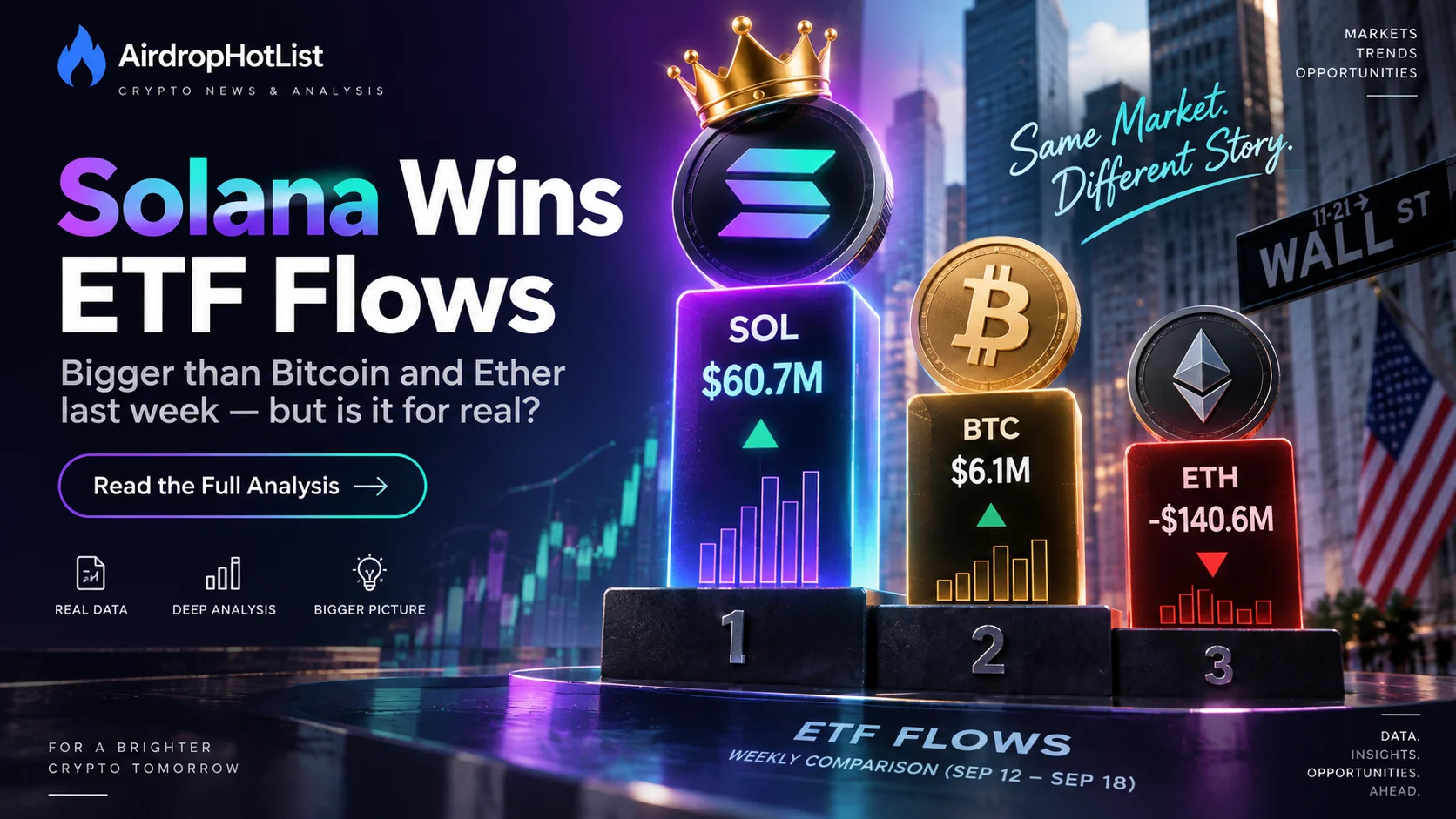

Solana won last week's ETF flow comparison against Bitcoin and Ether, but the victory is narrower than the headline suggests. U.S. products tied to SOL absorbed $60.7 million in the five sessions through September 18, while Bitcoin funds gained just $6.1 million and Ether funds lost $140.6 million. Yet $58.7 million of Solana's total came from Bitwise's BSOL. Is this durable allocation to SOL, or a concentrated bid for one staking-enabled wrapper?
The distinction matters after SOL outperformed both larger assets but surrendered some momentum on Sunday. At research time on September 20, SOL traded near $108 and remained 7.3% higher over seven days. Bitcoin was near $80,220, up 4.2% for the week, while Ether changed hands around $2,575, up 2.2%. All three were lower over 24 hours, leaving the ETF data as an important test rather than confirmation of a clean breakout.
For additional context, explore AirdropHotList's crypto market analysis.
The flow scoreboard favors Solana, not broad crypto risk
Solana's $60.7 million weekly intake came from reported daily totals of $11 million, $1.3 million, $800,000, zero and $47.6 million. That sequence was steadier than the flows into Bitcoin and Ether, whose funds endured sharp midweek redemptions before Friday buying repaired part of the damage.
Bitcoin's final result was especially deceptive. The category attracted $433 million on September 18, including $310.7 million for Fidelity's FBTC and $108.4 million for BlackRock's IBIT. That single session rescued the complex from a negative week, but the resulting $6.1 million five-day total was effectively flat. The Block described it as Bitcoin ETFs' smallest weekly inflow since launch.
Ether produced the opposite divergence. ETH rose over the seven-day period even though its funds shed $140.6 million, ending a four-week inflow run. Friday's $143.7 million intake was not enough to offset $405.4 million of combined withdrawals from Tuesday through Thursday. Price strength without matching fund demand can persist, but it leaves the move more dependent on native spot buyers, derivatives positioning and crypto liquidity outside U.S. wrappers.
If this opportunity involves trading, deposits, or exchange activity, review our crypto trading guide for beginners to understand fees, risk control, and safer decision-making.
BSOL is the trade inside the Solana ETF story
The most important Solana number is not the category total. It is BSOL's share of it. Bitwise's product supplied $58.7 million, or about 97%, of the $60.7 million reported for the week. Its cumulative net inflows reached roughly $1.09 billion, representing about 77% of the $1.41 billion category total shown by Farside.
A plausible product-level explanation is staking. The official Bitwise fund page showed that BSOL held approximately 10.09 million SOL worth $1.145 billion as of September 17. Bitwise reported 100% of fund assets staked and a 5.31% net staking reward rate as of September 18, although the issuer stresses that rewards can change and are not guaranteed.
That design gives BSOL a feature that Bitcoin products cannot offer and that many Ether wrappers do not consistently provide: explicit exposure to a network reward stream alongside the underlying asset. The investor paradox is that Solana's apparent institutional victory may say as much about product engineering as it does about conviction in SOL.
There is also an important legal nuance. Despite common ETF shorthand, Bitwise identifies BSOL as an exchange-traded product that is not registered under the Investment Company Act of 1940. It is not equivalent to owning SOL directly, and the issuer warns of volatility, liquidity, custody, blockchain and regulatory risks.
Concentrated demand can move SOL-and disappear quickly
Net creations demonstrate that capital entered Solana wrappers, but they do not prove that a broad institutional rotation is underway. One fund supplied nearly the entire weekly total, while the other products collectively contributed only about $2 million. If BSOL's inflows slow, the category currently has little demonstrated breadth to replace them.
That concentration does not make the demand irrelevant. BSOL's holdings place more than 10 million SOL inside a single trust, with the assets currently staked. Continued creations could expand that inventory and strengthen the marginal bid for SOL. The effect becomes more consequential if competing products also begin attracting capital, because that would show demand spreading beyond one issuer and one yield structure.
Bitcoin and Ether remain confirmation signals. SOL can outperform while BTC consolidates, but a sustained large-cap rotation becomes more credible if Bitcoin's ETF flows move decisively above last week's near-zero result and Ether funds reverse their first weekly outflow since mid-August. Without that confirmation, Solana's strength may remain an isolated relative-value trade rather than a market-wide risk-on signal.
If you prefer curated opportunities instead of browsing everything manually, check our featured airdrops and compare higher-signal campaigns first.
Three scenarios for the week ahead
Bull case: demand broadens beyond BSOL
SOL breaks above its recent seven-day high near $114.14 while the next ETF readings remain positive and other issuers begin contributing meaningful inflows. Bitcoin reclaiming its weekly high near $81,864 and Ether moving through roughly $2,656 would provide cross-market confirmation. In that scenario, the ETF divergence starts to resemble genuine capital rotation rather than a one-product event.
DeFi campaigns can involve protocol usage, liquidity, staking, or wallet activity. Before spending gas or locking funds, compare more DeFi airdrops and review the effort-to-reward balance.
Base case: SOL consolidates while BSOL keeps carrying the category
SOL remains between approximately $100 and $114, Bitcoin stays below the low-$82,000 area and Ether continues to struggle around $2,600. Solana ETF flows remain positive but concentrated in BSOL. This would preserve SOL's relative-strength thesis without confirming a broader breakout.
Bear case: the wrapper bid fails to support spot
SOL falls through last week's $96.07 low as the category records a net outflow or BSOL redemptions emerge. A simultaneous move below Bitcoin's seven-day low near $75,038 or Ether's low near $2,361 would indicate that the Solana flow story could not resist broader crypto deleveraging.
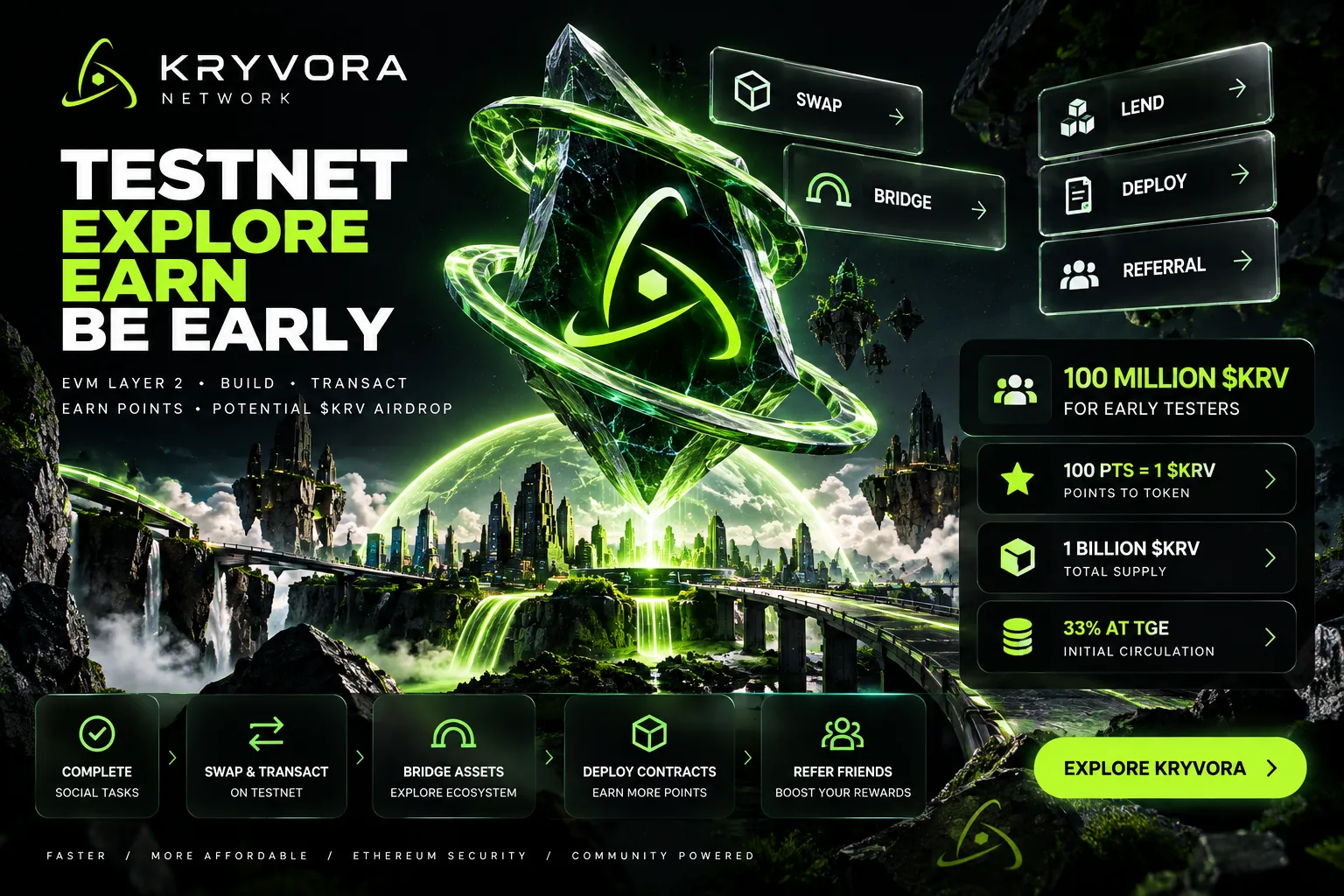
 Kryvora Network
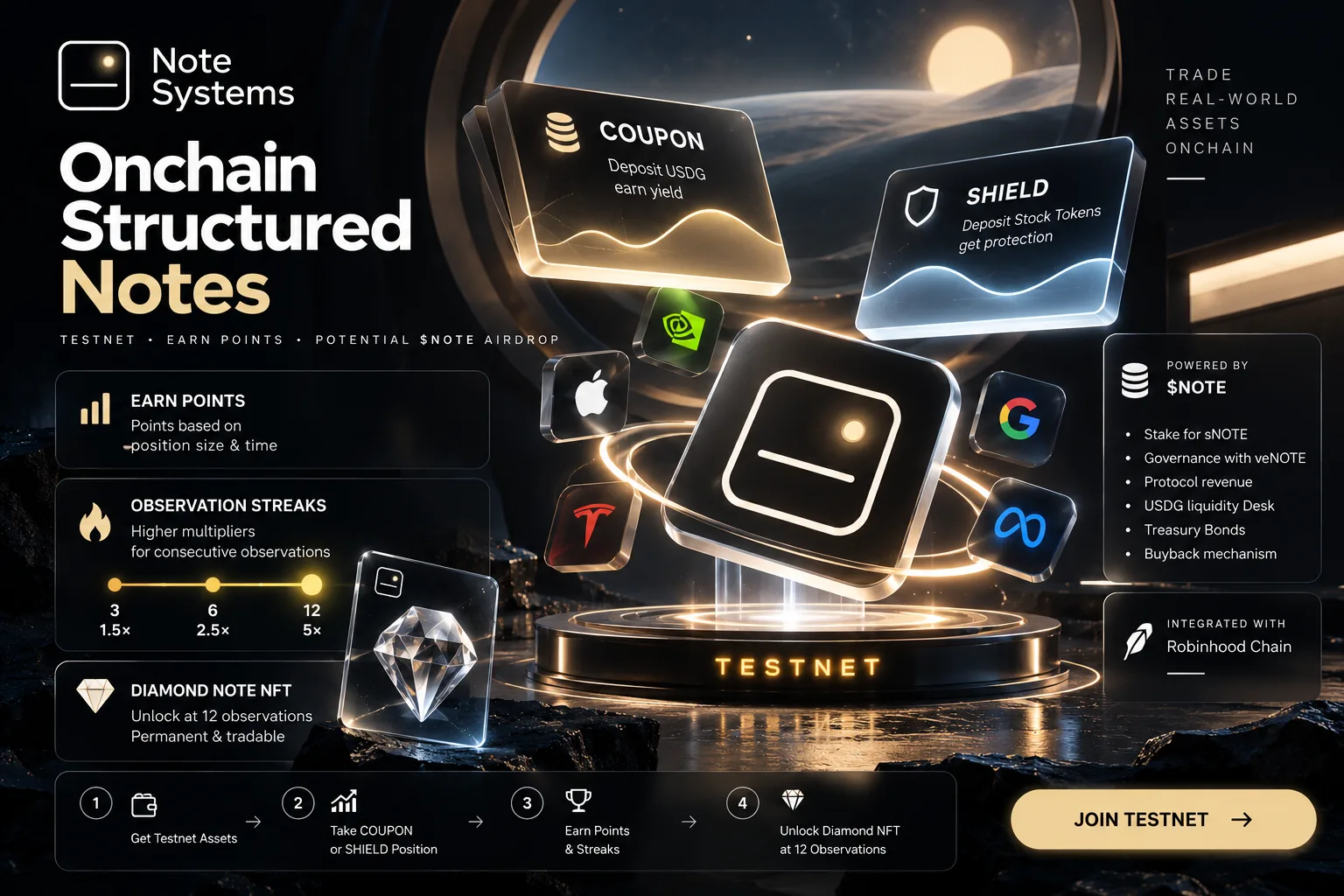
 Note Systems
 Nado
Nado
Watchlist: four signals that will settle the rotation debate
- The next five-session Solana ETF total, not a single strong daily print.
- Whether issuers other than Bitwise capture a meaningful share of new demand.
- SOL's ability to reclaim $114.14 after Sunday's pullback.
- Whether Bitcoin flows accelerate and Ether funds reverse their $140.6 million weekly outflow.
Conclusion
The defensible thesis is not that institutional investors have abandoned Bitcoin and Ether for Solana. It is that a staking-enabled Solana product captured the marginal ETF bid during a week when Bitcoin demand churned and Ether funds lost assets.
If inflows spread across issuers while SOL clears its recent range, the data will support a broader rotation. If BSOL remains the only engine, the stronger interpretation is more specific: investors are choosing a particular yield-bearing wrapper, not necessarily endorsing the entire Solana market. That difference will determine whether last week's divergence becomes a trend or an ETF footnote.




 Gaming Platforms
 Crypto Casinos
 Blockchain Bridges
 Staking & Restaking
 DEX Token Swapping
 Crypto Wallets