
 BTC
 ETH
 USDT
 BNB
 XRP
 USDC
 SOL
 TRX
 FIGR_HELOC
 ZEC
 HYPE
 DOGE
 XMR
 USDS
 WBT
 LINK
 LEO
 ADA
 NEAR
 XLM
 RAIN
 BCH
 USDE
 DAI
 UNI
 LTC
 CC
 AVAX
 USD1
 SUI
 GRAM
 HBAR
 XAUT
 USDG
 QNT
 PYUSD
 SHIB
 TAO
 ENA
 CRO
 RLUSD
 USYC
 USDY
 OKB
 M
 BUIDL
 AAVE
 ONDO
 PUMP
 USDF
 PEPE
 BTW
 EURSAFO
 PAXG
 ASTER
 USDD
 DOT
 WLFI
 MNT
 WLD
 U
 SKY
 ICP
 MORPHO
 HTX
 BFUSD
 BGB
 USDGO
 VVV
 ETC
 ARB
 JST
 KCS
 GT
 KAS
 POL
 ALGO
 JUP
 RENDER
 ATOM
 PI
 OUSD
 NEXO
 INJ
 LIT
 FIL
 USTB
 AKE
 GHO
 ZRO
 CAKE
 DASH
 NIGHT
 XDC
 PEARL
 ETHFI
 APT
 PYTH
 BDX
 STX
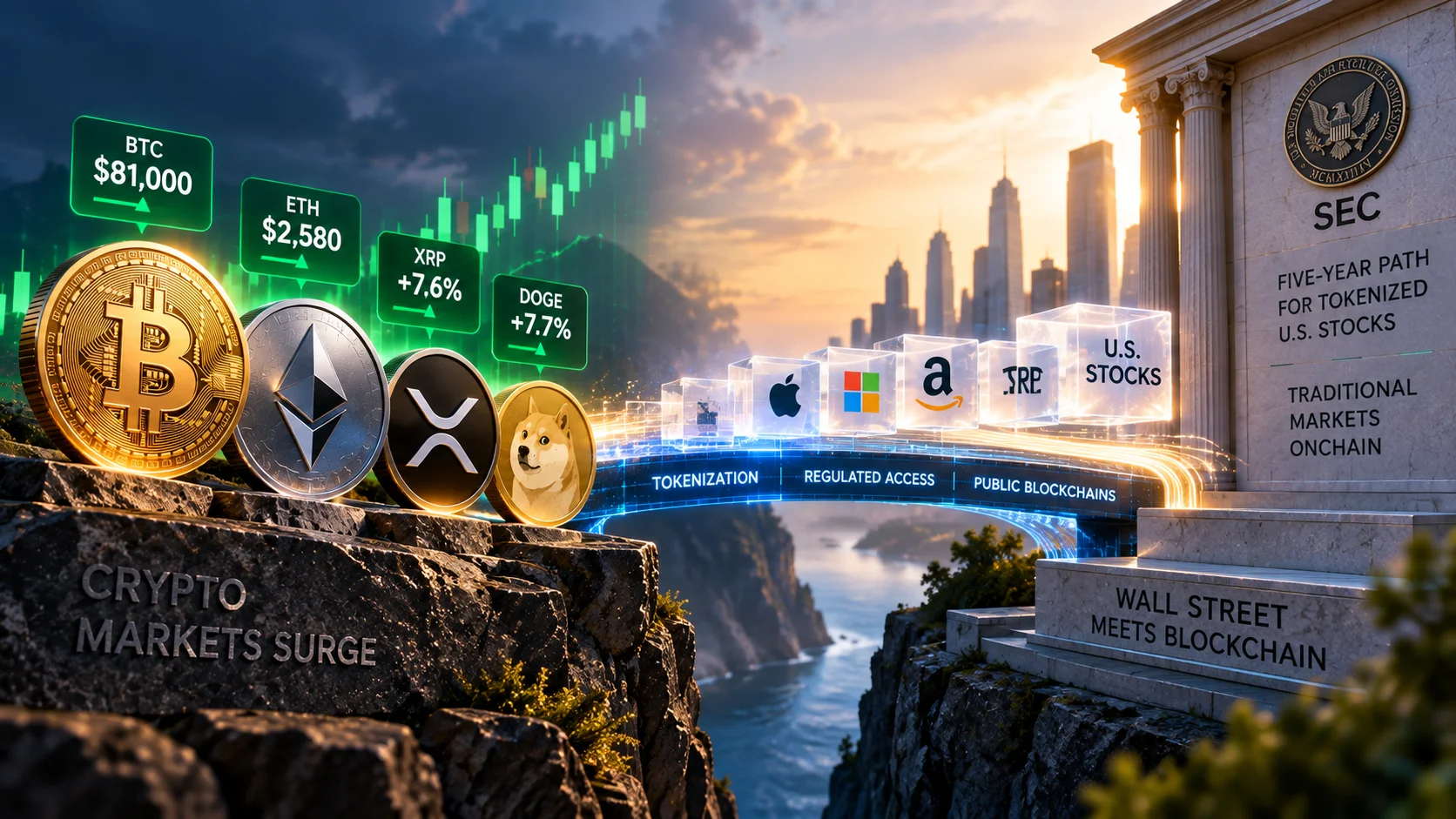

Bitcoin reached $81,000 on Friday, September 18, as Ether traded near $2,580 and XRP and Dogecoin gained 7.6% and 7.7%, respectively. Yet the most consequential catalyst was not a generic risk-on impulse. One day earlier, the SEC created a five-year route for tokenized U.S. stocks to trade through permissioned liquidity pools deployed on public blockchains. The question now is whether Friday's surge was merely a squeeze-or the first repricing of the infrastructure that could bring regulated equities onchain.
For additional context, explore AirdropHotList's crypto market analysis.
Bitcoin's breakout was stronger than the wider risk-on story
Bitcoin gained 5.8% over 24 hours to $80,829 after touching $81,000, according to The Defiant's September 18 market snapshot. Ether rose 5% to $2,580, while NEAR Protocol, Arbitrum and Uniswap advanced 32%, 26% and 20%. The S&P 500 was slightly lower at the time, weakening the claim that crypto was simply following equities higher.
Forced buying from liquidated short positions accelerated the move, but spot demand also showed an early improvement. U.S. spot Bitcoin ETFs recorded $159.5 million of net inflows on September 17 after losing a combined $746.3 million over the previous two sessions, according to Farside Investors' fund-level data. That reversal supports the breakout, although one positive session does not establish a durable institutional trend. September 18 ETF figures had not been populated at the research cutoff.
The distinction matters. A liquidation-driven rally can exhaust itself once bearish leverage is cleared. A sustained move requires new spot buyers, persistent ETF demand or a catalyst capable of changing expected crypto usage. The SEC's tokenized-stock exemption potentially offers the third-but only if companies actually build under it.
Not every reward campaign deserves your time. Before you commit, compare this opportunity with our active airdrops list and focus on campaigns with clearer upside, better trust signals, and realistic participation steps.
The SEC approved a controlled onchain experiment, not a free-for-all
On September 17, the SEC announced its Innovation Exemption, granting temporary and conditional relief from the legal definitions of an exchange and, for qualifying liquidity providers, a dealer. A new category called a Tokenized Securities Venue, or TSV, can facilitate secondary trading of tokenized National Market System stocks through permissioned automated market makers and liquidity pools.
The crypto-native detail is crucial: TSV smart contracts must be auditable, public and deployed on a public, permissionless distributed ledger. Participants, however, must be verified or credentialed. The structure therefore combines open blockchain infrastructure with controlled access-closer to permissioned DeFi than an unrestricted decentralized exchange.
The 60-page SEC order also sets strict boundaries. Tokenized shares must provide the same dividends, voting rights and liquidation claims as the equivalent traditional stock. Primary offerings are excluded, synthetic stock exposure does not qualify, and issuers can object to third-party tokenization of their shares.
Trading is capped at 75 Tier 1 symbols and 250 Tier 2 symbols per venue. Tier 1 activity cannot exceed 0.25% of the underlying stock's prior-month average daily volume, while Tier 2 is limited to 2.5%. Venues must coordinate trading halts with primary exchanges, publish dollar-denominated transaction and pool data, maintain records and avoid extending credit for tokenized-stock purchases.
This is an experimental lane, not blanket SEC approval of tokenized equities or the venues using it. Still, the order allows stock tokens to trade against other tokenized stocks, non-security crypto assets or tokenized money-market funds. That creates a direct regulatory opening for stablecoin settlement, blockchain liquidity pools and crypto-quoted equity markets-provided operators can satisfy the conditions.
Ethereum's rally carries a bigger burden of proof
Bitcoin is the market's preferred liquidity barometer, so it naturally captured the headline. Ethereum and other smart-contract networks face a more specific opportunity: supplying the execution, settlement and application layers required by TSVs. The order does not choose Ethereum, Solana, an Ethereum layer 2 or any other chain. It instead establishes a competition based on security, cost, liquidity, auditability and compliance tooling.
The market was already expanding before the SEC decision. Binance Research estimated that active tokenized-equity market capitalization rose from $965 million at the beginning of 2026 to approximately $4 billion by September 9. Monthly issuer trading volume increased from $237 million in January to $7.9 billion in August, while tokenized-equity value deployed in DeFi climbed from $21.6 million to $289.1 million.
Those figures explain why AMM and blockchain-infrastructure tokens outperformed during Friday's rally. They do not prove which network will capture regulated U.S. activity. Existing tokenized products may not satisfy the SEC's rights-parity, issuer-notification or market-control requirements, while qualifying TSVs could select chains for operational reasons that token traders have not priced correctly.
Here lies the investor paradox: the SEC catalyst is structurally more relevant to programmable chains than to Bitcoin, yet the clearest institutional cash signal favored BTC. Ether rose even though U.S. spot Ether ETFs posted $405.4 million of combined net outflows from September 15 through September 17, based on Farside's Ethereum ETF tracker. ETH therefore rallied on expected future utility while Bitcoin received measurable spot-fund demand.
Still unsure about wallets, eligibility, or reward rules? Visit our FAQ page for quick answers before joining any new crypto campaign.
Three paths for the tokenization trade
Bull case: regulated activity reaches public chains
TSV operators file notices quickly, select public networks and launch compliant stock-stablecoin pools. Rising transaction fees, liquidity depth and tokenized-equity collateral usage would then turn the regulatory headline into measurable blockchain demand.
If you want reward-focused opportunities that involve tasks or activity, compare more earn crypto airdrops before choosing where to spend your time.
Base case: useful pilots, limited token impact
Venues launch cautiously under the symbol and volume caps, proving the model without generating enough activity to transform network economics. Bitcoin retains its breakout if ETF demand continues, while the sharpest tokenization-token gains partially unwind.
 Arcus Exchange
 JoinCare
 Breath of Estova
Bear case: implementation exposes the friction
Rights verification, custody, issuer objections, wallet permissioning and market-halt coordination delay launches. Thin AMM liquidity or price dislocations reinforce the need for tighter rules. Without follow-through, Friday's move looks more like short covering than a durable tokenization repricing.
Conclusion: the four signals that decide whether this rally lasts
Bitcoin's return above $80,000 is meaningful, but the SEC exemption gives the rally a testable thesis. The next phase depends less on policy rhetoric and more on capital flows, venue launches and actual blockchain usage.
- Bitcoin support: whether $80,000 holds through weekend liquidity and subsequent spot trading rather than remaining a one-session print.
- ETF confirmation: finalized September 18 flows and whether Bitcoin funds extend the September 17 inflow reversal.
- TSV adoption: the first public venue notices, selected blockchains, eligible stocks and crypto or tokenized-fund trading pairs.
- Onchain capture: sustained growth in tokenized-equity volume, market depth and DeFi deployment-not simply higher prices for tokens associated with the narrative.




 Gaming Platforms
 Crypto Casinos
 Blockchain Bridges
 Staking & Restaking
 DEX Token Swapping
 Crypto Wallets