
 BTC
 ETH
 USDT
 BNB
 XRP
 USDC
 SOL
 TRX
 FIGR_HELOC
 ZEC
 HYPE
 DOGE
 XMR
 USDS
 WBT
 LINK
 LEO
 ADA
 XLM
 NEAR
 BCH
 RAIN
 USDE
 DAI
 UNI
 LTC
 AVAX
 CC
 USD1
 SUI
 GRAM
 HBAR
 XAUT
 USDG
 PYUSD
 QNT
 SHIB
 TAO
 ENA
 CRO
 RLUSD
 USYC
 USDY
 OKB
 M
 BUIDL
 AAVE
 ONDO
 PUMP
 USDF
 PEPE
 EURSAFO
 PAXG
 ASTER
 BTW
 USDD
 DOT
 MNT
 WLFI
 WLD
 U
 SKY
 MORPHO
 ICP
 HTX
 BFUSD
 BGB
 USDGO
 VVV
 ETC
 ARB
 JST
 KCS
 GT
 KAS
 POL
 ALGO
 Q
 JUP
 RENDER
 ATOM
 PI
 OUSD
 NEXO
 INJ
 FIL
 LIT
 USTB
 GHO
 AKE
 DASH
 CAKE
 XDC
 NIGHT
 PEARL
 ETHFI
 ZRO
 APT
 PYTH
 BDX
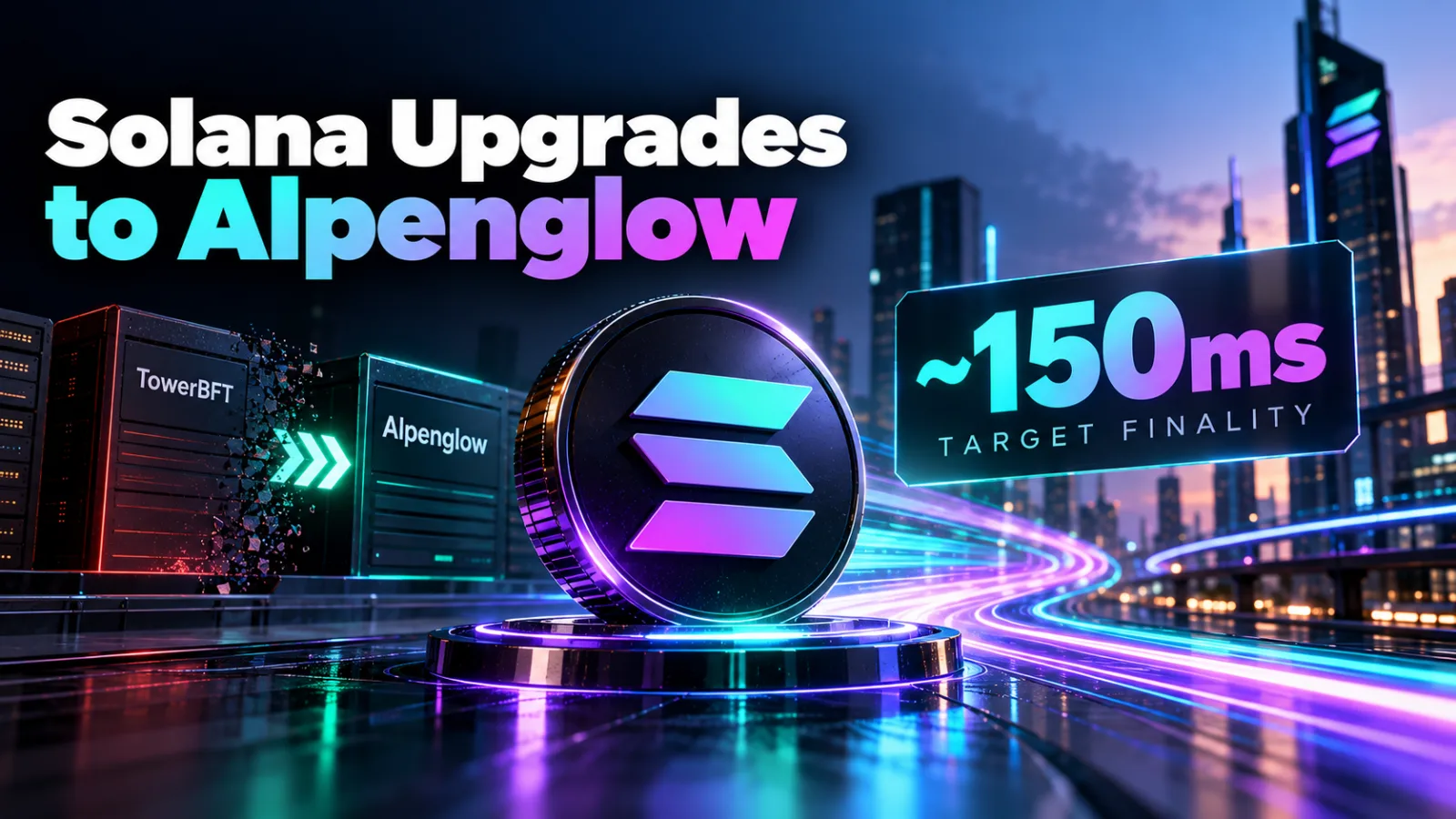

Solana has completed its biggest consensus change since launch, replacing TowerBFT with Alpenglow on October 21. The migration worked, blocks are reaching finality dramatically faster, and vote transactions have disappeared from the chain. Yet the figure investors will hear most often, roughly 150 milliseconds, is still a protocol target rather than the complete latency currently observed by users. The upgrade has cleared its first test. Now Solana must prove that subsecond finality changes trading, payments and application demand rather than merely improving a benchmark.
For additional context, explore AirdropHotList's crypto market analysis.
Alpenglow Replaced the Engine Without Stopping Solana
Alpenglow activated during epoch 1064, with the new consensus system taking control from slot 459,653,000. The Solana Foundation's official upgrade record says the transition began on October 21, 2026, and identifies slot 459,652,999 as the certified genesis block for the new system. Solana's live explorer now lists Alpenglow as the consensus protocol operating on mainnet.
That clean handoff matters because this was not an incremental parameter adjustment. Alpenglow replaced the network's original voting logic while Solana remained live. Under TowerBFT, validators submitted votes as onchain transactions and finality accumulated across multiple slots. Alpenglow's Votor system sends votes directly between validators, aggregates BLS signatures into certificates and can finalize a block after one or two voting rounds.
The fast path requires notarization votes representing 80% of stake. If that threshold is not reached, a two round path can finalize using separate 60% certificates. The technical design is documented in SIMD 0326, which also describes Alpenglow's distinctive fault model: it is designed to tolerate less than 20% adversarial stake alongside another 20% that may be offline.
Execution itself did not change. Solana programs, transactions, fees and the Solana Virtual Machine continue operating as before. For users, there was no token migration and no wallet action required. What changed was the time between a block appearing and the network treating it as irreversible.
If you want to understand how eligibility, snapshots, claiming, and reward distribution usually work, start with our crypto airdrop guide before joining new campaigns.
The First Mainnet Measurement Is Not 150 Milliseconds
The official target is approximately 150 milliseconds, down from a quoted TowerBFT finality time of 12.8 seconds. Those numbers describe the protocol's intended improvement, but they should not be mistaken for a clean before and after measurement from the same external observer.
An independent OpenChainBench mainnet study measured median finality at 404 milliseconds during the 24 hours ending October 23, with a 579 millisecond 90th percentile and a 765 millisecond 99th percentile across more than 357,000 slots. Its pre-upgrade measurement was approximately seven seconds, implying an observed improvement of about 17 times.
That is still a substantial result. The gap between 404 milliseconds and the 150 millisecond target is partly a measurement issue: an external RPC node must receive the block, replay it and then observe the root. A validator participating directly in vote exchange can see consensus earlier. The benchmark separated block arrival and replay from the voting phase and found that network delivery remained a material component of end-to-end latency.
This creates the central Alpenglow tension. Solana has already achieved subsecond finality from an outside observer's perspective, but Votor only solves the voting side. The network still uses Turbine to propagate block data. Rotor, the second major component originally envisioned for Alpenglow, is intended to replace that propagation layer but has no announced mainnet date.
If this opportunity involves trading, deposits, or exchange activity, review our crypto trading guide for beginners to understand fees, risk control, and safer decision-making.
Solana's TPS Optics May Get Worse as the Network Gets Better
The investor paradox is that Alpenglow can make Solana more efficient while making familiar activity charts look weaker. Before activation, validator votes represented roughly three quarters of the transactions processed by the network, according to Galaxy's account of operating an Alpenglow test validator. Those votes now move directly between validators rather than appearing as normal onchain transactions.
Raw TPS and total transaction counts from before and after October 21 therefore are not directly comparable. A falling headline transaction number does not automatically indicate fewer swaps, transfers, payments or application interactions. Analysts will need to prioritize successful non-vote transactions, fee generation, compute consumption and economically meaningful volume.
The validator cost structure also changed. Per-vote transaction fees were replaced by a Validator Admission Ticket charged each epoch. Galaxy estimated the ticket at about 0.8 SOL per epoch under the network's faster slot schedule, versus roughly 2 SOL per day in vote costs immediately before activation. The net benefit varies because block producers also lost the vote fees they previously collected, but removing vote traffic frees blockspace and reduces repetitive consensus overhead.
Before connecting a wallet or approving any transaction, slow down and verify the source. Our crypto safety guide explains how to avoid fake claim pages, phishing links, risky approvals, and common wallet mistakes.
Faster Finality Is Valuable Only If Applications Use It
Alpenglow does not automatically create more demand for SOL. Its investment significance depends on whether developers and financial applications convert faster certainty into products that were previously impractical or unnecessarily risky.
For Solana DeFi, shorter finality can narrow the period in which market makers, liquidators and trading systems are acting on transactions that are processed but not fully irreversible. It can also help exchanges and bridges reassess confirmation policies, although each platform controls its own risk rules. Payments may gain a clearer user experience when merchants can treat settlement as final in under a second instead of relying on an earlier confirmation level.
The upgrade also removes a longstanding distinction in Solana's user experience. TowerBFT offered fast optimistic confirmation but much slower full finality. Alpenglow brings those concepts closer together. That is important for institutional settlement, where the strongest commitment level matters more than an interface merely reporting success.
Still, application latency includes RPC performance, transaction routing, leader access, block propagation and frontend design. A protocol can finalize in milliseconds while a poorly connected application still feels slow. The next competitive phase will therefore move from consensus marketing to infrastructure execution.
 Arcus Exchange
 JoinCare
 Breath of Estova
The Signals That Will Confirm or Break the Thesis
- Sustained finality: Median, 90th percentile and 99th percentile finality should remain below one second through congestion, validator disruptions and software upgrades.
- Economic activity: Successful non-vote transactions, fees, stablecoin settlement and DeFi volume must grow without relying on the validator votes that previously inflated raw TPS.
- Application adoption: Wallets, exchanges, trading protocols and payment systems should begin changing confirmation logic or product design around faster finality.
- Rotor progress: A formal specification, test results and activation path for Rotor would show that Solana is addressing the remaining block propagation component of observed latency.
Conclusion: Solana Now Has to Turn Speed Into Demand
Alpenglow's first achievement is already defensible: Solana replaced its consensus engine on a live network and moved externally observed finality from several seconds to well below one second. The 150 millisecond figure should remain labeled as a target, not treated as a universal user measurement, but that does not diminish the scale of the improvement.
The harder test starts now. SOL investors should look beyond raw TPS and watch whether subsecond finality attracts more valuable order flow, payments and institutional settlement. If applications use the new certainty and Rotor closes the remaining propagation gap, Alpenglow becomes more than an engineering milestone. If demand metrics remain unchanged, Solana will have built a much faster clock without giving the market a new reason to watch it.


 Gaming Platforms
 Crypto Casinos
 Blockchain Bridges
 Staking & Restaking
 DEX Token Swapping
 Crypto Wallets