
 BTC
 ETH
 USDT
 BNB
 XRP
 USDC
 SOL
 TRX
 FIGR_HELOC
 ZEC
 HYPE
 DOGE
 XMR
 USDS
 WBT
 LINK
 LEO
 ADA
 NEAR
 XLM
 RAIN
 BCH
 USDE
 DAI
 LTC
 UNI
 CC
 AVAX
 USD1
 SUI
 GRAM
 HBAR
 XAUT
 USDG
 QNT
 PYUSD
 SHIB
 TAO
 ENA
 CRO
 RLUSD
 USYC
 USDY
 OKB
 M
 BUIDL
 AAVE
 BTW
 ONDO
 PUMP
 USDF
 PEPE
 EURSAFO
 PAXG
 ASTER
 USDD
 DOT
 MNT
 WLFI
 WLD
 U
 SKY
 ICP
 HTX
 MORPHO
 BFUSD
 BGB
 USDGO
 VVV
 ETC
 ARB
 JST
 KCS
 GT
 KAS
 POL
 ALGO
 JUP
 RENDER
 ATOM
 PI
 OUSD
 NEXO
 INJ
 LIT
 FIL
 USTB
 AKE
 GHO
 ZRO
 DASH
 CAKE
 XDC
 PEARL
 NIGHT
 ETHFI
 APT
 PYTH
 BDX
 JAAA
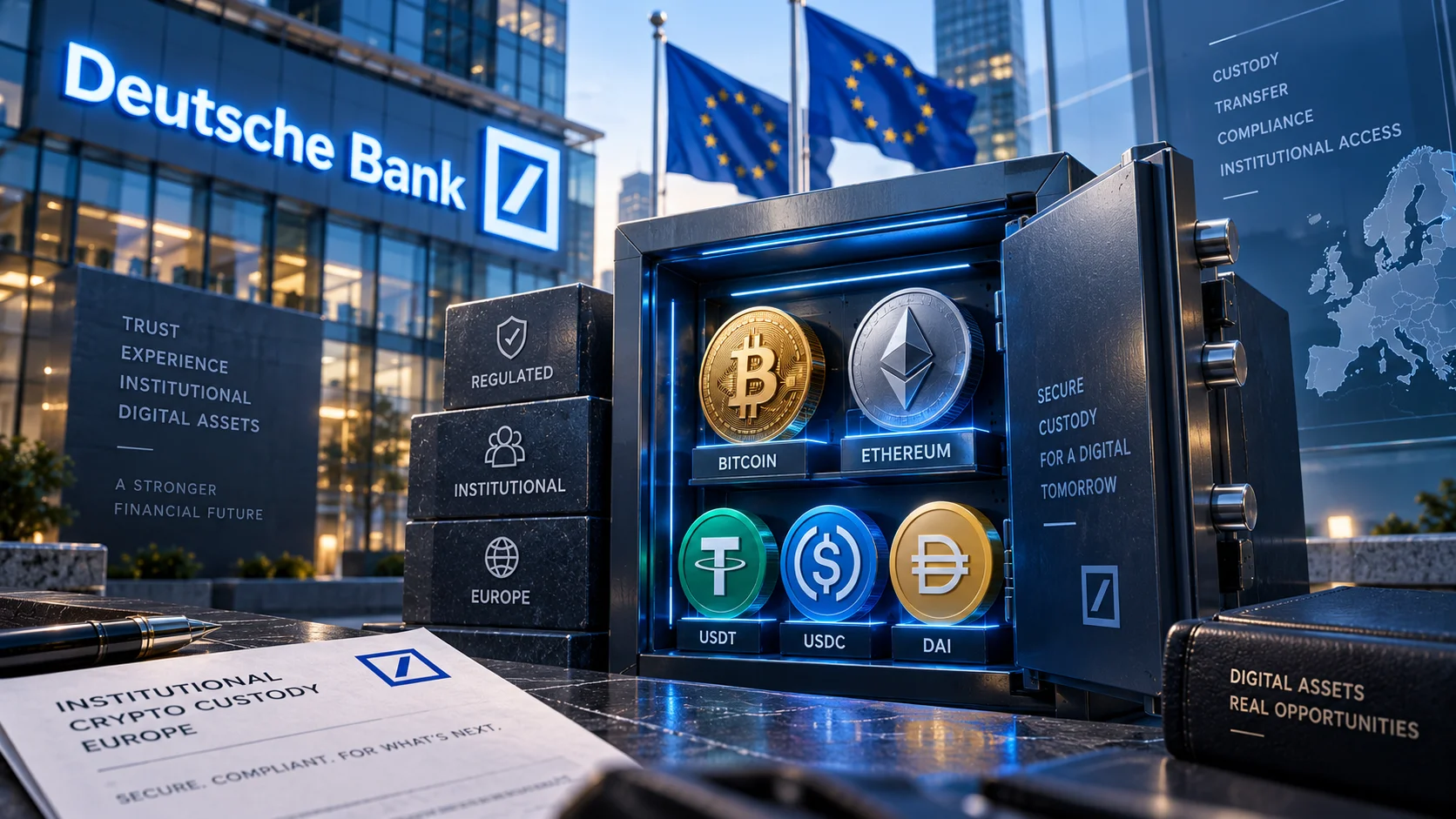

Deutsche Bank has confirmed plans to custody Bitcoin, Ether and three stablecoins for European institutional clients, moving a multiyear digital-asset project toward a potential 2026 launch. The strongest signal is not simply that another bank will hold crypto: clients would also be able to transfer assets to third parties while Deutsche Bank controls the wallets and private keys. The catch is decisive for investors-the service is not live, and regulatory completion still separates an institutional gateway from an announcement.
For additional context, explore AirdropHotList's crypto market analysis.
The product would remove a costly institutional bottleneck
In its September 16 announcement, Deutsche Bank said the initial service would target corporates, asset managers, hedge funds, custodians, brokers and sovereign institutions across its Corporate Bank and Investment Bank. The bank plans to manage private keys and wallets, support transfers to external parties and use hardware-based key protection, multi-person approvals, separate warm and cold storage environments, redundant infrastructure, and controlled recovery procedures.
That configuration addresses a real barrier without guaranteeing new crypto demand. An institution can outsource key management instead of building its own custody stack, but the announcement does not describe an exchange, lending product, staking service or automatic allocation to digital assets. Access is being built; investment decisions still belong to clients.
The plan is also more than a sudden response to market momentum. Deutsche Bank entered a global partnership with Taurus in September 2023 to integrate technology for cryptocurrency custody, digital currencies and tokenized assets. The new release does not identify which external providers will support the final service, but it confirms that selected third-party technology and infrastructure will be used.
If you prefer curated opportunities instead of browsing everything manually, check our featured airdrops and compare higher-signal campaigns first.
The stablecoin list reveals the deeper strategy
Bitcoin may command the headline, yet the inclusion of USDC, EURC and EURAU makes the product strategically more interesting. A custody platform limited to BTC and ETH primarily solves asset safekeeping. Stablecoins plus third-party transfers can potentially connect custody with treasury movements, settlement and the cash side of tokenized transactions. Deutsche Bank has also placed tokenized financial instruments on the product roadmap, although it has not announced a launch date for that expansion.
The selection is tailored to Europe's regulated digital-money market. Circle's European entity states in its MiCA redemption policy that it handles redemption conditions for USDC and EURC in the EU and European Economic Area. EURAU, meanwhile, was launched by AllUnity on July 31, 2025 after the issuer received an electronic-money institution license from Germany's BaFin. AllUnity is a joint venture involving DWS, Deutsche Bank's asset-management arm, alongside Flow Traders and Galaxy.
This creates the investor paradox at the center of the story. The more bank-controlled the crypto rails become, the easier they may be for institutions to approve-but the less they resemble permissionless custody. Due diligence, product approvals, transaction controls and the bank's risk appetite can reduce operational uncertainty while also limiting eligible clients, assets, networks and transfers.
Bitcoin and Ether gain access, not guaranteed buying pressure
For Bitcoin, the immediate consequence is another potential custody route for European institutions that prefer an established banking counterparty. That can reduce friction for investment committees and treasury departments. It does not mean Deutsche Bank is purchasing BTC, nor does it establish that clients will move meaningful balances into the service. A spot-market effect would require actual onboarding, funded accounts and measurable assets under custody.
Ether's inclusion is similarly important but incomplete. ETH sits beside stablecoins and future tokenized instruments in the planned asset set, giving it relevance to both investment and settlement workflows. Deutsche Bank has not disclosed supported blockchain networks, whether every asset will permit external withdrawals at launch, or whether services such as staking will eventually be considered. Those details will determine whether Ether support is basic storage or part of a broader on-chain operating model.
Still unsure about wallets, eligibility, or reward rules? Visit our FAQ page for quick answers before joining any new crypto campaign.
Europe's regulatory gate is now the real launch date
The bank says it intends to onboard its first clients during 2026, subject to completion of the applicable regulatory timeline. It also warns that timing, geographic availability, supported assets and product scope may change because of regulatory requirements, internal approvals, market conditions or client demand. Investors should therefore treat the launch window as conditional, not completed.
That caveat carries extra weight because the EU's MiCA transition period expired on July 1, 2026. ESMA has told unauthorized providers to cease relevant services and stressed that the rules apply to business-to-business relationships as well as retail activity. It has also highlighted restrictions around delegating custody to unauthorized entities outside the EU.
Supervisory scrutiny is increasing at the same time Deutsche Bank wants to go live. On July 8, 2026, ESMA launched a custody-focused review covering key management, storage, transaction controls, incident response, smart-contract risks and dependencies on third-party providers. The exercise runs from the second half of 2026 into the first half of 2027, directly overlapping Deutsche Bank's proposed rollout window.
Three paths from announcement to market impact
DeFi campaigns can involve protocol usage, liquidity, staking, or wallet activity. Before spending gas or locking funds, compare more DeFi airdrops and review the effort-to-reward balance.
Bull case: custody becomes a transaction rail
Regulatory work finishes on schedule, the bank names its first clients and external transfers operate across useful blockchain networks. Stablecoin balances and tokenized instruments then follow, turning custody into infrastructure for treasury and settlement rather than a passive vault. This would be the clearest route to sustained institutional crypto activity.
Base case: a controlled launch with limited flows
Deutsche Bank begins with a small client group, conservative transfer policies and the five announced assets. The service improves institutional access but produces little visible spot buying. Expansion depends on operating history, demand and further product approvals.
 Arcus Exchange
 JoinCare
 Breath of Estova
Bear case: approval delays or a narrower product
The regulatory timeline slips, supported jurisdictions shrink or the bank launches custody without commercially useful transfer capabilities. In that scenario, the announcement remains strategically notable but has little near-term effect on BTC, ETH or stablecoin liquidity.
Conclusion: client activity must validate the institutional signal
Deutsche Bank's decision confirms that regulated crypto custody is becoming part of Europe's banking infrastructure, but confirmation of demand has not arrived. The decisive catalyst is not another roadmap update-it is a functioning service that clients fund and use. Four signals will show whether the plan is becoming material:
- An official go-live date, named operating entity and completed regulatory process.
- Disclosed clients, assets under custody or transaction volumes.
- Supported blockchain networks and rules for third-party transfers.
- Expansion from BTC and ETH storage into stablecoin settlement or tokenized instruments.




 Gaming Platforms
 Crypto Casinos
 Blockchain Bridges
 Staking & Restaking
 DEX Token Swapping
 Crypto Wallets