
 BTC
BTC
 ETH
ETH
 USDT
USDT
 BNB
BNB
 XRP
XRP
 USDC
USDC
 SOL
SOL
 TRX
TRX
 FIGR_HELOC
 ZEC
ZEC
 HYPE
HYPE
 DOGE
DOGE
 XMR
XMR
 USDS
USDS
 WBT
WBT
 LINK
LINK
 LEO
LEO
 ADA
ADA
 NEAR
NEAR
 XLM
XLM
 RAIN
RAIN
 BCH
BCH
 USDE
USDE
 DAI
DAI
 LTC
LTC
 UNI
UNI
 CC
CC
 AVAX
AVAX
 USD1
USD1
 SUI
SUI
 GRAM
GRAM
 HBAR
HBAR
 XAUT
XAUT
 USDG
USDG
 QNT
QNT
 PYUSD
PYUSD
 SHIB
SHIB
 TAO
TAO
 ENA
ENA
 CRO
CRO
 RLUSD
RLUSD
 USYC
USYC
 USDY
USDY
 OKB
OKB
 M
M
 BUIDL
BUIDL
 AAVE
AAVE
 BTW
BTW
 ONDO
ONDO
 PUMP
PUMP
 USDF
USDF
 PEPE
PEPE
 EURSAFO
 PAXG
PAXG
 ASTER
ASTER
 USDD
USDD
 DOT
DOT
 MNT
MNT
 WLFI
WLFI
 WLD
WLD
 U
U
 SKY
SKY
 ICP
ICP
 HTX
HTX
 MORPHO
 BFUSD
BFUSD
 BGB
BGB
 USDGO
USDGO
 VVV
VVV
 ETC
ETC
 ARB
ARB
 JST
JST
 KCS
KCS
 GT
GT
 KAS
KAS
 POL
POL
 ALGO
ALGO
 JUP
JUP
 RENDER
 ATOM
ATOM
 PI
PI
 OUSD
OUSD
 NEXO
NEXO
 INJ
INJ
 LIT
LIT
 FIL
FIL
 USTB
USTB
 AKE
AKE
 GHO
GHO
 ZRO
ZRO
 DASH
DASH
 CAKE
CAKE
 XDC
XDC
 PEARL
PEARL
 NIGHT
NIGHT
 ETHFI
ETHFI
 APT
APT
 PYTH
PYTH
 BDX
BDX
 JAAA
JAAA
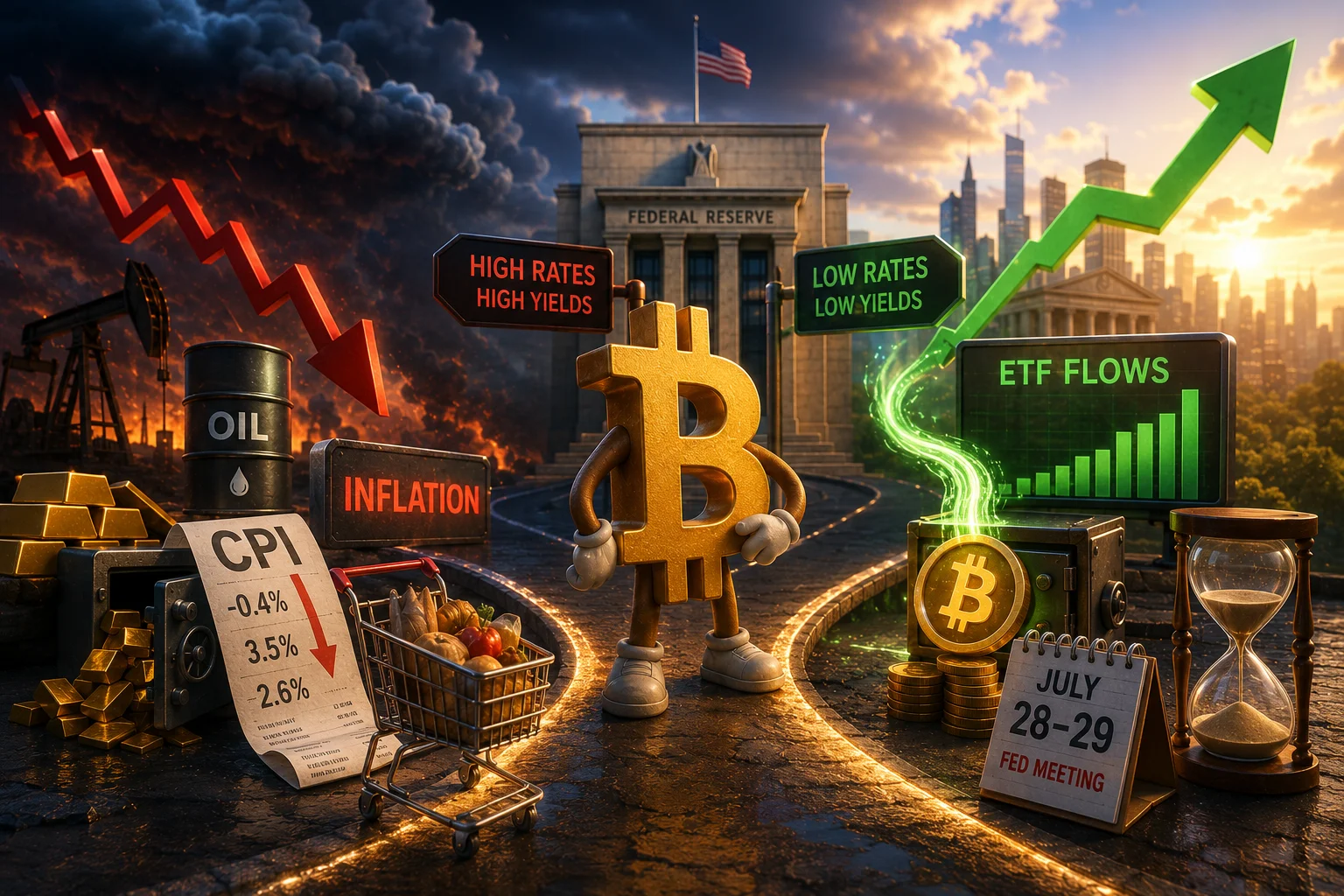

Bitcoin's latest response to inflation complicates the claim that it is a direct hedge against rising consumer prices. The U.S. Bureau of Labor Statistics reported on July 14, 2026 that headline CPI fell 0.4% in June, its largest monthly decline since April 2020, while annual inflation slowed to 3.5% and core inflation eased to 2.6%. Bitcoin advanced after the release-not because inflation accelerated, but because softer data reduced the immediate threat of tighter monetary policy. For investors, that distinction is crucial: Bitcoin is increasingly trading as a scarce, liquidity-sensitive asset rather than a dependable month-to-month CPI hedge.
The next test is the Federal Reserve's scheduled July 28-29 meeting. Investors should watch the policy signal, Treasury real yields and spot Bitcoin exchange-traded product flows together. Those channels are now more useful than the inflation rate alone for assessing whether Bitcoin can preserve purchasing power without behaving like a high-volatility risk asset.
For additional context, explore AirdropHotList's crypto market analysis.
June CPI exposed Bitcoin's real inflation mechanism
The June report contained two different inflation stories. Energy prices fell 5.7% during the month and gasoline dropped 9.7%, driving the headline decline. Yet energy remained 15.7% more expensive than a year earlier, while food prices were up 3.0%. Core prices were unchanged for the month, with the annual core rate declining from 2.9% in May to 2.6% in June, according to the same official CPI release.
Bitcoin's reaction looked more like a response to expected monetary policy than to the purchasing-power loss itself. In the hours following the report, Bitcoin rose 2% to about $63,400 as market pricing for a July rate increase declined sharply, according to CoinDesk's July 14 market coverage. A textbook inflation hedge would normally strengthen when unexpected inflation rises. This time, Bitcoin strengthened when inflation surprised on the downside because the result improved the liquidity outlook.
That does not make the inflation thesis worthless. It changes the transmission mechanism. Persistent inflation can support Bitcoin's long-term scarcity narrative, but the tradeable response depends on what inflation means for central-bank policy, the dollar, real interest rates and investor appetite for volatile assets.
DeFi campaigns can involve protocol usage, liquidity, staking, or wallet activity. Before spending gas or locking funds, compare more DeFi airdrops and review the effort-to-reward balance.
Bitcoin's fixed issuance does not guarantee stable protection
Bitcoin's structural case begins with supply. Its protocol reduces the block subsidy every 210,000 blocks, approximately once every four years, under the issuance process described in the Bitcoin developer reference. No central bank can increase issuance in response to a recession, banking shock or government financing requirement. That makes Bitcoin fundamentally different from fiat currency.
Scarcity, however, is not the same as a reliable hedge. An asset protects against inflation only if demand responds consistently enough to offset the decline in currency purchasing power. Bitcoin demand can be overwhelmed by leverage reductions, exchange failures, regulatory shocks, ETF redemptions or a rise in the returns available from safer assets.
A peer-reviewed study published in the Journal of Economics and Business found that Bitcoin returns sometimes increased after positive CPI surprises, but the result did not hold when researchers used core PCE inflation. The authors also found that Bitcoin's inflation-hedging properties weakened when early trading years were excluded and reversed in the post-COVID sample. Their conclusion was that Bitcoin is, at best, a context-specific inflation hedge, while gold displayed a stronger relationship with inflation shocks. The study and methodology are available through ScienceDirect.
Gold remains the cleaner real-yield comparison
Gold and Bitcoin both have scarcity narratives and produce no contractual cash flow. Their short-term pricing nevertheless differs. Gold has a longer record as a reserve asset, a deeper institutional market and a more established tendency to benefit when inflation-adjusted bond yields fall. Bitcoin carries additional adoption, custody, regulatory and technology risks.
The June CPI response illustrates the overlap: softer core inflation can lower expected policy rates and real yields, reducing the opportunity cost of holding both assets. But Bitcoin typically adds a stronger risk-appetite component. It may outperform gold when financial conditions loosen and ETF demand expands, yet underperform during forced deleveraging even when inflation remains high.
Investors therefore should not treat the two assets as interchangeable. Gold is the more direct benchmark for real-yield and defensive demand. Bitcoin is better understood as a scarce monetary asset with an embedded liquidity and adoption option.
If you want reward-focused opportunities that involve tasks or activity, compare more earn crypto airdrops before choosing where to spend your time.
Real yields and Fed policy remain the decisive bridge
The Federal Reserve held its target rate at 3.5% to 3.75% on June 17 and said inflation remained elevated relative to its 2% objective, partly because of energy-related supply shocks. That backdrop explains why one soft CPI report cannot settle the inflation debate. Policymakers must determine whether June marked a durable improvement or a temporary reversal caused by falling fuel prices.
For Bitcoin, higher real yields create competition from government securities that provide an inflation-adjusted return without crypto's volatility. Falling real yields have the opposite effect: they reduce the relative attraction of cash and bonds while supporting scarce assets. Investors can monitor the official Treasury real-yield curve rather than relying on CPI headlines in isolation.
ETF flows now measure whether the narrative attracts capital
Spot products have made Bitcoin's macro sensitivity easier to observe because institutional demand appears in daily creations and redemptions. After the June CPI release, U.S. spot Bitcoin products recorded net inflows of $181.1 million on July 14, $107.7 million on July 15, $79.1 million on July 16 and $132.3 million on July 17-a four-session total of $500.2 million, according to Farside Investors' fund-flow data.
Those inflows confirm that the softer inflation report improved demand, but they do not prove that Bitcoin hedges inflation. Instead, they show the current sequence: inflation changes expectations for Fed policy; policy expectations move the dollar, yields and risk appetite; those conditions influence ETF allocations; and ETF demand reaches the spot Bitcoin market.
If flows remain positive while real yields decline, Bitcoin's macro setup becomes more constructive. If yields rise and ETF redemptions return, the fixed-supply argument may not prevent a price decline.
Still unsure about wallets, eligibility, or reward rules? Visit our FAQ page for quick answers before joining any new crypto campaign.
Three scenarios for the July Fed catalyst
- Dovish scenario: The Fed emphasizes softer core inflation and reduced energy pressure. Real yields and the dollar weaken, ETF inflows continue and Bitcoin benefits as a liquidity-sensitive scarce asset.
- Base scenario: Officials leave rates unchanged but retain a cautious inflation message. Bitcoin remains driven by ETF flows and broader risk appetite rather than establishing a clean inflation-hedge relationship.
- Hawkish scenario: The Fed focuses on still-elevated annual inflation or renewed energy pressure. Higher real yields and a stronger dollar weigh on Bitcoin, particularly if spot products begin recording net redemptions.
 Arcus Exchange
 JoinCare
 Breath of Estova
What investors should monitor next
The Fed's July 28-29 meeting is scheduled to conclude on July 29, while the BLS has scheduled the July CPI release for August 12, 2026. Between those events, the most useful indicators are five- and ten-year Treasury real yields, the dollar's direction, daily spot Bitcoin product flows and Bitcoin's performance relative to gold and equities.
A stronger hedge case would require Bitcoin to hold up when inflation expectations rise without relying on falling nominal rates or an equity rally. Continued gains only when policy expectations turn dovish would instead reinforce the view that Bitcoin is primarily responding to liquidity.
Conclusion
Bitcoin has not lost its long-term monetary-scarcity argument, but the June CPI episode shows why scarcity alone does not make it a dependable inflation hedge. Its immediate gains followed cooler inflation, lower tightening risk and renewed ETF demand. That behavior is more consistent with a high-volatility monetary asset whose price is mediated by real yields and global liquidity.
The strongest defensible conclusion is therefore conditional: Bitcoin may protect against long-run currency debasement in some regimes, but it has not demonstrated the consistency required of a standalone inflation hedge. Investors evaluating the thesis should watch Fed policy, real yields and ETF flows-not CPI in isolation.





 Gaming Platforms
 Crypto Casinos
 Blockchain Bridges
 Staking & Restaking
 DEX Token Swapping
 Crypto Wallets