
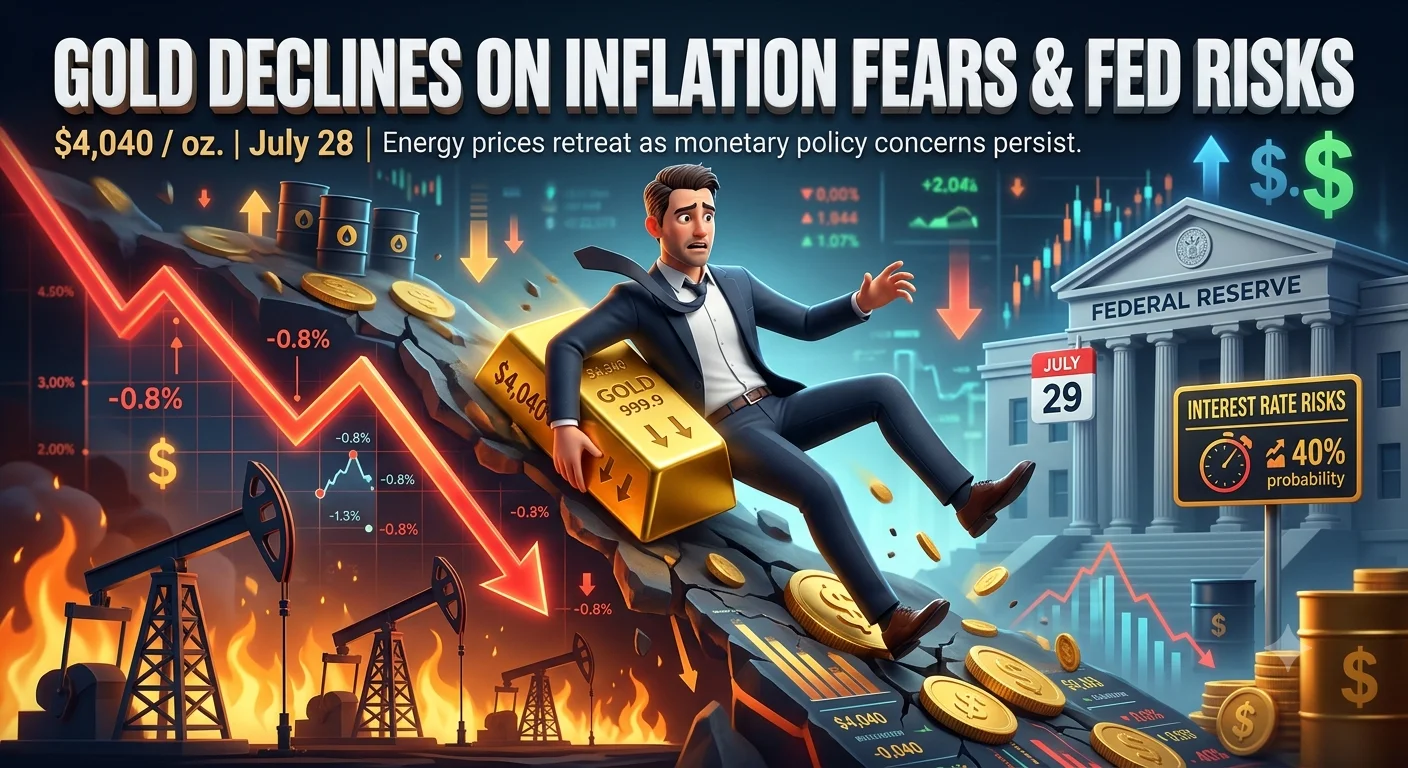

Gold declined on Tuesday, July 28, as a sharp retreat in oil reduced immediate inflation concerns but failed to eliminate the risk of tighter Federal Reserve policy. Bullion fell as much as 0.8% to around $4,040 an ounce in early trading, while interest-rate swaps indicated about a 40% probability of a quarter-point increase at the Fed's July 29 decision, according to The Straits Times. The important point for investors is that fading energy inflation is not automatically bullish for gold: if reduced geopolitical risk supports the dollar or allows the Fed to emphasize resilient economic activity, the metal can still face pressure.
The Federal Open Market Committee began its scheduled two-day meeting on July 28 and will announce its decision on Wednesday, July 29. The central bank's latest official statement, released on June 17, maintained the federal funds target at 3.5% to 3.75% and said inflation remained elevated relative to its 2% goal. The upcoming decision has therefore not been completed, and claims that rate-hike fears have disappeared would overstate the evidence. The confirmed development is narrower: lower oil prices and softer June inflation data have reduced the urgency for an immediate hike, but markets still see an unusually significant chance of one.
For additional context, explore AirdropHotList's crypto market analysis.
Cooling June inflation gives the Fed room to wait
The strongest argument for leaving rates unchanged comes from the June consumer and producer price reports. The Bureau of Labor Statistics said the Consumer Price Index fell 0.4% on a seasonally adjusted basis in June, its largest monthly decline since April 2020, while the 12-month inflation rate eased to 3.5%. The Producer Price Index also fell 0.3% during June, although final-demand prices remained 5.5% higher than a year earlier. Together, the reports show meaningful short-term cooling without establishing that inflation has returned sustainably to target.
The Fed's own June projections reinforce that distinction. Policymakers projected median 2026 PCE inflation of 3.6% and core PCE inflation of 3.3%, substantially above the 2% objective, while the median projected federal funds rate for year-end was 3.8%. Those official projections were prepared before the softer June CPI and PPI releases, but they explain why a hawkish hold-or even a hike-remains plausible despite the latest disinflationary signals.
DeFi campaigns can involve protocol usage, liquidity, staking, or wallet activity. Before spending gas or locking funds, compare more DeFi airdrops and review the effort-to-reward balance.
Gold is trading the credibility question, not inflation alone
Gold's immediate challenge is the interaction among real yields, the dollar and confidence in the Fed's inflation response. Lower inflation expectations can reduce nominal Treasury yields, normally helping a non-yielding asset. However, if investors conclude that the Fed can keep real policy settings restrictive without causing a severe downturn, real yields may remain elevated. A stronger dollar also raises the effective cost of bullion for buyers using other currencies.
The dollar index held near a one-month high at 101.55 on July 28 as traders retained a meaningful probability of a Fed hike, according to a Reuters report. That helps explain why gold slipped even as oil-driven inflation fears eased: the reduction in geopolitical and inflation risk removed part of bullion's defensive bid, while the dollar did not weaken enough to provide an offset.
The World Gold Council's mid-year outlook describes a similar two-sided setup. It said gold was broadly aligned with a backdrop of moderate growth, cooling but still elevated inflation and limited additional central-bank tightening. Its analysis also emphasized that a rate increase is not automatically negative for gold; the result depends on how tightening affects perceptions of Fed credibility, economic growth, financial stability and the dollar.
If this opportunity involves trading, deposits, or exchange activity, review our crypto trading guide for beginners to understand fees, risk control, and safer decision-making.
Oil and Treasuries carry the key transmission signal
The latest shift began in energy markets. On July 27, U.S. crude dropped 7.71% to $82.42 a barrel and Brent fell 8.9% to $88.17 after the United States suspended air strikes against Iran and officials raised the possibility of negotiations. The benchmark 10-year Treasury yield declined 3.2 basis points to 4.647%, according to Reuters market reporting. The combination reduced near-term inflation compensation and lowered the market-implied probability of an immediate Fed hike.
Lower oil can support Treasuries through weaker headline inflation, but the move is vulnerable to renewed conflict or disrupted shipping. The U.S. Energy Information Administration said on July 7 that increased traffic through the Strait of Hormuz had led it to expect crude production and trade flows to move toward pre-conflict conditions by year-end. Its official forecast put average third-quarter Brent at $74 a barrel, but that projection depends on continued normalization. A renewed energy shock would quickly revive the hawkish policy case and pressure both bonds and gold through higher inflation expectations.
Bitcoin depends on whether lower yields become easier liquidity
Bitcoin's connection to this catalyst runs primarily through global liquidity and risk appetite rather than through a simple inflation-hedge narrative. A Fed hold accompanied by lower Treasury yields and a softer dollar would reduce the opportunity cost of holding non-yielding assets and could improve demand for higher-volatility investments. Conversely, an unexpected hike or a warning that further tightening is imminent would likely lift short-term yields, tighten dollar liquidity and challenge leveraged crypto positioning.
Gold and Bitcoin can therefore respond differently to the same initial oil move. Gold may lose some geopolitical protection demand as tensions ease, while Bitcoin may benefit if falling oil and yields produce a broader risk-on environment. That divergence would be less likely if the dollar remains firm, because restrictive dollar funding conditions can cap both markets even when headline inflation is cooling.
Not every reward campaign deserves your time. Before you commit, compare this opportunity with our active airdrops list and focus on campaigns with clearer upside, better trust signals, and realistic participation steps.
Three Fed scenarios for cross-asset investors
- Hawkish scenario: The Fed raises rates by 25 basis points or signals that a near-term hike is likely. Treasury yields and the dollar would probably rise, creating the clearest downside risk for gold and Bitcoin.
- Neutral scenario: The Fed holds at 3.5% to 3.75% but repeats that inflation remains elevated and keeps further tightening under consideration. Gold could remain range-bound as lower oil offsets restrictive real yields.
- Dovish scenario: The Fed holds and places greater weight on softer CPI, PPI and energy prices. Falling yields and a weaker dollar would improve the backdrop for gold and risk-sensitive crypto assets, although renewed geopolitical tension would complicate that response.
 HoodTracker
 Pacifica
 FarmTown
Investor watchlist after the policy announcement
The policy statement and Chair Kevin Warsh's press conference are only the first tests. Investors should compare the Fed's wording on inflation with moves in two-year Treasury yields, the dollar and oil. A gold rally accompanied by falling real yields and a weaker dollar would have stronger macro confirmation than a price bounce driven only by short covering.
Attention will then turn to data the Fed will not have when it announces its decision. The Bureau of Economic Analysis has scheduled the advance estimate of second-quarter GDP and the June Personal Income and Outlays report, including PCE inflation, for July 30 at 8:30 a.m. Eastern time, according to the official release calendar. Those reports could either validate the recent cooling narrative or reopen the debate over another hike later in 2026.
Conclusion
Gold's decline is not evidence that inflation risk or Fed tightening fears have vanished. It reflects a more complicated repricing in which cheaper oil has reduced the probability of an immediate policy response while a firm dollar, elevated real yields and residual hike risk continue to restrain bullion. The July 29 Fed decision will determine whether the oil retreat becomes a durable easing in financial conditions or merely a temporary pause before the next inflation test.
 Gaming Platforms
 Crypto Casinos
 Blockchain Bridges
 Staking & Restaking
 DEX Token Swapping
 Crypto Wallets