
 BTC
BTC
 ETH
ETH
 USDT
USDT
 BNB
BNB
 XRP
XRP
 USDC
USDC
 SOL
SOL
 TRX
TRX
 ZEC
ZEC
 FIGR_HELOC
 HYPE
HYPE
 DOGE
DOGE
 LINK
LINK
 XMR
XMR
 WBT
WBT
 USDS
USDS
 ADA
ADA
 RAIN
RAIN
 LEO
LEO
 XLM
XLM
 NEAR
NEAR
 BCH
BCH
 UNI
UNI
 LTC
LTC
 CC
CC
 SUI
SUI
 USDE
USDE
 AVAX
AVAX
 DAI
DAI
 GRAM
GRAM
 USD1
USD1
 HBAR
HBAR
 TAO
TAO
 SHIB
SHIB
 CRO
CRO
 BTW
BTW
 USDG
USDG
 ENA
ENA
 QNT
QNT
 PYUSD
PYUSD
 M
M
 ONDO
ONDO
 XAUT
XAUT
 OKB
OKB
 RLUSD
RLUSD
 USYC
USYC
 AAVE
AAVE
 PUMP
PUMP
 BUIDL
BUIDL
 USDY
USDY
 MNT
MNT
 DOT
DOT
 WLD
WLD
 ASTER
ASTER
 MORPHO
 SKY
SKY
 PAXG
PAXG
 WLFI
WLFI
 PEPE
PEPE
 ICP
ICP
 USDD
USDD
 ARB
ARB
 HTX
HTX
 ETC
ETC
 EURSAFO
 U
U
 VVV
VVV
 BGB
BGB
 USDGO
USDGO
 USDF
USDF
 KAS
KAS
 BFUSD
BFUSD
 POL
POL
 GT
GT
 LIT
LIT
 JUP
JUP
 ALGO
ALGO
 RENDER
 JST
JST
 PI
PI
 KCS
KCS
 ATOM
ATOM
 BCAP
BCAP
 FIL
FIL
 CAKE
CAKE
 NEXO
NEXO
 DASH
DASH
 AERO
AERO
 VET
VET
 INJ
INJ
 USTB
USTB
 EUTBL
EUTBL
 APT
APT
 STABLE
 AKE
AKE
 GHO
GHO
 ETHFI
ETHFI
 PYTH
PYTH
 XDC
XDC
 STX
STX
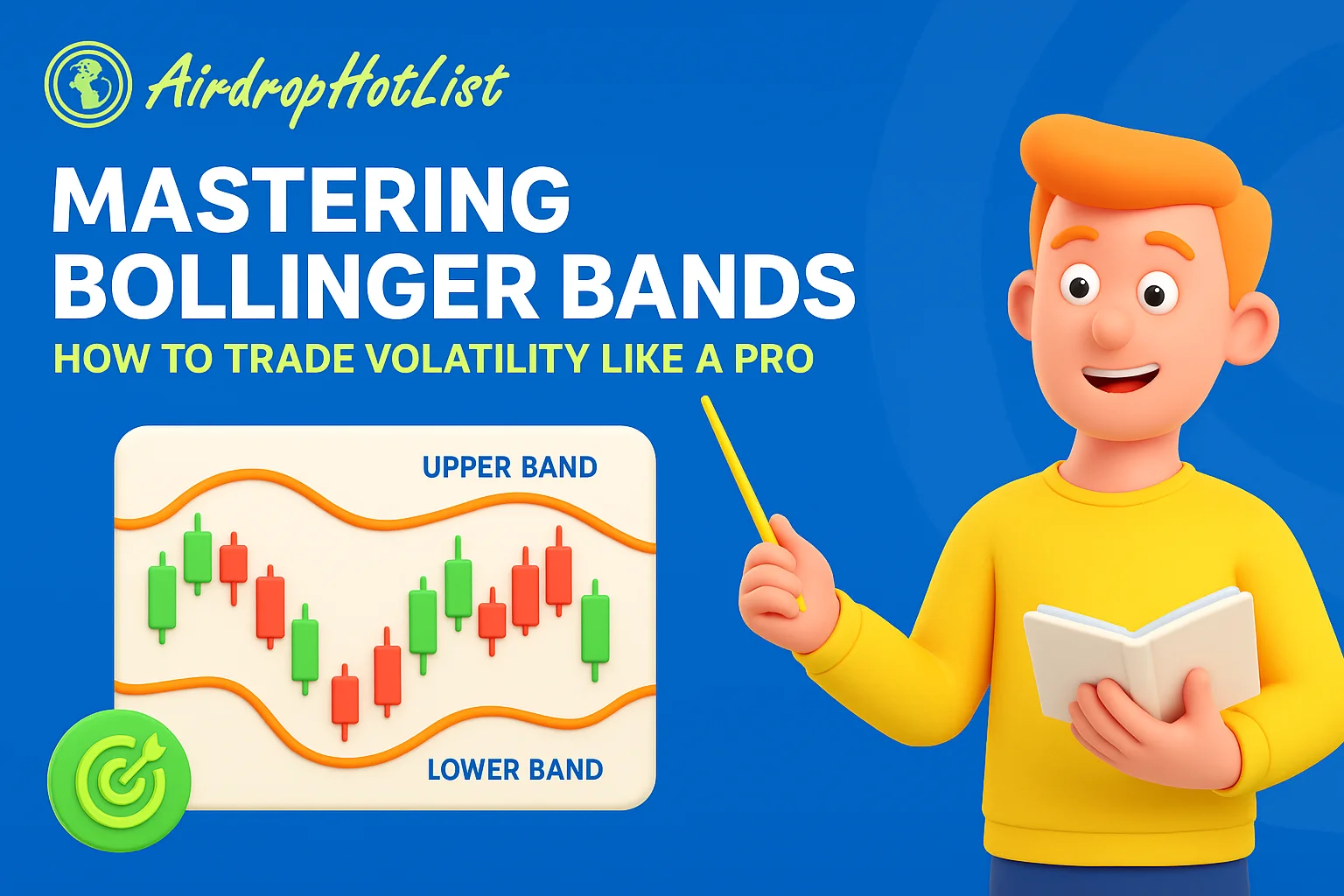

📈 Mastering Bollinger Bands: How to Trade Volatility Like a Pro
In trading, mastering technical analysis isn’t just about following signals — it’s about learning how to interpret and react to market behavior with precision. One of the most flexible and reliable indicators used by both beginners and seasoned traders is the Bollinger Bands indicator.
Let’s take a deep dive into what Bollinger Bands are, how they work, and how to use them to improve your edge in volatile markets. 🎯
💡 This is Part 13 of our AirdropHotList Trading Guide Series
📊 What Are Bollinger Bands?
Bollinger Bands are a technical indicator that visually measures market volatility and price action. Invented by John Bollinger in the early 1980s, these bands create a dynamic price envelope that adjusts in real time.
They consist of three lines:
-
Middle Band: A Simple Moving Average (typically 20-period)
-
Upper Band: Middle Band + 2 standard deviations
-
Lower Band: Middle Band – 2 standard deviations
When volatility increases, the bands expand. When it drops, the bands contract — signaling potential breakouts or quiet consolidation phases.
👨🏫 Who Is John Bollinger?
John Bollinger is a well-known market technician and founder of Bollinger Capital Management. With a background in statistics and engineering, he created the Bollinger Band system to make volatility visually trackable on price charts.
He introduced the concept that volatility isn't static — and that indicators must adapt as markets evolve.
Not every reward campaign deserves your time. Before you commit, compare this opportunity with our active airdrops list and focus on campaigns with clearer upside, better trust signals, and realistic participation steps.
🔧 How Bollinger Bands Work
Bollinger Bands adjust automatically based on market volatility:
-
Tight Bands = Low Volatility (possible breakout coming)
-
Wide Bands = High Volatility (trend continuation or reversal)
-
Price at the Upper Band = Overbought
-
Price at the Lower Band = Oversold
When price breaks out of either band, traders watch closely: Is this a real breakout or a fakeout?
🧮 How to Calculate Bollinger Bands
You can use any timeframe (1min, 1h, daily) depending on your strategy. Here's the basic calculation:
-
Choose a period (default: 20)
-
Calculate the Simple Moving Average (SMA)
-
Measure standard deviation for the same period
-
Add/subtract 2 deviations from the SMA for upper/lower bands
✅ Common settings:
| Strategy | Period | Deviation |
|---|---|---|
| Scalping | 10 | 1.5 |
| Swing | 20 | 2 |
| Trend | 50 | 2.5 |
If this opportunity involves trading, deposits, or exchange activity, review our crypto trading guide for beginners to understand fees, risk control, and safer decision-making.
📈 Bollinger Bands in Action
1. Identifying Market Trends
-
Rising Middle Band → Uptrend
-
Falling Middle Band → Downtrend
-
Flat Band → Range-bound market
2. Overbought & Oversold Signals
-
Price above Upper Band → Possible overbought
-
Price below Lower Band → Possible oversold
3. Mean Reversion (“The Bounce”)
In sideways markets, price tends to revert to the mean (middle band). Traders often:
-
Buy at the lower band
-
Sell at the upper band
4. Breakout Confirmation
Breakouts beyond the bands can signal new trends. Volume confirmation is key.
🔍 Combine with RSI or MACD for better confirmation.
⚙️ Bollinger Band Cheat Sheet
| Action | Meaning | Trading Idea |
|---|---|---|
| Narrow Bands | Low volatility | Prepare for breakout |
| Wide Bands | High volatility | Manage risk levels |
| Price at Upper Band | Overbought | Take profit / Short |
| Price at Lower Band | Oversold | Buy / Watch for bounce |
| Bounce from Lower Band | Mean reversion | Target middle or upper band |
| Price hugs Upper Band | Strong uptrend | Trend-following strategy |
📉 What to Watch For
Upper Band Signals
-
Expanding volatility
-
Overbought condition
-
Possible trend continuation or end
Use volume and RSI to validate strength.
Lower Band Signals
-
Oversold territory
-
Reversal potential
-
Panic selling or bearish confirmation
If price bounces back above the lower band, it’s often a long setup.
If you want to understand how eligibility, snapshots, claiming, and reward distribution usually work, start with our crypto airdrop guide before joining new campaigns.
🧠 How Reliable Are Bollinger Bands?
They are reactive, not predictive. So:
-
Best used with other indicators
-
Confirm with RSI, MACD, or volume
-
Avoid during erratic low-volume sessions
🔄 Alternatives to Bollinger Bands
If BBs aren’t giving clarity, consider:
-
Keltner Channels
-
Donchian Channels
-
ATR Bands
-
Moving Average Envelopes
Each has a different approach to volatility and trend measurement.
⚠️ Common Limitations
-
Lagging: Based on past price data
-
May trigger false breakouts in low-volume environments
-
Default settings don’t fit all markets
🔧 Adjust parameters or combine with other methods for better results.
 Kryvora Network
 Note Systems
 Nado
Nado
✅ Summary: When & How to Use Bollinger Bands
| Market Type | Best Strategy |
|---|---|
| Trending | Use bands for breakout confirmation and trend-following |
| Ranging | Trade the bounce between upper and lower bands |
| Volatile | Use wider bands + volume confirmation |
| Low Volatility | Wait for squeeze breakout |
🧠 Final Thoughts
Bollinger Bands are one of the most trusted indicators in technical analysis — not because they predict the future, but because they help you respond to the present.
By measuring volatility, defining dynamic support/resistance, and highlighting breakout zones, Bollinger Bands can help you make more informed decisions. Used properly, they add clarity to charts filled with noise.
But remember: no indicator works in isolation. Pair BBs with volume, RSI, and strong risk management for best results.
📚 Keep learning, keep backtesting — and let the bands guide your edge.






 Gaming Platforms
 Crypto Casinos
 Blockchain Bridges
 Staking & Restaking
 DEX Token Swapping
 Crypto Wallets